
A local government law workshop hosted by the Faculty of Law at the North-West University (NWU) brought together municipal councillors and officials from across the country to strengthen the legal knowledge required for effective service delivery.
The training workshop was organised by the South African Research Chair in Cities, Law and Environmental Sustainability (CLES) in partnership with UN-HABITAT and with support from the National Research Foundation.
Representatives from national, provincial and local government attended, including officials from COGTA, the Ekurhuleni Metropolitan Municipality, the eThekwini Metropolitan Municipality, the Ngaka Modiri Molema District Municipality, the Moses Kotane Local Municipality, the Ramotshere Moiloa Local Municipality, the Moretele Local Municipality and the Dr Ruth Segomotsi Mompati District Municipality.
The workshop focused on three themes: the constitutional mandate of local government, climate change law in the municipal context, and administrative justice in the South African local government. The training aimed to equip councillors and municipal officials with knowledge of the legal framework that regulates municipalities, including the constitutional basis of municipal powers, the obligation to respond to climate change and the duty to apply administrative justice in governance and disciplinary processes.
Participants were also introduced to the legal principles, rules and values that guide municipal decision-making, with the intention of enabling them to apply these principles in practice and to assess current governance processes against the requirements of the law. The organisers indicated that the training was intended to strengthen the ability of councillors and officials to carry out their responsibilities within the limits set by the Constitution and legislation.
Prof. Oliver Fuo from the Faculty of Law said the workshop responded to capacity challenges in municipalities, where councillors and administrators are required to operate within a complex legal framework.
“Even though local government is a highly regulated sphere of government with more than 200 laws and policies binding on municipalities, legal capacity constraints remain,” said Prof. Fuo. “Many councillors and officials do not have formal legal
training, yet the legislative and executive authority of a municipality is vested in municipal councils.”
“Everything that municipalities do must be based on the Constitution, because their powers and functions are derived from it. Without a clear understanding of constitutional principles, it becomes difficult to ensure accountable local governance,” he said.
On climate change, Prof. Fuo said municipalities have a direct responsibility to respond to environmental risks.
“The Climate Change Act requires metropolitan and district municipalities to adopt climate response plans as part of their integrated development plans. Cities are where the climate challenge will largely be won or lost, so councillors and officials must understand this mandate,” he said.
Administrative justice was also highlighted as central to municipal work, as municipal decisions affect residents, businesses and employees.
“Municipalities apply administrative law daily. Training in this area helps officials understand their duties and helps communities understand their rights when dealing with local government,” Prof. Fuo said.
Feedback from participants indicated that the workshop improved their understanding of legal responsibilities and that further training would be useful.
“The immediate impact is an improved knowledge base. Participants rated the training as relevant and asked for more sessions focusing on specific legislation and governance processes,” he said.
Organisers said additional workshops are being considered to focus on specialised areas of municipal law to support councillors, junior officials and managers in their roles.
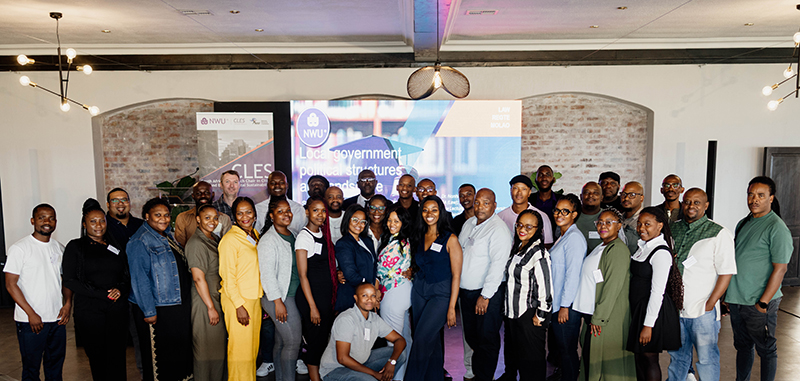
Municipal councillors and officials from several municipalities attended the local government law training workshop hosted by the Faculty of Law at the NWU.


