
Approximately 14% of employees in South Africa are at risk of burnout, highlighting the need for workplaces to recognise the warning signs of an occupational health crisis that affects employees’ well-being, productivity and performance.
The figure was highlighted by Prof. Leon de Beer, extraordinary professor in the WorkWell research unit in the Faculty of Economic and Management Sciences at the North-West University (NWU), following a recent burnout workshop hosted at the Vanderbijlpark Campus.
The hybrid event, titled “Burnout in higher education: Understanding, recognising and addressing an occupational health crisis”, was presented by internationally renowned work and organisational psychology expert, Prof. Wilmar Schaufeli. It brought together students, academics and practitioners to explore the causes, consequences and prevention of burnout, particularly in higher education.
Prof. Schaufeli, professor emeritus of work and organisational psychology at Utrecht University and emeritus professor with a special appointment at KU Leuven, explained that although burnout has been recognised for decades, its scientific study is relatively recent.
He attributed the growing concern around burnout to changes in modern society and the workplace, where people face constant stimulation, increasing competition and high expectations.
“Burnout is a very old concept, but the scientific study of it is very young,” he explained, highlighting how the nature of work has changed over time.
While many jobs previously demanded more physical labour, modern working environments increasingly require sustained emotional and cognitive effort. Employees are expected to remain productive, process large amounts of information and respond to competing demands, often with limited opportunities to recover.
Prof. Schaufeli identified the fear of missing out and blurred boundaries between work and personal life as additional factors contributing to burnout. With technology making employees increasingly accessible beyond working hours, switching off from work has become more difficult.
More than just exhaustion
One of the key messages from the presentation was that burnout should not be reduced to simply feeling tired after a demanding day.
Prof. Schaufeli explained that burnout involves more than exhaustion. It is characterised by extreme tiredness, mental distancing from one's work and impaired emotional and cognitive functioning. These symptoms can affect how employees think, feel and perform their duties. Irritability, difficulty concentrating and reduced ability to process information may become increasingly evident as burnout develops.
“Research shows that information processing is impaired when people are burnt out,” he warned, emphasising that the consequences extend beyond the individual employee.
In higher education, these effects can have serious implications. Academics experiencing burnout may struggle to teach effectively, support students and meet research expectations. This can affect the quality of teaching and the learning experience of students.
Support staff are also vulnerable, particularly when faced with administrative overload, understaffing, limited autonomy and insufficient resources to manage their responsibilities.
The presentation highlighted how burnout is associated with mental and physical health challenges, while impaired concentration and decision-making can increase the likelihood of mistakes in the workplace.
The dangers of overworking
Prof. Schaufeli also cautioned against workaholism and the belief that working longer hours automatically leads to better performance.
Employees who continually push themselves to work without adequate rest may struggle to recover. Some may even experience guilt when they are not working, making it difficult to establish healthy boundaries between their professional and personal lives.
He emphasised the importance of recovery, self-regulation and seeking help when necessary, noting that sustained performance requires opportunities to rest and replenish one's resources. The discussion also highlighted the need for organisations to take responsibility for preventing burnout rather than treating it solely as an individual problem.
In higher education, rising teaching workloads, pressure to publish research, competition for funding, insecure contracts and the demands of student support can create conditions that increase employees' risk of burnout.
Addressing these challenges requires appropriate workload management, supportive leadership, organisational policies that promote well-being and a workplace culture that encourages employees to seek assistance without fear of judgment.
A global and local concern
The presentation also explored international differences in reported burnout levels. Prof. Schaufeli noted that South Africa sits in the middle of the international comparisons discussed, while countries such as Japan, China and South Korea face significant pressures associated with highly competitive working environments and long working hours. Saudi Arabia and Singapore were also highlighted among the countries with high burnout scores.
Prof. De Beer further noted that women in South Africa scored slightly higher on burnout measures, underlining the importance of understanding how workplace pressures and differing responsibilities may affect employees' experiences.
These comparisons reinforce the importance of examining burnout in specific social and organisational contexts rather than assuming that employees everywhere experience the same pressures.
Building healthier workplaces
The workshop encouraged a shift towards understanding burnout as an occupational health concern that requires both individual and organisational intervention.
At an individual level, employees can benefit from healthy recovery practices, clear boundaries between work and personal time (switching off from work), effective self-regulation and seeking professional support when needed.
At an organisational level, employers must examine workloads, staffing levels, leadership practices and workplace cultures that may contribute to chronic stress and exhaustion.
For universities, this means recognising the demands placed on both academic and support staff and creating environments where employees have the resources, support and time needed to perform their work sustainably.
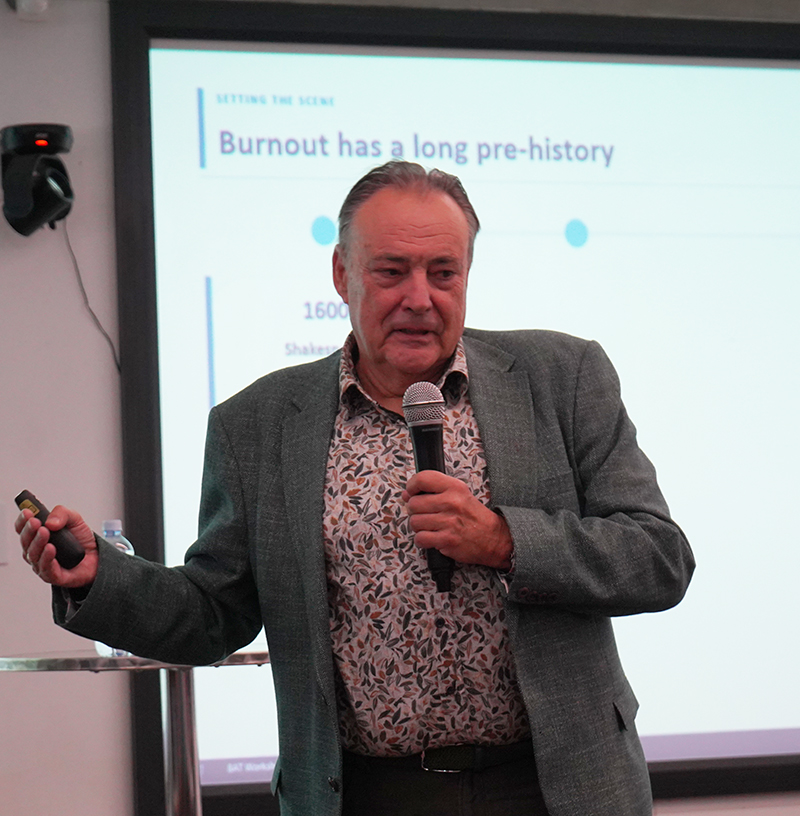
Internationally renowned work and organisational psychology expert, Prof. Wilmar Schaufeli, presented a burnout workshop on the NWU’s Vanderbijlpark Campus.


