
Roughly 384 400 km from the pale blue dot we call Earth hangs an orb that has fascinated humanity for millennia. The Moon is our planet’s only natural satellite and is about a quarter of Earth’s size. Only 12 people set foot on it between 1969 and 1972, but more than 50 years later the Artemis programme aims to add to that number.
In early March, NASA’s Artemis II mission will carry four astronauts on a lunar flyby during a 10-day trip, with later missions set to put feet back on the Moon’s surface.
For Prof. Amare Abebe, Director of the Centre for Space Research at the North-West University (NWU) in South Africa and president of the African Astronomical Society, the renewed international momentum around lunar exploration is due to both strategic and scientific imperatives.
“I think it is now easier than it has ever been before because technology has advanced, the cost of travel has reduced significantly, and the economic benefits are becoming clearer. The timing is also very much aligned with increasing international competition, with different countries starting space programmes. We have seen China and India catching up in what people call the ‘new space’ era, for example, along with many other countries. So there is a renewed sense of competition, in addition to advances in technology and the decreasing cost of travel,” he explains, adding that although there are similarities to the space race of the Cold War, “let us hope that is not the case”.
The Artemis II mission will be the first step in renewed crewed lunar exploration and one giant leap towards sustaining it.
“Artemis III and Artemis IV missions are already being planned after Artemis II. The first mission, Artemis I, was uncrewed and went closer to the Moon. Artemis II is now a crewed mission that will orbit the Moon, rather than land on it, to test technologies and conditions that will support future missions. The next step is Artemis III, which is expected to land on the Moon and explore the southern pole. Then Artemis IV aims to establish infrastructure such as a lunar space station. These are sequential steps designed to ensure sustainable space exploration in the future. That is essentially the plan. This will bring a great deal of experience, learning and new knowledge, particularly in engineering, life-support environments and technological spin-offs. All of this will generate valuable experience and new knowledge about the engineering required, the environments needed to sustain life and other technological developments,” says Prof. Abebe.
Although Africa is not regarded as a major player in the modern space race, there is a wealth of opportunities that will be created for the continent’s scientists, institutions and its growing space sector.
“This renewed interest in space exploration is becoming a catalyst globally, especially for African countries that have historically lagged behind in space science. Many are now working to catch up. You may have seen that the African Union launched the African Space Agency last year. That is a significant milestone. Several African countries are also establishing their own national space agencies. The African Astronomical Society has also been encouraging students and young researchers to get involved. The aim is to build a new generation interested in astronomy, space science and exploration.
“Another important aspect is the Artemis Accords. Countries that sign these agreements gain access to data generated by Artemis missions. That is a major opportunity. A few African countries have already joined, although South Africa has not yet done so, which is surprising given its strong astronomy and space research capacity.
“This means future African researchers — and young people in particular — will have increasing access to data, knowledge and technological developments linked to space exploration. The benefits for African science could be substantial.”
Here, the NWU’s Centre for Space Research has been positioning itself to contribute to the new era of lunar exploration.
“Our researchers work on heliospheric physics — the effects of the Sun on its environment — as well as atmospheric physics, particularly the ionosphere. We also conduct research on radiation protection. As humans travel further into space, solar radiation becomes a major challenge. Part of our work focuses on developing materials that are resistant to radiation in these environments.”
It is said that an infinite universe holds infinite possibilities, and Prof. Abebe is among those who are starry-eyed at the prospect of leaving the confines of our planet.
“There is so much beyond Earth that could benefit humanity. At the moment, our economic and scientific engagement is largely limited to Earth. Exploring beyond Earth has been humanity’s dream for a very long time, and advances in science and technology that make this possible can only be positive. I think it can serve as an inspiring symbol for everyone.”
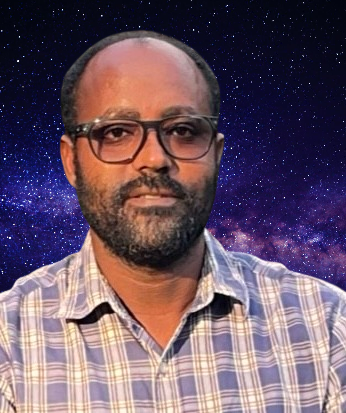
Prof. Amare Abebe


