
In today’s digital age, we live in a world overflowing with information. A quick scroll through your phone can bring up a news story, a social media post, a video, or even an answer written entirely by artificial intelligence.
This was the focus of the International Literacy Day 2026 event held at the Vanderbijlpark Campus on 15 September under UNESCO’s global theme, “Literacy for People, the Planet and Prosperity.” The event was hosted by North-West University’s Library and Information Service (LIS), together with the Faculty of Humanities. It brought people together to explore how the meaning of literacy is changing and changing fast. In a world shaped by digital technology, artificial intelligence, multiple languages and new ways of communicating, being literate means much more than simply being able to read and write.
The programme was directed by Dr Lesiba Ledwaba from the Faculty of Humanities. It began with a welcome by Dr Sabelo Chizwina of NWU LIS, who set the tone by sharing five key messages he hoped the audience would carry with them. He reminded everyone that literacy is still a basic human right and a foundation of social justice. He stressed that illiteracy is not someone else’s problem. It is everyone’s responsibility.
Dr Chizwina pointed out that modern literacy goes far beyond reading and writing and that it plays a vital role in sustainable development. He called on everyone in the room to become literacy champions. “Let us take on this challenge and learn to communicate and promote literacy, because it is through literacy that we can transform,” he said.
Prof. Jeffrey Mphahlele, deputy vice chancellor: Research, Innovation, Community Engagement and Postgraduate Studies, officially opened the event. He made a point that really stood out: the challenge today is not necessarily that people do not have access to information, but that many do not know how to tell what is trustworthy from what is not.
He called for critical thinking, the inclusion of multiple languages, and the use of knowledge not only to get ahead, but also to change lives for the better. Prof. Mphahlele said, “Having access to information does not necessarily mean that we have knowledge or that we are truly informed.”
The highlight of the day was the keynote address by Dr Seani Rananga, a researcher whose work focuses on how technology can help tackle information challenges across Africa. Her pioneering research led to the development of a multilingual AI system that can detect misinformation in English, isiZulu and Sepedi. This is a powerful reminder that African languages must have a place in the technologies shaping how we access and understand information.
Dr Rananga did not hold back. Speaking from her own experience as a lecturer, she raised a concern that many in education are quietly thinking about: students are increasingly relying on AI to do the reading, thinking and writing for them. She asked a simple but uncomfortable question: if a student can answer an assignment using AI, can they answer the same question in a closed book exam without it? She also spoke about AI hallucination, which is when AI systems lose context and produce information that sounds right but is not. This, she said, is exactly why human literacy still matters. “We cannot hand over our ability to think, interpret and understand to a machine,” she said.
An essential part of her message was the need to move from passively consuming information to actively questioning it. Can we tell the difference between evidence and opinion? Can we spot misleading content? Do we check our sources before hitting “share”? “Are we able to make informed decisions before sharing information? That is how literacy can be defined in this day-to-day digital era.”
She urged universities, and NWU in particular, to bring together different forms of literacy so that students are equipped to research, write and engage with digital tools in a meaningful way. She also connected the day’s three pillars, People, Planet and Prosperity, arguing that they cannot be separated. Healthy people need knowledge they can actually use. A protected planet needs people who can tell fact from fiction. And shared prosperity depends on skills and trust in reliable information.
She left the room with one final, direct question: “Can our students read and understand complex academic text anymore?” It was a challenge to institutions to stop assuming everything is fine and start measuring what is really happening.
The conversation continued during a lively panel discussion led by Prof. Adri Breed from the Faculty of Humanities. Under the theme “Multiliteracies in the Age of AI: Navigating Misinformation, Multilingualism and Meaning in South Africa,” the panel featured Prof. Ilse de Korte, Ontlotlile Seemela, both from the faculty of Humanities, Marcia Ramodike, an author and publisher, and Dumisani Ndubane, a Wikimedia board representative.
They explored the everyday challenges people face when trying to make sense of today’s information landscape, from assessing whether something is true to communicating across different languages and platforms. The discussion also tied in beautifully with South Africa’s Heritage Month, celebrating the richness of indigenous languages, culture, oral traditions, storytelling and different ways of creating and sharing knowledge.
Adding a creative touch to the day, the campus choir, Voices of the River performed music that reminded everyone that literacy and knowledge are not limited to the written word. Stories, songs and spoken traditions are just as powerful.
The event was a timely reminder that being literate today means being able to engage confidently and critically with different forms of information, languages, technologies and perspectives.
.JPG)
Prof. Jeffrey Mphahlele
.JPG)
Dr Sabelo Chizwina, Director of Information and Learning Services
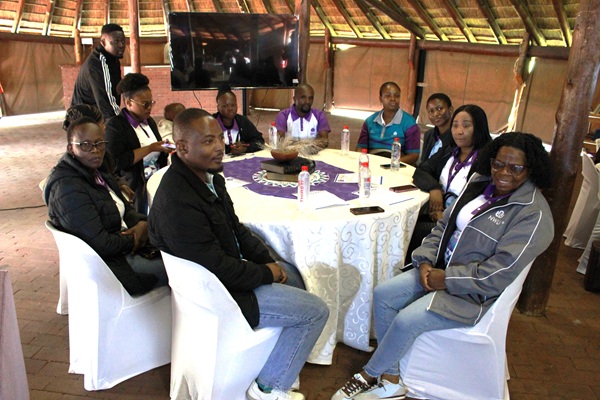
Attendees


