
By Khumo Sebambo
Ga ke se bope ga se ipope: Fragments of What We Carry is Lerato Motaung's third solo exhibition. Showing at the North-West University (NWU) Gallery, Motaung brings together secondhand luggage and pallets—materials that continue his exploration from his previous solo exhibition, Whispers of what was, shown at Constitution Hill. Where that previous work utilised carts, stretchers, sleighs, and remnants of mining granite to examine memory and movement, this current iteration deepens his ongoing fascination with everyday items meant for transport, utility, and the physical history of moving from place to place.
Instead of relying solely on the flat surface of a canvas or a print, Lerato Motaung works directly with the physical objects themselves. By bringing these worn, torn, and weathered materials into the Gallery, Motaung allows everyday transport items to find a profound new expression. These objects arrive at the artist's studio heavily laden with their own stories, possessing an inherent memory, the weight of roads walked, carriages travelled in, checkpoints passed, dompasses approved, and the distinct, tactile imprint of their original handlers' touch. By bringing these suitcases together, Motaung creates a spatial dialogue in which these hidden histories coexist and interrogate his own experiences of movement, loss, and carrying.
This intuition forms the bedrock of the exhibition. Within the Gallery, Motaung creates a deliberate juxtaposition between two specific objects: the vintage suitcase and the industrial shipping pallet. What interests Motaung about mobility is not movement as an abstract condition. Rather, it is the movement of people explicitly understood as labour. Pallets are made for the movement of mass goods and consumer items, while suitcases are simply about people in motion." [Pallets are] entirely indifferent to whatever is stacked upon it. While the suitcase represents personal agency, the pallet belongs entirely to the machine," says Motaung. Though they inhabit the same room, they perform opposite functions. For Motaung, the object's authenticity is key; a suitcase that hasn't actually been used by a person on a journey is nothing more than a theatrical prop, and his practice doesn't use props.
"The suitcases are all secondhand, which means they come with their own histories, which I cannot fully know, but can still feel," Motaung notes.
Coming from a formal background in painting and printmaking, Motaung's artistic practice has evolved as it transitions toward large-scale installation. But the printmaker remains visible through a unique application of rhythm and structural repetition. Instead of repeating a carved image onto paper with ink, Motaung repeats physical objects, shapes, and spatial arrangements. He creates layers within the three-dimensional space that build upon one another, functioning much like multiple, heavy impressions pressed onto a single sheet of print paper, or perhaps in this case, the mind.
This spatial shift completely redefines the viewer's relationship to the art. Where audiences once viewed Motaung's paintings from a frontal distance, visitors to the Gallery must now approach the work physically— walking around, through, and within the weight of the history he has assembled. The complete absence of ink or paper here is intentional. Print operates through a process of
multiplication, carrying an image across multiple surfaces. "There's no print here, and that's a deliberate position, not an absence. Print is a flat, reproducible medium; its value lies in multiplying an image without incurring a cost to the original. This work depends on the opposite condition: objects that can't be reproduced without losing their authority, because the suitcase's weight depends on it being that suitcase, not an image standing in for it," says Motaung. "I don't see this as abandoning print, it's where I've learnt image-making discipline.
The conceptual gravity of Ga ke se bope, Ga se ipope relies entirely on this condition: it relies on objects that cannot be multiplied without losing the specific truth of their lived histories. The heavy emotional weight of the suitcase depends entirely on it being that specific suitcase. Ga ke se bope, ga se ipope means "I did not make it, and it did not make itself," but there is more to it than that. It says that history, family, place, and culture shape us. In Setswana, there is a strong sense of shared identity that is hard to express in English.
Ultimately, this profound inquiry into material memory is deeply informed by Motaung's own biographical movements across South Africa's geography. Born in Katlehong, raised in the North West province, and currently living and working in the bustling economic hub of Johannesburg, his own life has been defined by shifting locales. Bringing this specific body of work to the NWU Gallery represents a meaningful full-circle moment, grounding these personal migrations in the landscape of his upbringing. These shifts inform his nuanced understanding of home and identity as always in flux—continually forming and dissolving rather than existing as fixed, static, or complete.
It is this ongoing state of flux, paired with a deep historical curiosity, that drives his studio practice. The exhibition acts as a manifestation of cumulative loss—a type of grief and displacement that is not singular; it repeats itself, stacks onto itself, and compounds across time, echoing through generations of people who have moved through these movements.
Motaung is still developing his craft, language, and practice, driven by an ongoing curiosity about his chosen materials. "What keeps me in the studio," he reflects, "is the suspicion that there's more weight in these objects than I've yet found a form for. The suitcase holds what one person chose to keep. The pallet holds what an entire system never asked anyone to choose. I'm still working out what it means to put both in the same room."
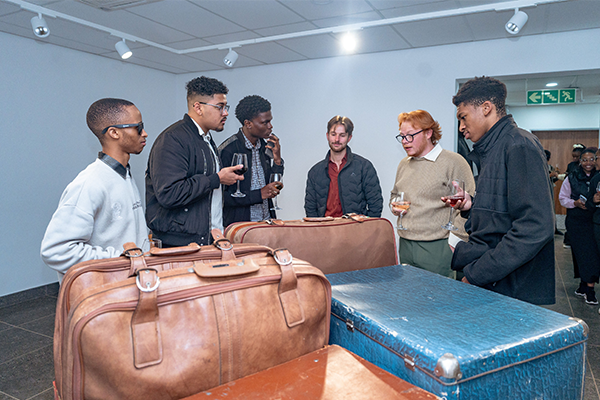
Attendees of Ga ke se bope ga se ipope: Fragments of What We Carry exhibition


