
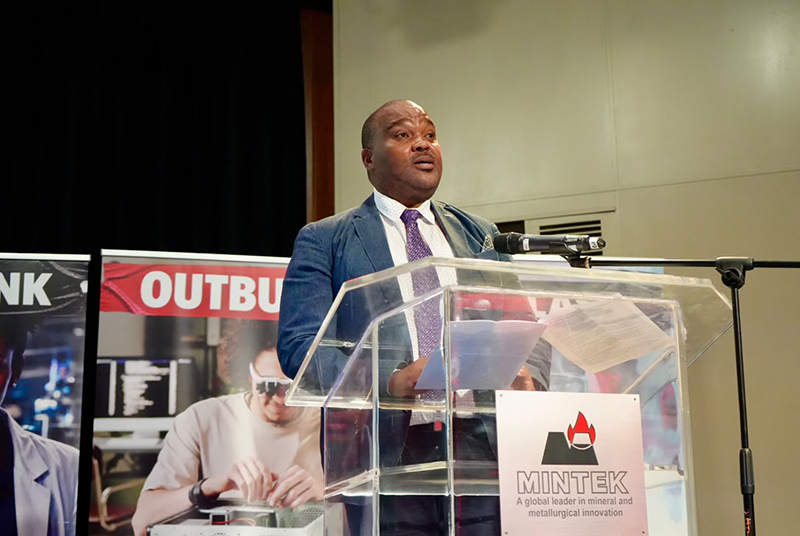
Prof. Bismark Tyobeka, NWU principal and vice-chancellor, delivered the keynote address at Mintek-SCi 2026, the Science Convention of Innovators.
The North-West University (NWU) principal and vice-chancellor, Prof. Bismark Tyobeka, has challenged emerging researchers and innovators in Africa to look beyond the extraction of mineral resources and focus on developing the knowledge, technologies and industries needed to drive sustainable economic growth.
Prof. Tyobeka recently delivered the keynote address at Mintek-SCi 2026, the Science Convention of Innovators, held at Mintek in Johannesburg. The annual convention brings together young researchers, scientists, engineers and innovators to explore solutions to challenges facing the minerals and industrial sectors. This year the programme focused on critical minerals, energy, emerging technologies, sustainability and the circular economy.
“Human progress has never depended only on what lies beneath our feet. It has depended on what we learn to do with it,” Prof. Tyobeka said. He said Africa’s mineral wealth presented significant opportunities, but warned that resource ownership alone did not translate into industrial development. “Opportunity is not a business plan. Owning a resource does not automatically confer industrial strength.”
Prof. Tyobeka called for greater investment in capabilities across mineral value chains, including engineering, process control, specialised technologies and intellectual property. He also highlighted the importance of reliable and affordable energy in supporting mineral processing, manufacturing and industrial growth. “We cannot build a competitive minerals industry on uncertain electricity,” he said.
Drawing on his background as a nuclear engineer, Prof. Tyobeka said nuclear energy could contribute to reliable, low-carbon electricity, alongside renewable energy, storage, stronger grids and energy efficiency. He urged researchers working with emerging technologies such as artificial intelligence, digital twins and advanced sensors to ensure that innovation addresses real industrial problems. “Start with a problem worth solving. Spend time with the people who operate the plant. Understand the water bill, the downtime, the recovery loss and the safety concern,” he said.
Prof. Tyobeka also encouraged stronger partnerships between universities, research institutions and industry to move promising ideas from laboratories into pilot projects, commercial applications and new enterprises.
Turning to the circular economy, he called for greater attention to product design, repair, reuse, remanufacturing and recycling, noting that valuable materials could also be recovered from mine residues and tailings where technically and economically viable. “Circularity begins before a product becomes waste,” he said.
In his closing message, Prof. Tyobeka challenged emerging researchers to think beyond publication and consider how their work could create a tangible impact. “Identify one important problem. Find a partner who experiences it. Define what success would look like,” he said.
He ended by reminding young researchers that Africa’s greatest resource is not limited to what lies beneath its soil. “There is great value beneath our soil. There is also great value in the curiosity, discipline and imagination of our young people. Let us mine that resource too.”


