
The North-West University’s (NWU’s) Vanderbijlpark Campus commemorated Arbor Day 2026 by planting indigenous trees and reaffirming its commitment to a greener and more sustainable future.
Held under the theme “Leave a legacy – plant a tree”, the programme brought together campus management, student leadership, academic and support staff, faculties, departments and residences.
Facilitated by Chris Williams, director for student life, the programme featured an environmental sustainability address by Prof. Heleen Janse van Vuuren, director of the School of Accounting Sciences in the Faculty of Economic and Management Sciences, who spoke on behalf of executive dean, Prof. Mabutho Sibanda.
Prof. Janse van Vuuren highlighted the environmental challenges facing the Vaal region, including its status as an Air Quality Priority Area. A simulated carbon audit identified commuter and fleet vehicles, electricity consumption and diesel generators as major contributors to the carbon footprint of the campus, estimated at approximately 4 250 tons of CO₂ equivalent annually.
“We are part of the problem, but we are also uniquely positioned to be part of the solution,” she said.
The Arbor Day programme forms part of the Arbor Day 2026: Green Legacy Initiative, which aims to plant 65 indigenous trees across the campus, including the wild olive, recognised as the national tree of the year.
Prof. Janse van Vuuren said the initiative was about more than planting trees, urging the university community to reduce electricity waste, explore renewable-energy solutions and make more sustainable choices.
“We should never see sustainability as a marketing slogan. It is not a photo opportunity,” she said.
She also linked environmental sustainability to environmental justice, emphasising the need for a just transition that protects both the environment and livelihoods in the Vaal region.
Andiswa Msi, campus chief director, reflected on the significance of the initiative and the location of the campus alongside the Vaal River.
“The river symbolises life, continuity, movement, connection and resilience,” said Andiswa.
She said planting a tree was an investment in future generations, with students yet to come potentially benefiting from the trees planted today.
“This is the essence of legacy,” she said.
The first three trees were symbolically planted at the T-junction towards the new hockey field, with the remaining trees planted by faculties, departments and residences with support from the landscaping team.
The event also featured Voices of the River, the campus choir, whose performance reinforced the connection between the university community, culture and the natural environment.
Andiswa said as the trees take root, they will become a living reminder of the commitment of the Vanderbijlpark Campus to sustainability, environmental responsibility and future generations.
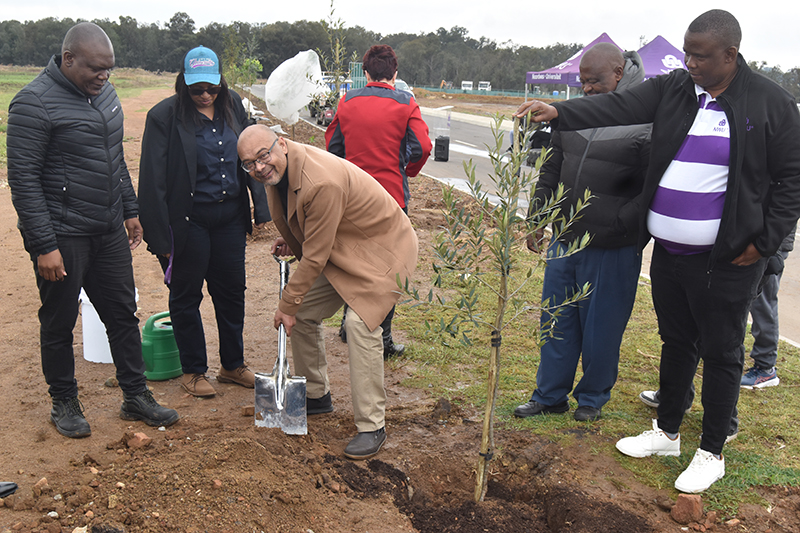
Photo: Chris Williams, director for student life, lends a hand in planting the trees.


