
The Riverside Hotel in Vanderbijlpark recently buzzed with intellectual energy as academics, students, policymakers and thought leaders from across Africa gathered for the North-West University (NWU) Trio Conference on Afrocentric Governance, Multilingualism and Transformation.
Over three days, participants from South Africa, Uganda, Nigeria, Zimbabwe, Tanzania, Malawi and Lesotho and beyond convened to reimagine the development of Africa through an Afrocentric lens – grounded in indigenous knowledge, African languages and cultural values.
The dignitaries who attended the conference included Advocate Melanchton Makobe, the acting director-general of the Department of Planning, Monitoring and Evaluation and the president of the African Association of Public Administration and Management, Dr John Nakabago, who is also the director for finance and administration at the Uganda Management Institute. Other dignitaries included Dr David Kalaba, the deputy director general of the Eastern and Southern African Management Institute (formed by 10 countries in eastern and southern African countries); the deputy inspector general of the government of Uganda, Dr Patricia Okiria; the president of the South African Association of Public Administration and Management, Prof. Kgotatso Shai; and Prof. King Costa, the chancellor of Amadi University College in eSwatini and officials from the policy and research services unit in the Presidency of the Republic of South Africa which is headed by Pulane Kole.
Opening the conference, Prof. Costa Hofisi, research director of Afrocentric Governance of Public Affairs, chairperson of the NWU Trio Conference and the organiser of the event, stressed the urgency of rethinking governance on the continent.
“The development of Africa must be anchored in its own knowledge systems, languages and values. Afrocentric governance is not an alternative – it is essential if we are to achieve meaningful and lasting transformation.”
The academic tone was set by Prof. Mirna Nel, deputy dean for research in the Faculty of Humanities, who welcomed delegates and introduced the deputy vice-chancellor. The formal opening was led by Prof. Jeffry Maphahlele, deputy vice-chancellor for research and innovation, community engagement, postgraduate studies with assigned function of the Vanderbijlpark Campus. Prof Maphahlele also introduced the keynote speaker, Advocate Makobe. Prof. Dumi Moyo, executive dean of the Faculty of Humanities, and acknowledged Prof. Hofisi for organising a landmark event.
A highlight of the conference was the keynote address by Adv. Makobe, who emphasised the strengthening of state capacity to drive development and improve service delivery across African nations. He underscored the centrality of African languages to constitutional mandates and asked delegates whether sustainable development could truly emerge without the decolonisation of knowledge.
“Afrocentric governance must place African development at the centre. We need to bridge the gap between theory and practice, cultivating ethical leadership that universities embed into their curricula,” Adv. Makobe said.
Panel discussions brought together experts from across the continent to address governance, policy and social transformation. Students played an active role, participating in discussions, presentations and workshops, while a dedicated session on scientific writing for emerging researchers highlighted the commitment of the conference to nurturing the next generation of thinkers in Africa.
Apart from the formal sessions, the conference fostered invaluable networking. Delegates exchanged ideas, forged collaborations and built cross-border partnerships that are expected to extend far beyond the event.
Contributions from African institutions enriched the dialogue, reinforcing the importance of continental collaboration in addressing shared challenges. Discussions centred on Afrocentric governance, multilingualism and social justice, exploring how African philosophies like ubuntu can inspire inclusive, community-driven leadership while addressing structural inequalities rooted in colonial legacies.
Language was a central theme, with participants calling for the recognition and use of indigenous African languages in education, research and governance. Many emphasised that linguistic inclusion is essential for broadening access to knowledge and achieving sustainable transformation.
Technology and innovation were also spotlighted, with presentations examining how Africa can harness digital tools and artificial intelligence in ways that reflect local realities. The concept of Afrocentric AI sparked vital conversations about data sovereignty and cultural representation.
Reflecting on the conference, Prof. Hofisi expressed pride in the success of the event. “The NWU Trio Conference has exceeded all expectations. In bringing together scholars, students and policymakers from across Africa we have not only shared knowledge, but also strengthened a pan-African commitment to Afrocentric governance, multilingualism and transformation,” he said.
“The energy, engagement and ideas generated over these three days show that the future of Africa is best shaped by Africans themselves – through our languages, our values and our knowledge systems. We work on a policy brief based on this conference, which we will submit to the policy research unit of the Presidency, since we are collaborating with them to establish a policy lab at the NWU. The policy lab will adopt a multi-stakeholder approach to confronting societal challenges in our quest to enhance societal impact at the NWU.”
As the conference concluded, delegates – including students – voiced a shared commitment to translating ideas into action. There was a strong call for governments, institutions and communities to embrace Afrocentric approaches as practical pathways for development in Africa.
Closing the conference, Prof. Linda du Plessis, vice-principal and senior deputy vice-chancellor for teaching and learning, reaffirmed the dedication of the university to advancing these ideals across its programmes and initiatives.
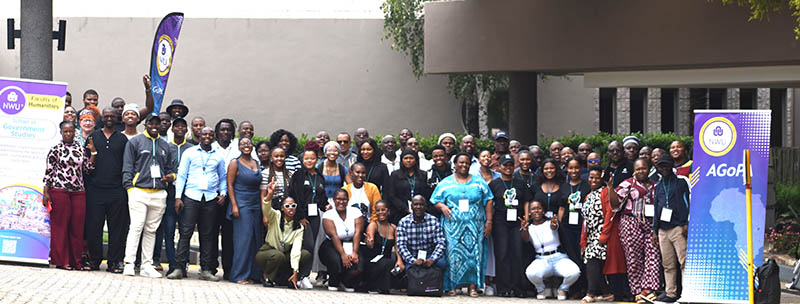
Academics, students, policymakers and thought leaders from across Africa gathered for the NWU Trio Conference on Afrocentric Governance, Multilingualism and Transformation.


