
Second-year Social Work students at the Vanderbijlpark Campus of the North-West University (NWU) recently stepped into the world of legal proceedings during a mock trial at the Vanderbijlpark Magistrates’ Court.
This provided them with practical experience in how social workers can help protect the rights and best interests of vulnerable children.
The exercise exposed students to courtroom procedures and highlighted the importance of professional evidence, ethical practice and effective communication when social workers are called upon to assist the court in matters involving children.
According to Livhuwani Siaga, junior lecturer in Social Work, the mock trial provided an important opportunity for students to connect theoretical knowledge with the realities of professional practice.
“Social work goes beyond providing support, conducting assessments and offering counselling. Social workers also have a responsibility to protect vulnerable children and ensure that their circumstances, needs and rights are properly represented in the legal system,” says Livhuwani.
She explains that social workers may be required to present professional assessments, explain their findings under questioning and provide objective evidence to assist the court in making informed decisions.
“This requires more than theoretical knowledge. Social workers must be able to think critically, exercise sound professional judgement, uphold ethical standards and communicate their findings clearly and confidently. Their evidence can have far-reaching consequences for the children and families they serve.”
The mock trial was particularly significant given the size of the second-year cohort, making it one of the largest groups to participate in this practical learning exercise at the Vanderbijlpark Campus. Despite the logistical demands of accommodating a large group, students participated enthusiastically and demonstrated critical thinking skills throughout the exercise.
Their engagement reflected a growing understanding of the relationship between social work theory, legislation and professional responsibilities. The advocate involved in the exercise also expressed positive feedback about the students’ preparation and participation.
For Livhuwani, such practical learning opportunities are essential in preparing future social workers for the complexities of child protection and the demands of working in the justice system.
“Exposing students to courtroom procedures while they are still in training helps them develop the confidence and competence they will need in their professional careers. It also allows them to appreciate the seriousness of their responsibilities when their assessments and professional opinions may influence decisions about a child’s safety and future,” she says.
The exercise also reinforced the importance of collaboration between higher-education institutions and legal professionals. By engaging with courtroom processes in a simulated environment, students can become more familiar with what is expected of social workers who provide evidence in legal proceedings.
However, preparing students for the courtroom is not simply about teaching them to argue a case. It is about ensuring that they understand the importance of truthfulness, impartiality and evidence-based professional practice.
A social worker’s role is to present credible information and professional opinions grounded in sound assessments, rather than to promote a particular outcome. Although the ultimate decision rests with the court, reliable social work evidence can help ensure that the circumstances and best interests of a child receive appropriate consideration.
The mock trial gave students an opportunity to reflect on how their future responsibilities will extend beyond the office or consultation room. Every assessment conducted, report written and professional opinion presented may have significant implications for the individuals and families they serve.
Livhuwani emphasises that experiential learning remains an important part of preparing students for these realities.
“Learning becomes more meaningful when students can apply what they have been taught in practical settings. Opportunities such as this mock trial help bridge the gap between the classroom and professional practice, while encouraging students to become critical thinkers who understand both their ethical obligations and their responsibilities under the law,” she says.
As part of its commitment to developing capable social work professionals, the NWU continues to provide learning opportunities that encourage students to engage with real-world professional challenges and understand the impact of their future work.
The mock trial at the Vanderbijlpark Magistrates’ Court demonstrated how practical exposure can help nurture a generation of social workers who are knowledgeable, confident and prepared to engage effectively with the legal system.
Ultimately, preparing social workers to present credible evidence, uphold professional ethics and understand legal processes is an important step towards strengthening the protection of vulnerable children. For the students who participated, the courtroom experience offered a valuable lesson: their future work will not only involve supporting individuals and families, but also help to ensure that children’s rights, safety and well-being remain central to decisions that shape their lives.
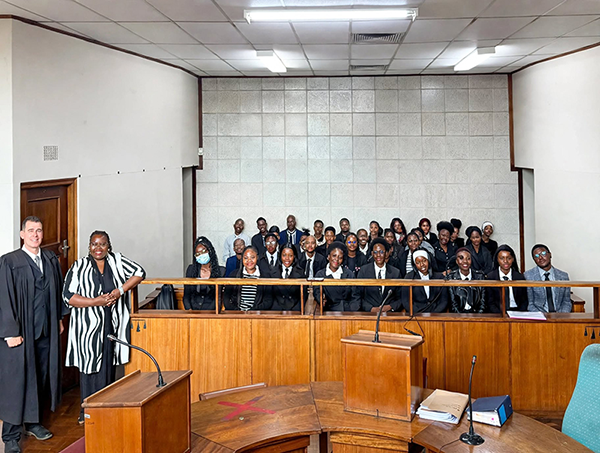
Second-year Social Work students at the Vanderbijlpark Campus recently attended a mock trial at the Vanderbijlpark Magistrates’ Court.


