
A group of 13 Public Policy Analysis honours degree students from the North-West University (NWU) were given a rare opportunity to engage directly with the architects of public policy and governance inside the historic chambers of the Union Buildings – where some of the most critical national decisions in South Africa are shaped.
In what has been described as a groundbreaking experiential learning initiative, the students participated in a high-level policy exhibition collaboration project hosted over two intensive days in partnership with the Presidency’s Policy and Research Services unit. The programme immersed students in the realities of policymaking, exposing them to the complex processes, institutional dynamics and strategic decision-making that influence the development agenda of South Africa.
Far more than an academic excursion, the collaboration placed students at the centre of real policy conversations involving senior government officials, analysts and decision-makers from some of the most influential institutions in the country. Students engaged with representatives from the National Treasury, Statistics South Africa, the Department of Planning, Monitoring and Evaluation, the Department of Health and several other national departments responsible for shaping public policy and national development priorities.
The initiative formed part of the commitment to innovative teaching and experiential learning by the School of Government Studies, aimed at bridging the gap between classroom theory and practical governance experience.
The first day of the programme focused on policy foundations, institutional roles and government decision-making processes. Sessions explored the fundamentals of public policy analysis, agenda setting and national priorities, while also unpacking the role of fiscal policy and procurement systems in shaping government service delivery. Students gained valuable insight into how government departments formulate and align policies with national development objectives.
One of the key highlights of the first day was a session led by the Department of Health, which focused on policymaking challenges surrounding the implementation of National Health Insurance. The discussion exposed students to the complexities of balancing public expectations, financial sustainability, administrative capacity and political considerations within large-scale policy reforms.
Students also engaged with officials from the Department of Human Settlements, who shared perspectives on housing policy, service delivery challenges and the realities of implementing development programmes within diverse communities across South Africa.
The second day shifted its attention towards the broader policy environment, implementation frameworks and external influences on policymaking. Discussions examined the role of diplomacy and international relations in shaping national policy priorities, while officials from Statistics South Africa demonstrated the importance of statistical evidence and data-driven governance in policy planning and monitoring.
Another important session focused on social policy and inclusive governance, with discussions centred on gender equality, youth development and disability inclusion in government planning processes. Students were encouraged to critically reflect on the importance of equity and representation in policymaking and public administration.
Further sessions explored productivity, economic competitiveness and the alignment of policy development between public and private sector institutions. Students also participated in discussions on agricultural policy and food security, where stakeholders examined the policy trade-offs involved in balancing economic growth, sustainability and social protection.
According to Dr Nkosingiphile Mkhize, the collaboration represented a transformative learning experience for students pursuing careers in governance and public administration.
“This initiative provided our students with an invaluable opportunity to engage directly with policymakers and experience the realities of governance at the highest level. It is one thing to study policy in a lecture room, but it is entirely different to sit inside the Union Buildings and interact with the institutions responsible for shaping the country’s future,” said Dr Mkhize.
“Experiential learning opportunities such as these are essential in preparing graduates who are critically engaged, analytically strong and capable of contributing meaningfully to public sector transformation and evidence-based policymaking.”
Dr Mkhize further emphasised that the collaboration reflected on the broader vision of the university of producing graduates who are socially responsive and professionally equipped to navigate complex governance environments.
Beyond the formal discussions, students also participated in a guided tour of the Union Buildings, gaining insight into the historical and symbolic significance of one of the most iconic government landmarks in the country. For many students, the experience represented not only an academic milestone, but also a moment of inspiration and motivation for their future careers.
“Many students described the programme as eye-opening, intellectually stimulating and career-defining. Most of them highlighted the value of engaging directly with senior officials and witnessing how policy decisions are debated, negotiated and implemented within government structures,” said Dr Mkhize.
The initiative was made possible through faculty small grant funding, which supported student participation and strengthened collaboration between academia and government institutions. Stakeholder evaluations are currently being finalised and will help inform future partnerships between the NWU and the Presidency’s Policy and Research Services unit.
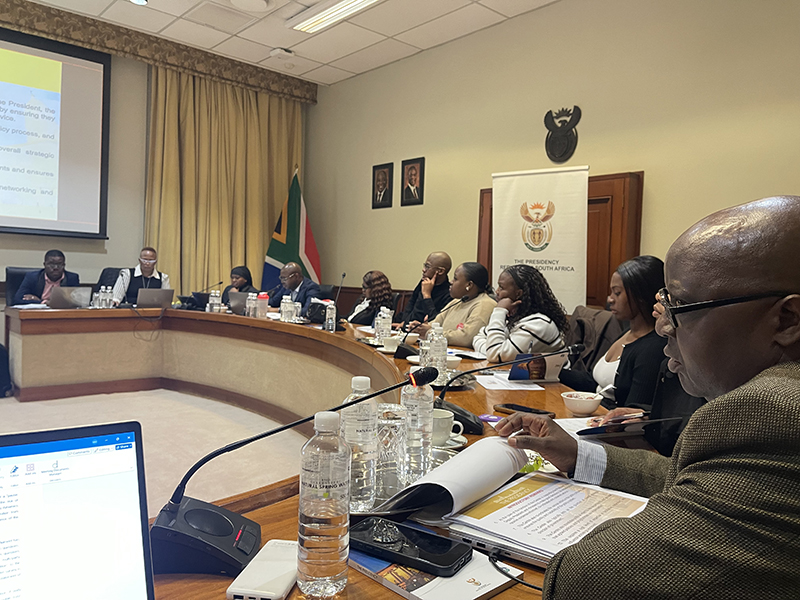
A group of 13 Public Policy Analysis honours degree students engaged with the architects of public policy and governance inside the historic chambers of the Union Buildings.


