
Twelve years ago, Prof. Liezl van Dyk, executive dean of the Faculty of Engineering, came to the North-West University (NWU) on a mission: to play a central role in developing industrial engineering as an impactful discipline at the university. Her daughter, Karla, was 10 years old at the time. Now, on 31 March this year, Prof. van Dyk experienced the fruits of her labour first-hand when Karla graduated as an industrial engineer.
“It is a full-circle moment that highlights the impact of academic leadership and the inspiration it offers to future generations of women in engineering and science,” says a proud Prof. van Dyk. “I am looking forward to watching her career, and also the careers of everyone who graduated today.”
Prof. van Dyk points out that although this was Karla’s own career choice, she was not surprised that her daughter would choose industrial engineering. “I recall that as a little girl she would often join me on Saturdays when the faculty hosted initiatives for schoolgirls to encourage them to consider careers in industrial engineering. I believe in role models, and this is why it is so special to me, as a female leader in engineering, that my daughter has also chosen this career path.”
Karla sets her sights on further study and lecturing
What drew Karla to industrial engineering is its problem-solving aspect. “I like taking various aspects and options into consideration when making decisions, especially if I know there are better ways of solving problems. Just as Prof. Linda du Plessis, senior deputy vice-chancellor for teaching and learning, said in her address to us graduates, we are now able, with the skills and knowledge our degrees have given us, to go out into the world and make a meaningful difference.”
Her thirst for knowledge has inspired her to take her studies further. She is currently busy completing a master’s degree in industrial engineering while working as a junior lecturer at the NWU’s School of Industrial Engineering.
More about industrial engineering
Industrial engineers optimise systems by creatively designing solutions that integrate people, processes, technology and data.
Originating over a century ago during the industrial revolution, industrial engineering focused on finding the best, cheapest and fastest ways to manufacture products. Today, this discipline is essential across industries due to the challenges of the Fourth Industrial Revolution and changing market demands.
At the NWU, graduates are trained in key knowledge areas including optimisation and control, statistics and simulation, operational excellence and supply chain, programming and IT, business improvement, management and manufacturing design.
Graduates work in diverse industries such as aerospace, agriculture, finance, healthcare, IT, logistics, manufacturing, mining, energy and consulting.
The NWU’s School for Industrial Engineering offers a close knit learning environment, equipping graduates to drive innovation, informed decision making and positive change across industries and communities.
Prof. van Dyk says any industrial engineer will be able to tell you why this programme is so special. “In a nutshell, industrial engineers solve problems and design solutions. Where a mechanical engineer develops new mechanical systems and an electrical engineer designs things like power stations, for example, industrial engineers focus on systems and industries. They are the people who connect the dots and make life easier for everyone,” she concludes.
Watch the video below.
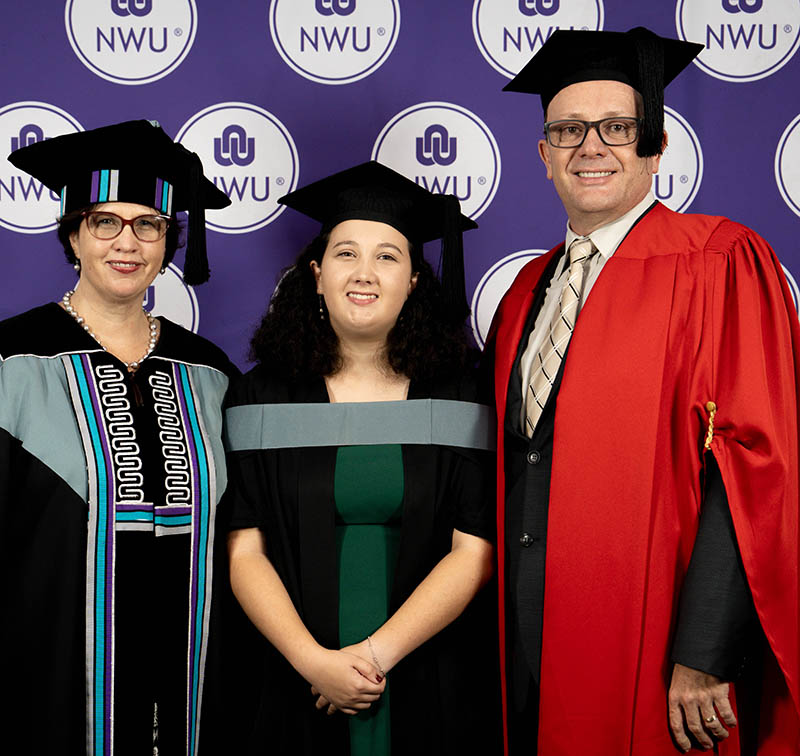
Prof. Liezl van Dyk, executive dean of the Faculty of Engineering, with Karla van Dyk and Prof. Tobie van Dyk from the Faculty of Humanities. Prof. Tobie says he is happy to see that the two women in his life, his wife and daughter, are making contributions as engineers. “I have learned a little bit about industrial engineers over the years and I know the world needs them.”


