Walk into almost any entrepreneurship workshop in South Africa and the ritual is familiar.
Someone hands out a business-plan template. Boxes must be completed. Markets analysed. Revenue streams estimated. Risks quantified. Funding projections prepared.
Only afterwards comes the awkward silence.
Many participants have never written a business plan before. Some have no formal business education. Others are still trying to understand whether the problem they have identified is even worth solving. Yet they are immediately confronted with language borrowed from MBA classrooms rather than township streets.
According to Prof. Leenta Grobler of the North-West University, this may explain why so many entrepreneurship programmes produce paperwork instead of businesses.
"South Africa does not have a shortage of entrepreneurial potential," she argues. "What we often lack are tools that speak the language of people's lived realities. KasiKanvas was designed to start where entrepreneurs are, not where we expect them to be."
That distinction matters.
South Africa has spent years debating finance, regulation and unemployment while paying surprisingly little attention to a simpler question: are aspiring entrepreneurs being asked to think in ways that actually fit the environments in which they operate?
Prof. Grobler believes the answer is often no.
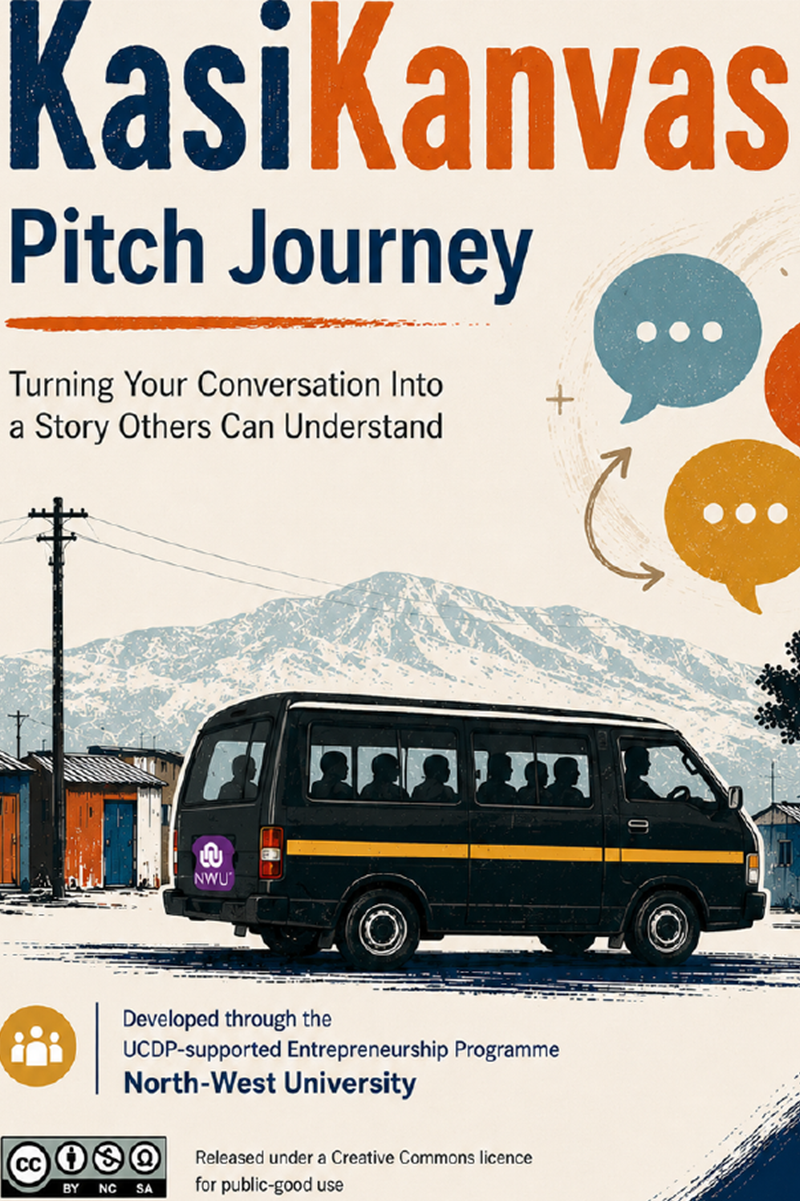
KasiKanvas, a conversation-based entrepreneurship initiative developed through the North-West University's UCDP-supported Entrepreneurship Programme, was created to answer precisely that question. Rather than asking aspiring entrepreneurs to begin with business plans and financial projections, the framework encourages them to begin with conversations, lived experience and practical problem-solving. It aims to bridge the gap between conventional entrepreneurship training and the realities of township and informal-economy entrepreneurs.
KasiKanvas emerged after researchers spent time working alongside township entrepreneurs in Ikageng. The discovery was not that entrepreneurial talent was absent. Quite the opposite.
"The entrepreneurial potential was already there," says Prof. Grobler. "People had ideas, creativity, resilience and a deep understanding of their communities."
The problem lay elsewhere.
Many entrepreneurship programmes assumed that participants already understood formal business language and conventional planning processes. "Entrepreneurs were frequently confronted with complex templates and formal business plans before they had even fully explored the problem they wanted to solve."
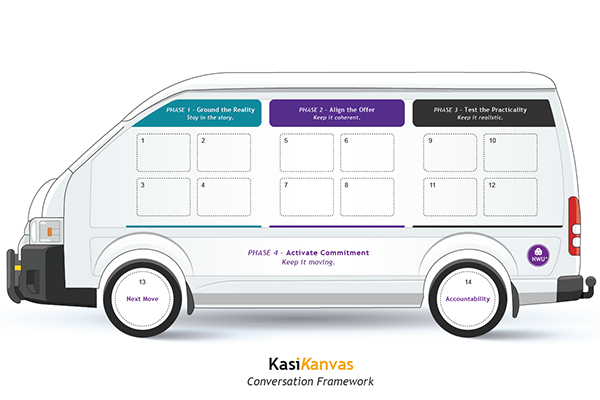
The framework borrows an unmistakably South African metaphor. Each stage of the entrepreneurial process is represented as another stop on a minibus taxi journey. Entrepreneurs move through four phases—from grounding the problem and aligning an idea to testing its practicality and finally committing to action. The destination is not a completed document but a business idea that has survived honest conversation and practical scrutiny.
"Most traditional business-model frameworks start with planning, structure and documentation," says Prof. Grobler. "KasiKanvas starts with people, stories and conversations."
The distinction is visible throughout the framework itself. Rather than beginning with spreadsheets, entrepreneurs begin with a question: What problem are you trying to solve? They move through fourteen conversation cards, each representing another stop on a familiar journey. Every stage encourages reflection before action, conversation before documentation and clarity before complexity.
"The goal is not to complete a canvas correctly," Prof. Grobler explains. "The goal is to think clearly, honestly and practically about an opportunity."
It sounds almost obvious. Yet it challenges decades of entrepreneurship training.
Many development programmes have traditionally assumed that entrepreneurship begins with writing.
KasiKanvas assumes it begins with talking.
Ideas are explored before they are documented. Stories come before structure. Conversation precedes planning. As the supporting material explains, "ideas are spoken about first, written down second" and the framework starts "with a real story, not a template".
That reflects a broader economic reality.
South Africa's informal economy represents one of the country's largest sources of entrepreneurial activity, yet many support systems continue to be designed around formal-sector assumptions.
"Township entrepreneurs operate within unique social, economic and infrastructural realities," says Prof. Grobler. "They often face resource constraints, limited access to formal support systems, inconsistent infrastructure and highly localised market dynamics."
Those realities shape how businesses emerge.
"If entrepreneurship development is to be genuinely inclusive, the tools we use must reflect the environments in which entrepreneurs actually live and work."
Context, she argues, matters.
"Entrepreneurship support becomes significantly more effective when people can see themselves, their communities and their lived experiences reflected in the development process."
Entrepreneurs frequently possess intimate knowledge of local problems but lack access to mentors, business networks, digital capability and structured support that can help transform survival activities into sustainable enterprises.
"There is also often a disconnect between grassroots innovation and formal support ecosystems."
The result is predictable.
"Many promising ideas remain informal, small-scale and localised despite having significant growth potential."
The implications extend beyond entrepreneurship.
South Africa's youth unemployment crisis continues to rank among the highest in the world. Policymakers understandably search for large-scale interventions, yet Prof. Grobler suggests the country may also need to rethink something much smaller: how entrepreneurial thinking itself is developed.
"While not every young person will become an entrepreneur, entrepreneurial thinking is an important capability regardless of career path."
KasiKanvas therefore focuses less on producing business owners than on developing habits of mind.
It encourages opportunity recognition, problem-solving, critical thinking, communication and action-oriented decision-making.
More importantly, it reduces intimidation.
"Instead of presenting entrepreneurship as something only experts can do, it demonstrates that meaningful businesses often begin with simple observations, conversations and small practical steps."
That psychological shift may be one of the framework's greatest innovations.
Entrepreneurship often appears inaccessible because it is introduced through the language of finance rather than the language of everyday life.
KasiKanvas deliberately reverses that.
Its participant guide repeatedly reminds users that they do not need "a perfect idea" before they begin. They need only "a starting point". It also encourages entrepreneurs to remain connected to "real people, real places and real stories" before trying to develop solutions.
Universities, Prof. Grobler argues, should play a different role as well.
"Universities have a unique role to play as knowledge brokers, convenors and innovation partners."
Rather than seeing themselves simply as institutions that transfer knowledge, they should become collaborators.
"Rather than simply transferring knowledge to communities, universities should engage in co-creation processes that recognise the knowledge and expertise that already exist within communities."
That represents a subtle but profound change.
For decades universities have often seen themselves primarily as producers of knowledge.
KasiKanvas suggests they can become translators instead.
"By combining academic expertise with lived experience, universities can help entrepreneurs access training, mentoring, research, technology, networks and innovation ecosystems that accelerate business development."
The framework itself embodies that philosophy. It was developed alongside township entrepreneurs, whose stories, feedback and lived experiences shaped every stage of its evolution.
Prof. Grobler believes that long-term economic growth is most likely when universities "help build entrepreneurial capability, strengthen local innovation systems and create pathways that connect grassroots ideas with broader markets and opportunities."
In the end, KasiKanvas may matter less because of the cards, the taxi metaphor or even the framework itself.
Its significance lies in a more uncomfortable question.
Perhaps South Africa's entrepreneurship problem has never been a shortage of ideas.
Perhaps it has been a shortage of people willing to listen before asking entrepreneurs to write.