South Africa was developing HALEU-range nuclear fuel years before it became a global strategic priority.
The knowledge acquired through the PBMR programme could help South Africa re-enter the advanced nuclear fuel market.
Rebuilding South Africa’s nuclear capability could begin with something as small as a single TRISO fuel particle.
South Africa should aim to supply the global small modular reactor industry, rather than merely purchasing its technology.
Retiring PBMR specialists possess technical knowledge that South Africa must capture before it is lost.
Africa cannot afford to participate in the next nuclear revolution only as a consumer.
The global nuclear industry is entering a new era. Small modular reactors, microreactors and other advanced nuclear technologies are moving from laboratories and design offices towards demonstration and commercial deployment. Yet, behind the excitement surrounding these reactors lies a less glamorous but increasingly decisive question: where will their fuel come from?
At the centre of this question is high-assay low-enriched uranium, or HALEU.
HALEU is uranium enriched to more than 5% but less than 20% uranium-235. Conventional light-water reactors generally operate with uranium enriched to below 5%. Many emerging advanced reactors require higher enrichment because it enables smaller cores, longer operating cycles, improved fuel utilisation and greater design flexibility.
HALEU is therefore becoming not merely another nuclear material, but a strategic commodity in the emerging global nuclear economy.
For South Africa, however, there is an intriguing dimension to this story.
We have been here before.
South Africa’s forgotten head start
During the development of the Pebble Bed Modular Reactor (PBMR), South Africa acquired sophisticated capabilities in coated-particle nuclear fuel. The PBMR design used TRISO-coated uranium dioxide particles embedded in graphite fuel spheres.
Importantly, the reference PBMR fuel enrichment was approximately 9.6% uranium-235.
In today’s terminology, that fuel falls squarely within the HALEU range.
South Africa was therefore developing and manufacturing experimental fuel belonging to what the world now regards as one of the strategically important fuel classes for advanced nuclear reactors.
This was not simply a theoretical capability. At Pelindaba, considerable knowledge, infrastructure and human expertise were developed in fuel kernels, coating technologies, graphite fuel manufacture, quality assurance and associated nuclear fuel-cycle activities.
When the PBMR programme was discontinued, much of that momentum was lost.
But the world did not stand still.
Ironically, it has moved towards some of the very technologies South Africa was developing.
HALEU has become a strategic issue
Today, several advanced reactor developers are designing systems that require HALEU.
The United States Department of Energy acknowledges that most advanced reactor designs being developed in the country require HALEU to achieve smaller reactor configurations, longer operating cycles and improved efficiencies. Yet commercial supply remains constrained.
The United States has consequently established a dedicated HALEU Availability Program, committing substantial public resources to enrichment, deconversion, transportation, fuel fabrication and the creation of a sustainable domestic supply chain.
The lesson is important.
Countries increasingly recognise that leadership in advanced nuclear technology cannot be separated from leadership in the nuclear fuel cycle.
A country may have an excellent reactor design, but without an assured source of qualified fuel, that reactor remains little more than a sophisticated drawing.
This creates an opportunity for South Africa.
We should not simply try to rebuild the past
Re-entering the HALEU economy does not mean rebuilding the PBMR programme exactly as it existed 20 years ago.
Nor should South Africa immediately attempt to recreate every element of the nuclear fuel cycle.
Instead, we should identify where our historical capabilities intersect with emerging global demand.
The nuclear fuel chain can broadly be divided into uranium mining, conversion, enrichment, deconversion and fuel fabrication. South Africa does not currently have a commercial uranium enrichment capability.
Re-establishing enrichment would be a major undertaking requiring substantial capital investment, technological development, regulatory oversight, safeguards arrangements and a convincing long-term economic case.
That should therefore not necessarily be our starting point.
South Africa could initially procure appropriately enriched HALEU feed material from international suppliers while rebuilding expertise further downstream, particularly in advanced fuel manufacture and TRISO fuel.
That is where our historical experience becomes particularly valuable.
Start with the first South African TRISO particle
I propose a relatively simple national objective:
South Africa should establish a programme aimed at once again manufacturing and qualifying an advanced nuclear-grade TRISO fuel particle at Pelindaba.
That objective is sufficiently focused to be achievable, yet sufficiently ambitious to begin rebuilding an industrial capability.
The first step should be a comprehensive PBMR Fuel Capability Recovery Study.
Necsa, working with universities, the government, the nuclear regulator and industry, should determine what remains of the previous programme: equipment, laboratories, intellectual property, manufacturing records, qualification data, technical documentation and, most importantly, human expertise.
The human dimension is urgent.
Many of the scientists, engineers and technicians who worked on the PBMR fuel programme are approaching or have already reached retirement. Their knowledge cannot simply be reconstructed from engineering drawings.
South Africa should identify these specialists and systematically capture their knowledge while there is still time.
Build a Pelindaba Advanced Nuclear Fuel Centre
The longer-term ambition should extend beyond the PBMR.
South Africa should consider establishing a Pelindaba Advanced Nuclear Fuel Centre focused on the research, development, testing and eventual commercial manufacture of fuels for advanced reactors.
Its purpose should not be restricted to supplying a single South African reactor design.
The strategic question should instead be:
Can South Africa become one of the trusted international centres capable of manufacturing and qualifying advanced nuclear fuels for the global SMR industry?
That creates an entirely different economic proposition.
South Africa would then participate not only as a potential purchaser of SMRs, but also as a contributor to their global supply chain.
Our universities could support reactor physics, materials science, fuel-performance modelling, thermal hydraulics and postgraduate training. Necsa could provide nuclear infrastructure and fuel-cycle expertise. International reactor vendors and fuel companies could provide technological partnerships and access to markets.
The National Nuclear Regulator would have an equally important role to play in developing the regulatory capability required for advanced fuel manufacture, handling and transportation.
Do not underestimate enrichment
Eventually, South Africa should also have a serious national conversation about enrichment.
This should not be driven by nostalgia or national prestige.
It should be driven by economics, energy security, industrial strategy and international safeguards obligations.
If the African and global deployment of SMRs creates sufficient demand for HALEU, the economics of establishing an appropriately sized enrichment capability in South Africa may look very different in 10 or 15 years from what they do today.
The sensible approach is therefore sequential.
First, rebuild advanced fuel knowledge.
Then establish research and pilot-scale manufacturing.
Then qualify the fuel.
Then develop commercial manufacturing capability.
Only when the market and strategic case justify it should South Africa consider whether domestic HALEU enrichment should form part of the country’s long-term nuclear fuel-cycle strategy.
Africa should not only import the next nuclear revolution
There is a broader issue at stake.
Africa cannot perpetually participate in major technological transitions only as a consumer.
If SMRs and advanced reactors become an important part of the global clean-energy system, African countries will eventually procure reactors, components, engineering services and fuel worth billions of dollars.
South Africa possesses one of the continent’s most mature nuclear ecosystems. We have operated nuclear power reactors, research reactors and fuel-cycle facilities. We have produced radioisotopes for global markets. We have universities with established nuclear engineering and physics programmes, an experienced regulator and decades of accumulated nuclear knowledge.
That foundation should be leveraged.
The objective should therefore not simply be: “Which SMR should South Africa buy?”
We should ask a more ambitious question: “Which parts of the global SMR value chain can South Africa own?”
Advanced nuclear fuel should be one of the answers.
From PBMR legacy to future industrial capability
There is a certain historical irony in the current global enthusiasm for HALEU and TRISO fuels.
South Africa invested heavily in these technologies years before they became central to international discussions about advanced reactors.
We cannot recover the time that was lost.
But neither should we discard the knowledge that remains.
The PBMR experience should not be viewed simply as an expensive chapter in South Africa’s nuclear history. Embedded within it are technologies, people, knowledge and intellectual property that may have considerably greater strategic value today than they did when they were originally developed.
The global race for advanced nuclear energy is accelerating. Countries are securing uranium supplies, expanding enrichment capacity, developing HALEU supply chains and constructing advanced fuel-manufacturing facilities.
South Africa now has a choice.
We can watch this new nuclear industrial ecosystem develop elsewhere and eventually purchase its products.
Or we can examine what we already know, recover what we once built, partner intelligently with the international community and re-enter the advanced nuclear fuel value chain.
Perhaps the first milestone need not be a new reactor.
Perhaps it should be something much smaller: a tiny TRISO particle manufactured at Pelindaba once again.
Inside that particle could lie the beginning of South Africa’s return to the frontiers of advanced nuclear technology.
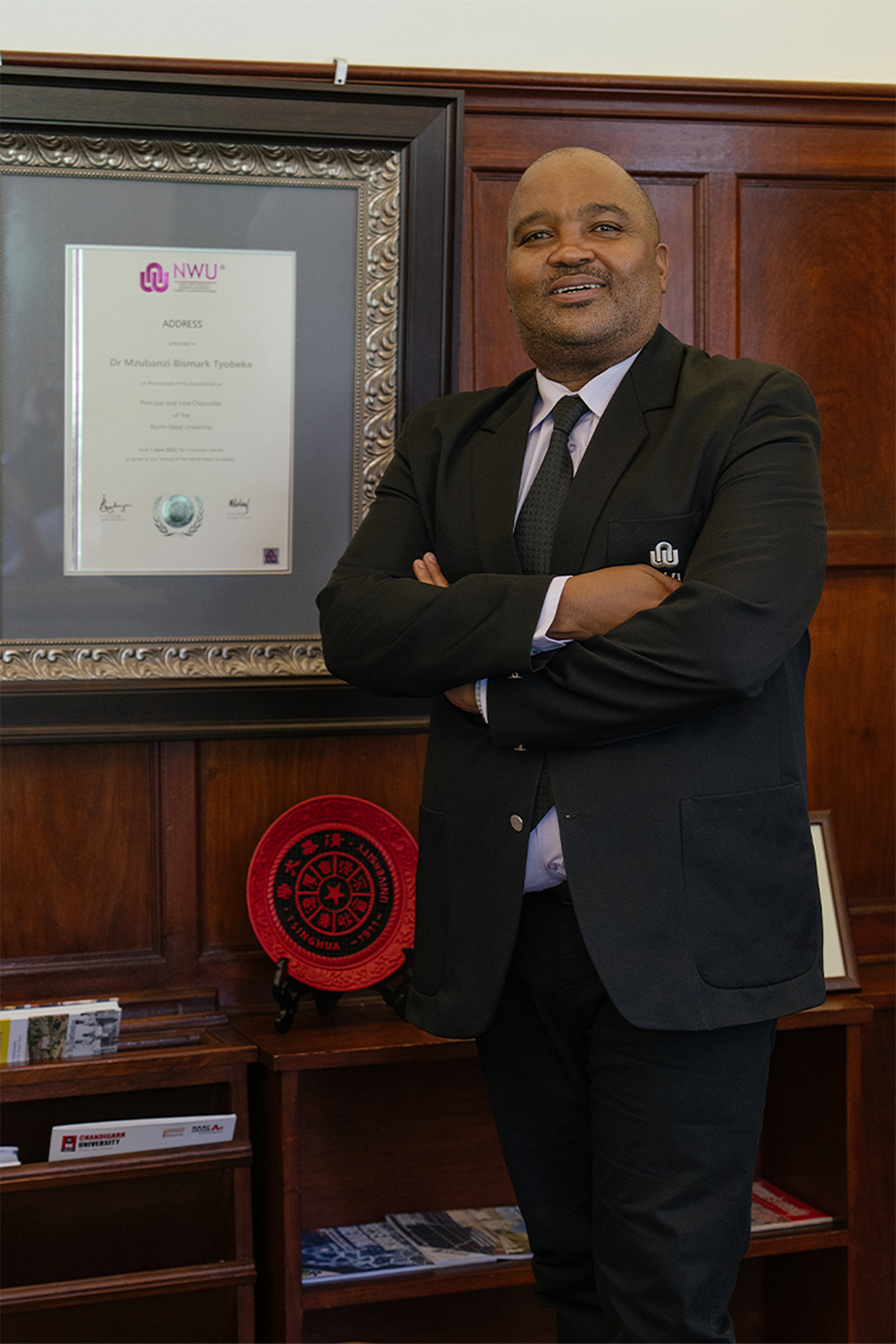
By Prof. Bismark Tyobeka, principal and vice-chancellor of the North-West University (NWU).