
Sesotho scholars from universities across Southern Africa gathered at the Riverside Hotel in Vanderbijlpark for a colloquium exploring how the language can be strengthened in education, research, technology and the digital space.
The colloquium brought together academics and researchers from the North-West University (NWU), the University of the Free State (UFS), UNISA, the University of Lesotho and other institutions to share research and discuss the future of Sesotho and other indigenous languages in knowledge production.
Andiswa Msi, campus chief director at the NWU’s Vanderbijlpark Campus, welcomed delegates, emphasising the close relationship between language, identity and history.
“We are not only celebrating history – we are celebrating identity. Language comes with people’s stories, and at the NWU we appreciate multilingualism,” she said.
Prof. Adri Breed, director of the School of Languages, delivered a message, and Linda Thekiso, a Sesotho lecturer, delivered the messages of support on behalf of Prof. Dumi Moyo, executive dean of the Faculty of Humanities and the deputy dean for research and innovation, Prof. Mirna Nel.
Dr Keaobaka Seshoka, CEO of the Pan South African Language Board and the keynote speaker on the first day of the colloquium, challenged Sesotho speakers to take ownership of the language’s digital future by producing more content in Sesotho, particularly on social media.
“Sesotho must not be the language of the past, but a language of the future. It must not only be the language of traditional ceremonies, poetry or the kitchen. It has a place in business and boardrooms,” she said.
Dr Seshoka also called for more Sesotho data to be generated to support the development of artificial intelligence (AI) in African languages.
“We need to teach AI Sesotho and leave a digital footprint. We need to start feeding the algorithms by writing in Sesotho,” she said.
Prof. Jeffrey Mphahlele, NWU deputy vice-chancellor for research and innovation, community engagement and postgraduate studies with the assigned function of the Vanderbijlpark Campus, highlighted AI as an opportunity to accelerate the development of Sesotho and ensure that it can compete with other languages in the digital environment.
He said the NWU had already embraced its language policy framework, but stressed that universities could not develop indigenous languages in isolation.
“We need community collaboration – not only the university community, but the communities that speak the language. This is the space where we need to focus our attention,” he said.
Prof. Mpho Chaka, chief director for teaching and learning at the NWU, said universities should create spaces where students and academics feel that their languages belong.
“Your language belongs here. This is what inclusion means,” he said, calling on delegates to ensure that indigenous languages become languages of service, technology, innovation and research.
The academic programme also showcased research covering a wide range of issues affecting Sesotho and indigenous-language scholarship.
Dr Naledi Filita examined teachers’ competence in integrating technology into the teaching and learning of Sesotho. Linda Lucia Thekiso and Dr Tsietsi Mahlasela explored the use of references in Sesotho research documents as a research method in indigenous-language education, highlighting the importance of incorporating indigenous approaches and knowledge system.
One of the hights was a presentation by Lintle Lydia Mosola from the UFS who used lesokoana (a traditional Basotho game and churning stick) as a visual participatory methodology to study and support education for visually-impaired learners.
Other presentations explored Sesotho expressions relating to time, gender stereotypes in the song Kooko, traditional Basotho games and the changing use of Sesotho on social media.
Researchers also examined mother-tongue education and the challenges faced by language and literature students at a public high school in Lesotho.
Chairperson of the LOC Lebona Mafisa said the discussions highlighted that the future of Sesotho depends on more than preserving its cultural heritage. The language must also be developed as a language of teaching, research, business, technology and innovation.
“The colloquium provided an important platform for scholars from South Africa and Lesotho to exchange ideas, share research and strengthen collaboration around Sesotho and indigenous-language scholarship,” he said.
He added that the gathering also positioned the Vaal region as a space for meaningful conversations about the future of African languages in higher education and the digital age.
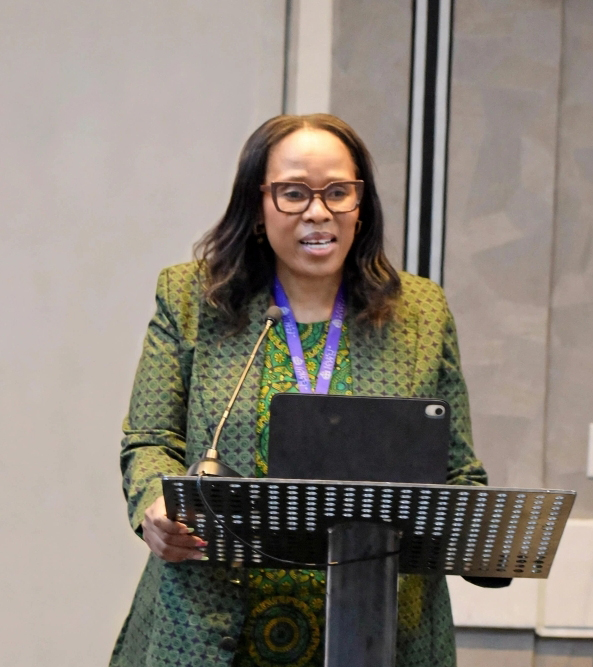
Andiswa Msi, campus chief director at the NWU’s Vanderbijlpark Campus, welcomes delegates at the colloquium.


