
How can research help improve healthcare? This question was at the heart of the 2026 Sedibeng District Research Conference, held on 2 October at the North-West University’s (NWU’s) Vanderbijlpark Campus.
Hosted by Sedibeng District Health Services in collaboration with the NWU’s Faculty of Health Sciences, the conference brought together healthcare professionals, researchers and academics to share findings and discuss ways to improve patient care.
The district hosted its research event independently for 13 years before the NWU joined as a co-host in 2025. This was the second year that the two institutions worked together to host the conference.
Prof. Jeffrey Mphahlele, the deputy vice-chancellor for research and innovation, community engagement, postgraduate studies with the assigned function of the Vanderbijlpark Campus, welcomed delegates and highlighted the importance of connecting research with healthcare practice.
Siyabonga Jikwana, acting chief director of Sedibeng District Health, followed with a message of support.
Putting people and better care first
The first keynote speaker, Prof. Laurel Baldwin-Ragaven, addressed the need to overcome divisions in healthcare in her presentation, “Daring to disrupt: the courage to overcome fragmentation and deliver the care we need”.
A physician, educator, researcher and social justice advocate, Prof. Baldwin-Ragaven previously served as clinical head of family medicine for all four Southern Gauteng districts in the Gauteng Department of Health. She is now a professor of Family Medicine at the University of the Witwatersrand’s Faculty of Health Sciences. Her research includes health and human rights, gender-based violence, migrant health and professional ethics.
She highlighted the need for stronger teamwork and better coordination, explaining: “We cannot policy-write, report-compile, or SOP our way into continuity. True care coordination isn't achieved by giving clinicians more paperwork to prove that they are coordinating. It is achieved by building trusting, motivated, and collaborative teams.”
Her message was that better healthcare depends on healthcare professionals working together, building trust and providing coordinated care rather than relying on more policies and paperwork.
The second keynote speaker, Dr Kathleen Froneman, focused on the role of nursing education in preparing students to provide compassionate, patient-centred care. Her presentation, “Transforming Nursing Education through Presence and Reflective Practice: A Model for Nurse Educators”, explored how educators can model the behaviours and attitudes expected of future nurses.
“Who are best to model present behaviours to your students that they can go and apply in practice, because at the end of the day, we all have the same goal in mind, quality patient care. It's all about the patient,” she said.
Dr Froneman is a senior lecturer and postgraduate programme leader in the NWU’s School of Nursing. Her work focuses on nursing education, student engagement and innovative teaching methods. She also leads the DREAM Guideline initiative, which promotes dedication, respectful relationships, a supportive environment, the art of healthcare, a positive attitude, advocacy and motivation.
Her presentation highlighted how educators can help shape future nurses by demonstrating the compassion, attentiveness and commitment to patients they want their students to practise.
Research that speaks to real challenges
The conference programme featured three research tracks covering key healthcare challenges.
The first explored health professions education, ethics and professional practice, with topics including medication-error reporting, pharmacist intern assessments, care for neurodiverse children in hospitals and cultural competence among nursing students.
The second focused on mental health, fairness and culturally sensitive care. Presentations examined mental health support for preschool children, the experiences of families affected by suicide attempts, mental health stigma among black university students and the experiences of HIV-positive men attending a public men’s clinic in Evaton.
The third addressed healthcare quality and patient-centred services. Research covered respectful maternity care, challenges in maternal healthcare, the role of occupational therapists in primary healthcare and medication adherence among people experiencing homelessness and mental illness.
Three workshops complemented the research presentations. They explored teamwork and inclusive care through the DREAM Guideline, compassion in maternity services, and gaps in South Africa’s 2017 breast cancer screening, prevention and management policy.
The NWU supported the event by providing the venue and institutional assistance. The university’s NuMIQ research entity helped promote the call for abstracts, encourage participation and provide research interns to assist with preparations. Prof. Awie Kotzé, executive dean of the Faculty of Health Sciences, also provided financial support.
The conference also benefited from the participation of NWU exhibitors, including the Optentia research unit, Library and Information Service, and NuMIQ. Their contributions were valuable in supporting knowledge sharing and guiding emerging researchers in accessing resources and exploring opportunities to strengthen their research.
The conference highlighted the value of research that responds to real challenges faced by patients and communities. By bringing healthcare professionals and researchers together, the event created an opportunity to share knowledge and explore practical ways to strengthen patient safety, mental health support, nursing education and compassionate care.
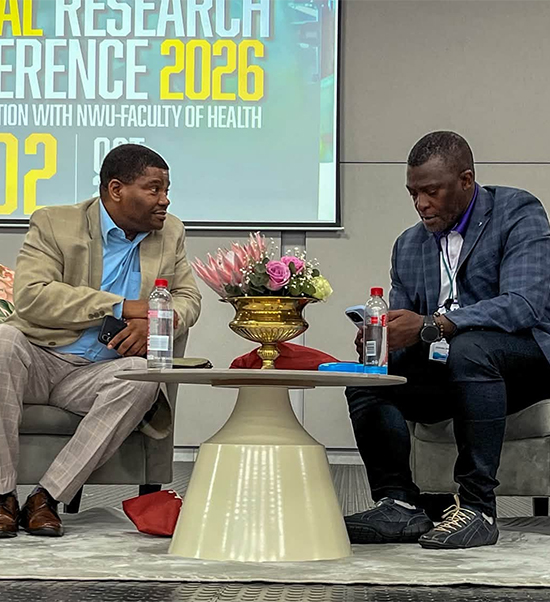
Prof. Jeffrey Mphahlele and Siyabonga Jikwana
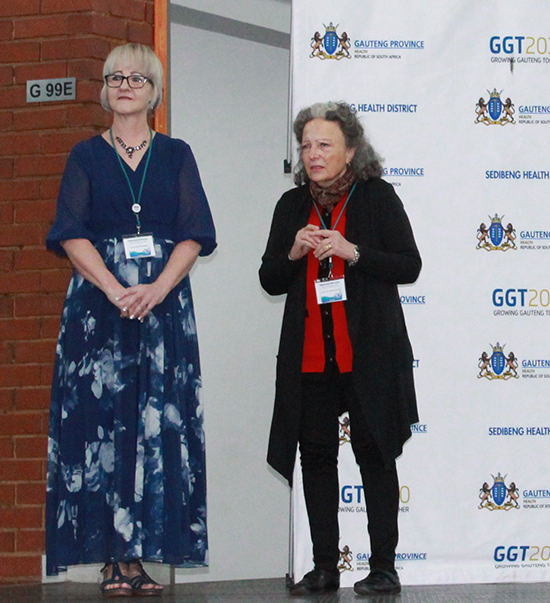
Dr Kathleen Froneman and Prof. Laurel Baldwin-Ragaven


