
Final-year Safety Management students from the North-West University’s (NWU’s) Vanderbijlpark Campus recently participated in an immersive practical learning experience at the NWU’s Potchefstroom Campus as part of the BSMN 311: Managing Safety Incidents module.
The educational visit forms part of the NWU’s commitment to experiential learning, equipping students with industry-relevant skills and practical exposure that prepare them for the realities of the workplace.
The programme was facilitated under the leadership of Leslie Barends, director of Safety, Health and Environment, who designed an interactive experience aimed at bridging the gap between classroom theory and real-world practice.
During the visit, students were exposed to a variety of workplace environments and safety scenarios. Activities included observing chipper operations and incident overviews, conducting process and risk assessments in engineering environments, exploring workshop safety procedures involving machinery and hazards and gaining insight into laboratory safety and the handling of hazardous chemicals.
According to Reagile Raditsela, junior lecturer in Business and Safety Management at the Faculty of Economic and Management Sciences, practical learning plays a critical role in developing future-ready safety professionals.
"Practical learning brings theory to life. In a module like Managing Safety Incidents, students need to develop the ability to think critically, interpret situations and make informed decisions–best developed through experience, not theory alone," she said.
Reagile explained that the visit exposed students to the complexity of real workplace environments, where hazards are not always immediately visible and where safety decisions require both technical knowledge and critical thinking.
"It is essential for final-year students to be exposed to practical safety incident management before entering the workplace. It helps build confidence, competence and a clearer understanding of professional expectations," she added.
The experience also left a lasting impression on students, many of whom described the visit as both educational and inspiring.
Nokuthula Mbonani said the site visit strengthened her understanding of workplace safety through practical observation.
"My on-site experience during the Potchefstroom visit was very informative and practical. It gave me a chance to see how safety procedures are applied in a real environment. I found it interesting and helpful because it improved my understanding of workplace safety," she said.
For Swazi Mphasane, the opportunity to move beyond the classroom and observe real-life safety environments was particularly valuable.
"It was a great and tiring experience, but I enjoyed seeing the campus and observing the different sites. Walking around and conducting site observations is key to gaining practical insight into workplace hazards and risks. It gave me a practical perspective; what I learnt in class was shown, not just read," she said.
Kamogelo Mamafa highlighted the importance of proactive safety management, saying the visit reinforced concepts covered in class.
"This experience reinforced the concepts learned in class by showing how they occur in real-life situations and how safety is more of a proactive approach than a reactive one. It has motivated me to approach my future career with a stronger focus on practical application while continuously developing my skills and remaining adaptable in different safety environments," Kamogelo said.
Njabulo Nkosi said the experience broadened his career aspirations and inspired him to continue learning across different industries.
"I now have an interest in travelling to more places to inspect, learn and not only work as a safety practitioner, but become a master of many career paths where I can ensure safety within those spaces while expanding my knowledge," he said.
Reagile noted that initiatives such as the Potchefstroom visit align closely with industry expectations, as employers increasingly seek graduates who can apply their knowledge in practical settings from the outset of their careers.
Throughout the programme, students demonstrated high levels of engagement by actively participating in discussions, asking insightful questions and linking classroom concepts to practical observations.
"The experience aimed to develop critical thinking, observation, problem-solving and the ability to apply safety principles in real-world contexts. These are all important competencies within the safety profession," Reagile said.
She further acknowledged the contribution of the broader NWU team to making the visit a success.
"Experiences like these remind us that impactful learning is often the result of meaningful collaboration and the willingness of professionals to invest in student development," she concluded.
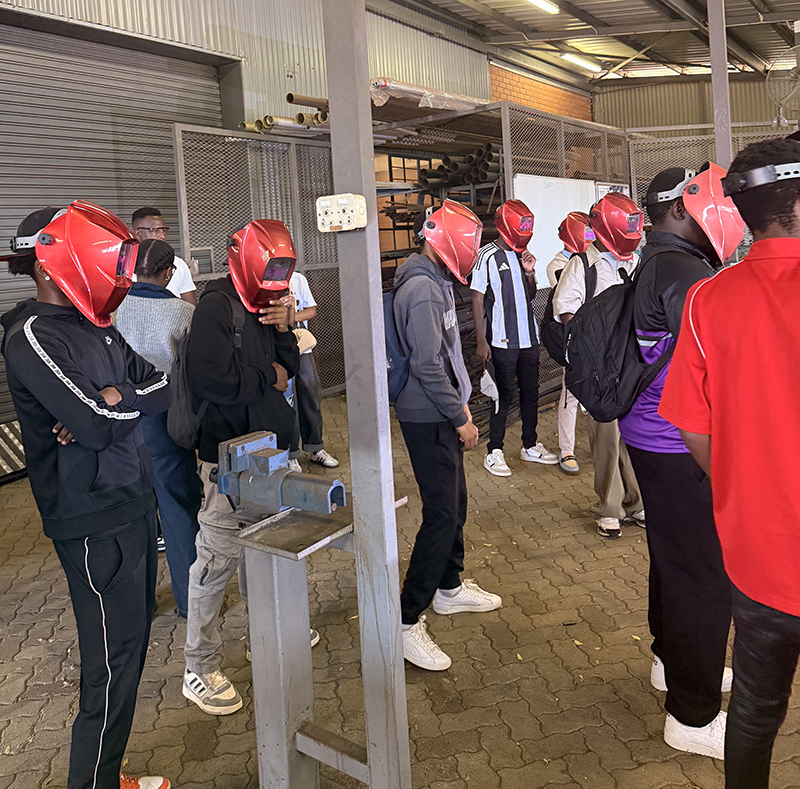
Final-year Safety Management students from the Vanderbijlpark Campus participate in an immersive practical learning experience at the Potchefstroom Campus.


