
Science came alive long after the classroom bell had rung as educators, learners and community members gathered at Hoërskool Wolmaransstad for a Pre-Vice-Chancellor's Science Day programme that combined robotics, astronomy and hands-on learning.
The activities formed part of the build-up to the North-West University's (NWU's) 2026 Vice-Chancellor's Science Day, which is held under the theme "Science, technology and innovation are for everyone".
The afternoon programme began with a coding and robotics workshop for educators, aimed at strengthening the teaching of coding and robotics in schools. Participants received practical training in Scratch programming, LEGO robotics and robot movement, including forward and backward motion, turning techniques and problem-solving exercises. The workshop concluded with a reflection session on how these skills could be integrated into classroom teaching.
The workshop builds on the NWU Science Centre's ongoing efforts to equip teachers with practical skills in coding and robotics. Through the Vice-Chancellor's Science Day outreach programme, the university continues to support educators with skills that encourage critical thinking, creativity and problem-solving, helping to strengthen science, technology, engineering and mathematics (STEM) education in schools.
As the sun set, the focus shifted from robotics to astronomy. Prof. Thebe Medupe, deputy dean for teaching and learning in the Faculty of Natural and Agricultural Sciences, captivated the audience with his presentation, "The sky tonight", introducing participants to the constellations and celestial objects visible above Wolmaransstad.
He was followed by Prof. Don Kurtz, an A1-rated National Research Foundation researcher and extraordinary professor of Astrophysics at the NWU, who presented "Artemis – back to the Moon". He explained how NASA's Artemis programme is laying the foundation for humanity's return to the Moon while preparing for future exploration beyond Earth's natural satellite.
"Unlike the Apollo missions, Artemis aims to establish a sustained human presence on the Moon while testing technologies needed for future missions to Mars. The programme combines scientific exploration with international collaboration and will enable researchers to study the Moon's geology, search for water ice at the lunar south pole and develop technologies for long-duration space exploration," said Prof. Kurtz.
The evening concluded with telescopic stargazing, allowing participants to observe some of the celestial objects discussed during the presentations. For many attendees it was their first opportunity to view the Moon, planets and stars through a telescope, transforming the evening's scientific discussions into a practical experience.
The Pre-Science Day programme reflects the broader objectives of the NWU Vice-Chancellor's Science Day, one of the university's flagship science outreach initiatives. Since its launch, the programme has travelled to communities across the North West and Northern Cape, bringing researchers, educators and industry partners together to inspire young people to pursue careers in STEM.
By combining practical robotics training with astronomy and space science, the university continues to demonstrate that science is accessible, relevant and open to everyone.
Photo captions:
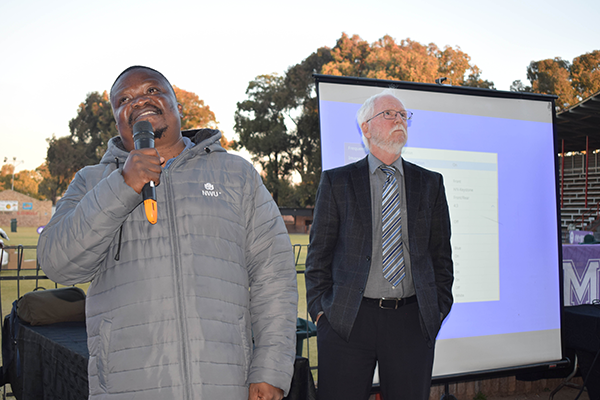
Prof. Thebe Medupe, deputy dean for teaching and learning in the Faculty of Natural and Agricultural Sciences, with Prof. Don Kurtz, an A1-rated National Research Foundation researcher and extraordinary professor of Astrophysics
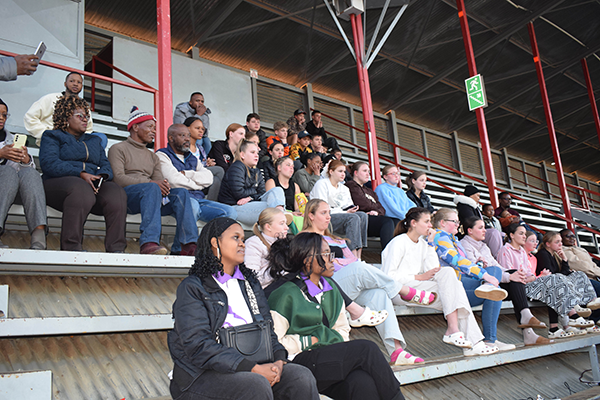
Attendees of the astronomy lecture
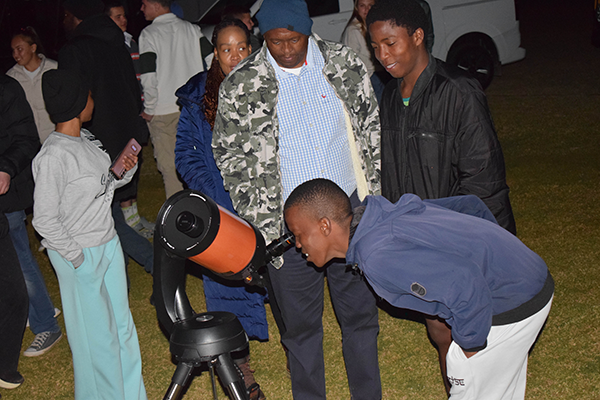
Sky-viewing during the Pre-Vice-Chancellor's Science Day programme
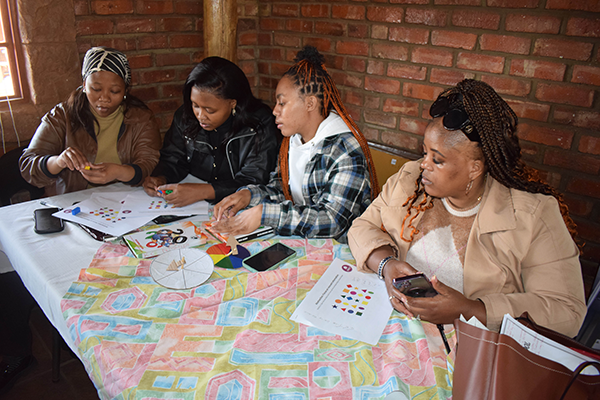
Educators during the robotics workshop


