
The North-West University (NWU) continues to advance community-engaged scholarship through a compelling historical documentation project led by Dr Mojuta Motlhamme, a History Education lecturer in the Faculty of Education at the Mahikeng Campus.
His work focuses on preserving and sharing the rich heritage of the Barolong boo Ratshidi, a prominent Setswana-speaking community rooted in the Mahikeng region.
Titled “Namane ya Tholo: The Jubilee Story of Kgosi Jeffrey Kgotleng Montshiwa of the Barolong Boora Tshidi – 25 Years of Chieftainship (2001–2026)”, the project commemorates the 25-year leadership of Kgosikgolo Jeffrey Kgotleng a Kebalepile II a Lotlamoreng I am Montshiwa a Tau II a Leshomo a Tshidi a Tau I. It is both a scholarly and community-driven initiative that brings together oral histories, archival research and lived experiences.
A story inspired by leadership and trust
Dr Motlhamme explains that the project was inspired by the jubilee milestone of Kgosi Kgotleng Montshiwa, as well as the openness and trust extended to him by the Barolong community.
“This is an ongoing 2026 project that has already yielded close to 20 interviews, site visits and archival materials,” Dr Motlhamme says. “The humility and willingness of the Barolong people to share their private and communal histories have been deeply inspiring.”
Bridging scholarship and community
With an academic background in Setswana historical studies, Dr Motlhamme brings both scholarly depth and cultural sensitivity to the project. His previous research on figures and cultural movements such as Onkgopotse Tiro, the Diturupa Carnival and Lucas Mangope has taken him across diverse communities, shaping his understanding of the Setswana cultural imagination.
Having been raised in the multicultural township of Alexandra, he notes that his personal experiences have instilled a deep appreciation for diversity as an essential lens when documenting the varied histories, dialects and traditions of Batswana communities.
Understanding the Barolong boo Ratshidi
The Barolong boo Ratshidi are part of the broader Barolong nation of Southern Africa, with historical roots linked to the descendants of Kgosi Tau. Today, they are primarily located in Mahikeng and parts of Botswana, particularly Goodhope.
Their history is closely intertwined with significant regional developments, including the South African War (1899 to 1902), the founding of Mahikeng and the region’s role as a political and administrative hub during different historical periods, from the Bechuanaland Protectorate, Bophuthatswana to democratic South Africa.
Preserving indigenous knowledge
Dr Motlhamme emphasises the importance of documenting indigenous histories, particularly for rural communities like the Barolong boo Ratshidi.
“Their story reflects resilience, adaptability and a powerful relationship with land and identity,” he explains. “They show us how tradition and modernity can coexist, and how cultural identity can remain intact despite historical disruptions.”
The name “Mahikeng”, which is derived from the Setswana word for “place of rocks”, illustrates the deep indigenous knowledge and spiritual connection the community has with its environment.
Research rooted in community voices
The project relies heavily on oral interviews, supported by archival materials from institutions such as the Mahikeng Mail archives, the North West Provincial Archives and private collections held by the Barolong community.
Elders and community members have played a central role, contributing oral testimonies, photographs and cultural artefacts. Their guidance has been instrumental in interpreting indigenous knowledge systems and cultural practices.
Discoveries and complex histories
Among the key insights from the research is a deeper understanding of the Barolong royal family structure, which comprises nine houses, collectively forming the royal lineage (Barwa Tawana).
The project also traces the journey of Kgosi Kgotleng Montshiwa from his early life in Mahikeng to his time in Botswana during the 1970s, and his eventual return to assume leadership in the early 2000s. It further explores complex historical issues, including land disputes during the Bophuthatswana era and chiefly succession disputes within the community.
Challenges in documenting history
Like many community-based research projects, the initiative has faced challenges. These include limited access to participants due to demanding schedules, reluctance to discuss sensitive historical events, and logistical difficulties in reaching contributors based in Botswana.
Dr Motlhamme also highlights the need for a centralised archive for the Barolong boo Ratshidi to support future research and preservation efforts.
The role of the NWU
The project is supported by the NWU as part of its commitment to community engagement and socially responsive research. Through his role as a lecturer in the Faculty of Education, Dr Motlhamme envisions expanding the project into a service-learning initiative, allowing students to collaborate with the Barolong royal house.
“It is not enough to conduct research; it must benefit the community,” he says. “This project reflects the commitment of the NWU to ethical engagement and mutual value creation.”
Inspiring future generations
A key objective of the booklet is to inspire younger generations, particularly within the Barolong community, to take pride in their heritage and actively participate in preserving it.
Dr Motlhamme encourages young people to document their own local histories, promote cultural tourism and contribute to new digital archives through platforms such as social media.
Towards broader scholarship
Looking ahead, the booklet forms part of a larger research vision to document the histories of all four Barolong polities, Ratlou, Ratshidi, Seleka and Rapulana, and to integrate these narratives into academic curricula and alternative learning platforms.
Dr Motlhamme also plans to explore the history of female dikgosi in Setswana-speaking communities, further expanding the scope of indigenous historical scholarship.
A rewarding journey
Reflecting on the journey thus far, Dr Motlhamme describes the experience as both professionally and personally enriching.
“Building relationships with the community, engaging directly with Kgosi Montshiwa and earning the trust of the Barolong people have been the most rewarding aspects,” he says. “This project is not just about history, but it is about connection, identity and shared knowledge.”
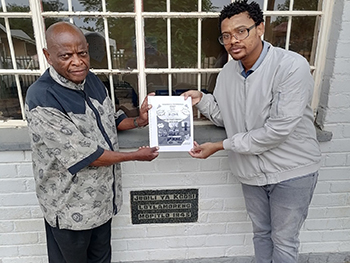
Kgosi Kgotleng a Kebalepile II Montshiwa of the Barolong Boora Tshidi and Dr Mojuta Motlhamme holds a booklet about Stadt Primary._
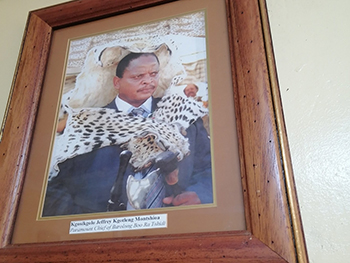
A Portrait of Kgosikgolo Kgotleng a Kebalepile II Montshiwa at the Tshidi Barolong royal offices
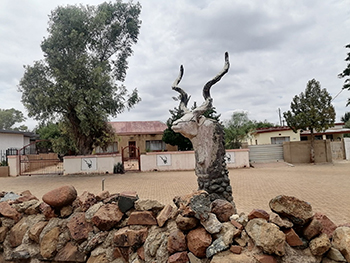
Tholo (Kudu) Morolong - the royal totem animal of the Barolong Boora Tshidi


