
An educational game inspired by a mother's experience with her two sons has crossed the borders of South Africa for the first time.
Dr Moleboheng Mokhele, an academic at the North-West University (NWU), formally launched Renewable Rangers in Eswatini during the fourth International Conference on Education at the University of Eswatini. The launch marked a new stage for an innovation that started at home and grew through research, classroom testing and university support.
For Dr Mokhele, the journey began with her sons, Wavhudi and Rivhavhudi, while the family was living in the United Arab Emirates.
“Renewable Rangers began as something quietly personal, a way of helping my sons stay rooted in their South African identity while we were far from home,” she says.
Her sons experienced a speech delay. This changed how Dr Mokhele viewed learning and later influenced her research into early childhood science, technology, engineering and mathematics (STEM) education.
“It taught me to look at learning differently, and to recognise the knowledge that mothers carry quietly, long before it is ever written down in a textbook.”
Dr Mokhele trained as a microbiologist, but motherhood led her towards early childhood STEM education.
“Motherhood rewrote that trajectory entirely,” she says. “Look at me now, an innovator of educational games.”
Her experiences also inform a book she is writing, What a Mother Knows: Grounding Early Childhood STEM Education in African Context(s). The book explores how STEM education can start with children's families, communities and lived experiences.
The launch in Eswatini provided an opportunity to take that thinking beyond South Africa. The NWU already has relationships in the country, including links with the Eswatini Schools Sports Association and the Ministry of Education and Training.
Dr Mokhele says the conference theme of innovation, inclusion and sustainability also matched the purpose of Renewable Rangers.
The game uses storytelling, movement and hands-on activities to help young children understand subjects such as renewable energy.
“You do not need to be a scientist or an engineer to innovate,” Dr Mokhele told teachers at the conference. “You simply need to understand your learners and be willing to try something new.”
Before its international launch, Renewable Rangers was piloted with 24 Grade R learners in two South African classrooms. The pilot showed that children could identify renewable energy sources and explain some of their uses.
Some learners could also make links between natural resources, electricity and people's needs. Teachers reported that the game fitted into Grade R teaching and encouraged children to learn through play.
“This is not a game designed simply to occupy children, but one grounded in research and educational purpose,” Dr Mokhele says.
She adds that the approach does not depend on costly equipment.
“A carpet, a story, and a teacher willing to create space for exploration is all it takes.”
The Eswatini launch has also opened discussions about the next stage of the project. Dr Mokhele is developing a digital version inspired by Minecraft: Education Edition. The plan is to work with partners in different African countries so that learners can explore problems relevant to their own communities.
The section on South Africa will focus on load-shedding, while the Eswatini chapter is expected to explore unemployment. Other themes could include water, food security, flooding and climate resilience.
The aim, Dr Mokhele says, is “not to hand them an answer, but to give them something worth solving.”
While the digital version could reach several African countries, the physical tabletop game will remain rooted in South African experiences.
“I want children on that carpet to recognise their own communities, cultures and challenges in the game,” she says.
Dr Mokhele is also taking Renewable Rangers from research into business. She is the CEO of Warinova (Pty) Ltd, which is commercialising the innovation after the NWU licensed the intellectual property to her.
She credits the Support for Teaching and Learning funding from the NWU for helping her develop and test the concept. She also acknowledges support from the office of the vice-chancellor, the Faculty of Education, the Research Unit for Self-Directed Learning, the Technology Transfer and Innovation Support office and her colleagues and mentors.
During the Eswatini launch, she was supported by her NWU colleagues, Letlotlo Lebeko from the office of the vice-chancellor and Jabu Sithole, manager for activations and sponsorships.
Her next goal is to introduce Renewable Rangers to schools in Ikageng, Potchefstroom. She believes this could strengthen cooperation between the NWU and the North West Department of Education and take the innovation directly to local classrooms.
For Dr Mokhele, the journey shows that innovation does not always begin with a fully developed plan.
“Sometimes it starts with a problem, sometimes with a child, sometimes with an idea you are not even sure will work,” she says.
She believes the lesson is to have “the courage to begin before you have every answer, and the humility to keep learning as you go.”
Photo captions:
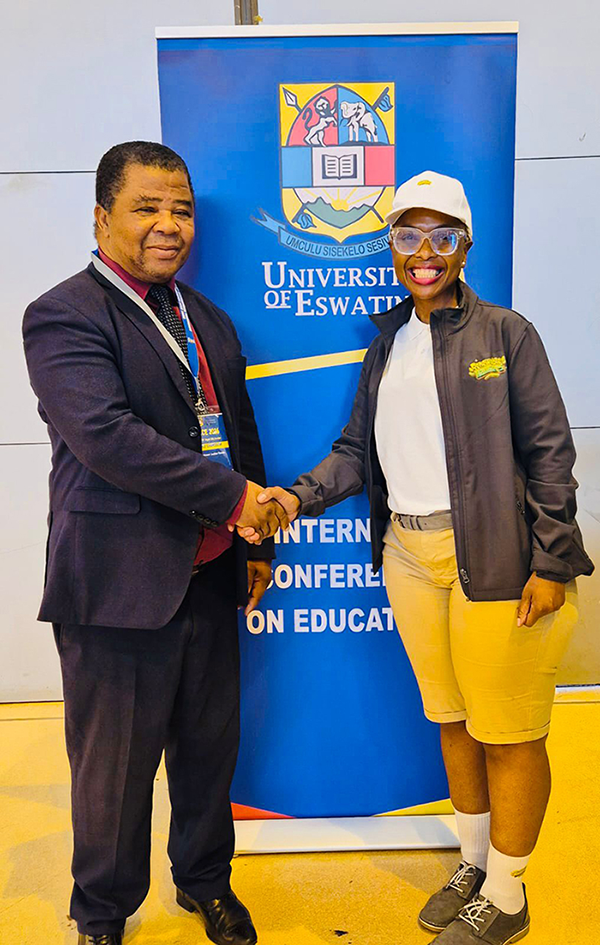
Dr Moleboheng Mokhele with Prof. Justice Thwala, vice-chancellor of the University of Eswatini, at the launch of the Renewable Rangers Educational Carpet Game.
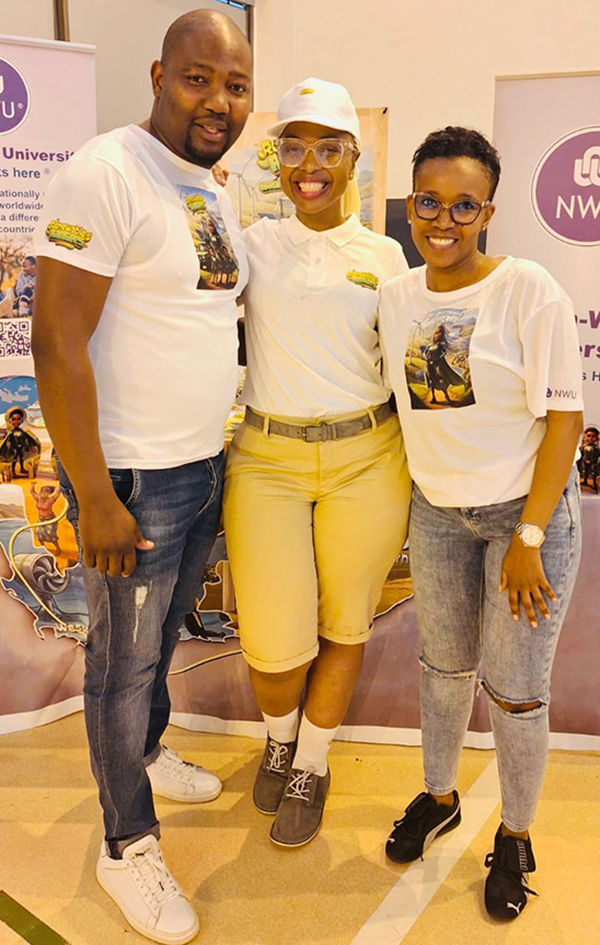
From left are Jabu Sithole, manager for activations and sponsorships, Dr Mokhele, and Letlotlo Lebeko, executive assistant to the Director: Strategy and Strategic Projects in the office of the vice-chancellor.
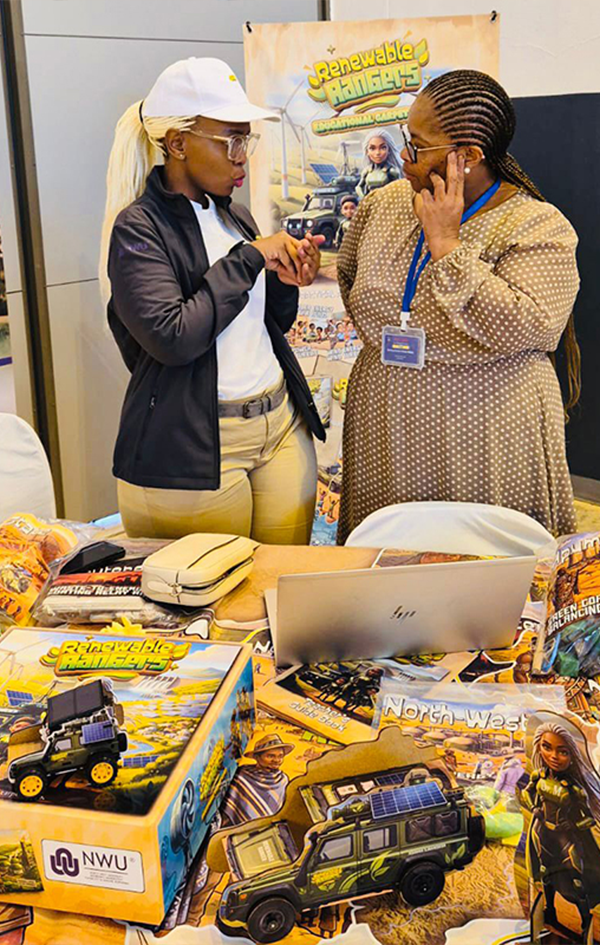
Dr Mokhele and Nomsa Kubheka-Mohosho, a lecturer in the Faculty of Education.


