
Shedding light on a subject is usually positive, but when it comes to the stars, the North-West University (NWU) is giving scientists a clearer view of the night sky by moving its 20-inch optical telescope off the bustling, light-polluted Mahikeng Campus.
The Mahikeng Astronomy Observatory (MAO) 20-inch optical telescope has moved from the fast-developing Mahikeng Campus to the university’s Molelwane Farm, where there is much less light pollution.
“The new buildings on the campus come with lots of light pollution, which makes it harder to do research, especially on fainter stars, exoplanets and minor planets,” said the Prof. Thebe Medupe, an astrophysicist known for his research on pulsating stars.
The new site gives researchers access to improved technology with a modern mount allowing for accurate pointing and stable tracking. The telescope’s fast, wide-field camera can capture an area of the sky about the size of the Moon in one image.
Small but powerful
Prof. Medupe said the telescope may not be large, but it is a research-grade instrument.
“The telescope will mainly be used for postgraduate student research in the physics department and for research by staff members,” he said.
Scientists at the facility, which forms part of the NWU’s Centre for Space Research, will focus on three main research areas.
The first involves pulsating stars. Researchers will study seismic waves inside these stars to understand their internal structure. They can also attach a spectrograph to study the chemical make-up of stars and measure their movement.
The second area is exoplanet research, the study of planets orbiting stars beyond our Sun. The telescope can conduct follow-up studies of known exoplanets and could help discover new ones.
For Prof. Medupe, this research addresses a question that extends beyond astronomy. “We want to know how common life-friendly, or habitable, planets are in our solar neighbourhood, our galaxy and the universe as a whole,” he said. “Are we alone in the universe?”
A third research area will focus on minor planets. The telescope can track and study asteroids, dwarf planets, trans-Neptunian objects and comets. The findings could contribute to the International Astronomical Union’s Minor Planet Center.
The NWU also plans to join international telescope networks. It hopes to support follow-up observations of discoveries made by the Vera C. Rubin Observatory in Chile. This could connect NWU students and researchers with collaborators in the United States, Chile and elsewhere.
Upgrades were a collaborative effort
The Molelwane Farm upgrades were years in the making and involved internal and external role players.
The Faculty of Natural and Agricultural Sciences instrument-making workshop designed and built the telescope dome while the Department of Science, Technology and Innovation, National Research Foundation and the faculty provided financial support for the project over the past five years.
The facility, which runs on solar power, forms part of the Centre for Space Research and the physics group at the Mahikeng Campus. It will increase the university’s capacity to supervise MSc and PhD students at both the Mahikeng and Potchefstroom campuses.
Schools will also be able to access the telescope online when it is not being used for research. The 16-inch telescope at the Mahikeng Campus will remain available for school visits, community outreach and stargazing.
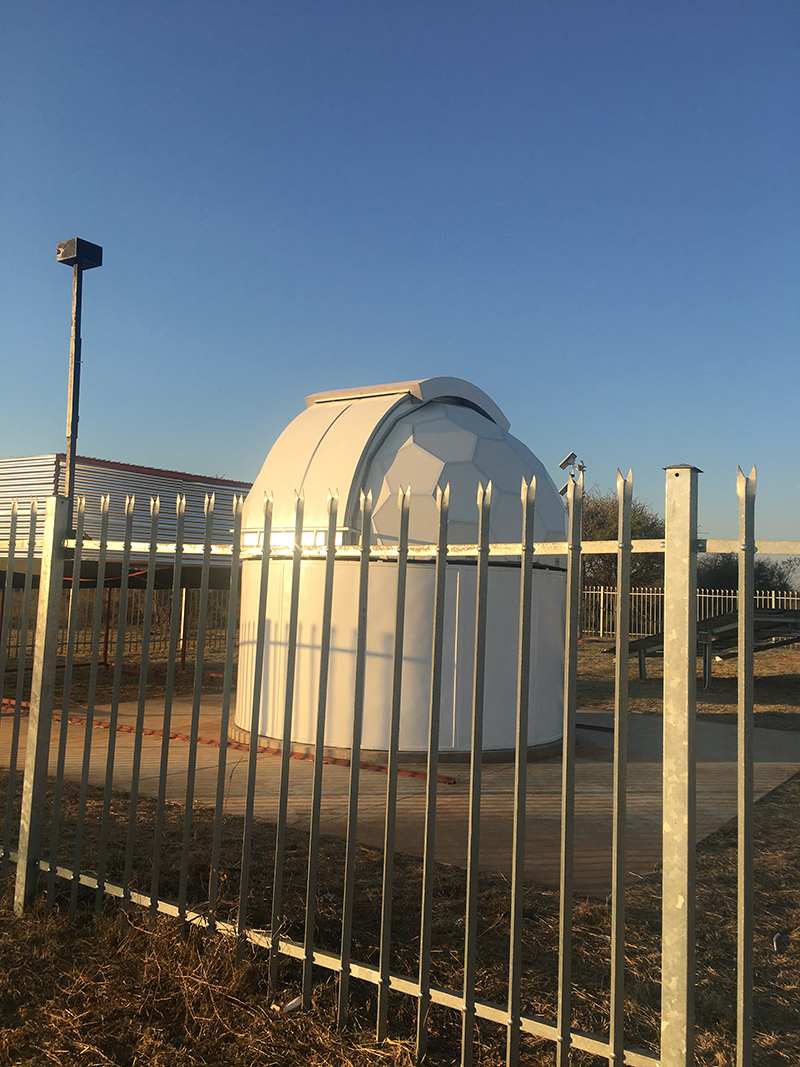
Photo: The Mahikeng Astronomy Observatory 20-inch optical telescope has moved to the university’s Molelwane Farm, where there is much less light pollution.


