
- The Centre for Digital Humanities was born out of the realisation that the humanities are central to creating equitable digital futures for South Africans.
- “As digital humanists, we understand that technology exists within a network of human and more-than-human relationships,” says Prof. Janelize Morelli.
- “True digital transformation must be accompanied by cultural democracy, where our citizens are empowered to fully participate in the digital economy as producers, not merely consumers, of culture.”
The digital age, for all its promise of efficiency and connection, often forgets the human element that gives technology meaning. At the North-West University (NWU), Prof. Janelize Morelli and her team is working to change that. As director of the Faculty of Humanities’ Centre for Digital Humanities (CDH), she believes that South Africa’s digital future must begin with people, stories, and ethics, not machines.
“The Centre for Digital Humanities was born out of the realisation that the humanities are central to creating equitable digital futures for South Africans,” she explains.
“It stands to reason that the Faculty of Humanities at the NWU should play a decisive role in South Africa’s digital transformation.” For her, technology is never neutral.
“As digital humanists, we understand that technology exists within a network of human and more-than-human relationships. To truly understand and create the technologies we need for the Africa we want, we must ensure that the human and social sciences remain integral to the conversation.”
This vision requires reimagining what it means to be both humanist and digital. The centre’s work is not about gadgets or code for their own sake, but about using digital tools to empower communities, preserve heritage and expand opportunity. “Scholars in the human and social sciences need to continue developing their digital skills to ensure their teaching, learning and research remain relevant and impactful,” she says.
At the heart of this work is a conviction that communities themselves must lead the process. “We believe in the power of grassroots movements,” Prof. Morelli says. “Our initial projects are focused on empowering community members to strengthen digital heritage practices.” The centre has embraced what she calls “a public humanities approach”, one that prizes accessibility and modesty over grandeur.
“We emphasise shoestring digital humanities projects. This means leveraging mobile devices, which we know are the primary way most South Africans access the internet, to drive community digitisation and curation.”
Such projects depend on partnerships as much as on technology. The centre works closely with government bodies, NGOs and stakeholders in the cultural heritage and creative sectors. “We are actively pursuing relationships to ensure that these projects create economic opportunities for community partners and students,” she adds.
Preserving cultural stories in a digital form raises delicate ethical questions about ownership and representation. “Conversations around equitable digital heritage practices are highly complex,” she notes.
“The most equitable solutions to these challenges can only be determined through strong relationships.” The CDH’s approach rests on two sets of international standards: the FAIR principles - Findable, Accessible, Interoperable, Reusable - and the CARE principles - Collective Benefit, Authority to Control, Responsibility, Ethics. “In our own work and in our training for staff in the Faculty of Humanities, we prioritise adherence to these principles,” she explains.
The centre’s workshops aim to demystify the digital for scholars and community partners alike. “We started small to ensure that everyone could jump on board. Our first workshop was on using OpenRefine to clean messy data,” she says. In its digital heritage projects, the CDH ensures that communities are active participants in designing data management plans.
“We explore various levels of openness and encourage the use of content management tools such as Mukurtu to build research structures that honour community ownership of cultural data.”
The same spirit guides the centre’s hands-on training. “We train community members practically to ensure they can leverage the power of widely available smartphones – specifically applications that work on mid-range Android phones – together with open-access or low-cost tools to engage in digitisation projects. This also means training community partners as co-researchers and, of course, acknowledging their contribution in final outputs.”
Digital transformation, for Prof. Morelli, is also a creative enterprise. One of the centre’s most imaginative initiatives, Defenders of the DH Commons, celebrates scholars across the Faculty of Humanities who already use digital methods in their work.
“We identified scholars and worked with a graphic designer and alumnus, Rizanne Diedericks, to create heroes embodying these scholars’ research focus and individual personalities,” she says. “These sketches were then transformed into comic strips and an educational game to teach postgraduate and early-career scholars about the complex ethical dilemmas at the heart of digital humanities in South Africa.”
That playfulness belies a serious purpose. The CDH’s philosophy rests on three interwoven pillars: ethical digital heritage, multimedia and transmedia storytelling, and bridging the digital divide through mobile-first capacity building. While other initiatives have focused on multilingual infrastructure and language justice, Prof. Morelli hopes the centre will expand the field’s reach by showing how digital humanities can operate across disciplines.
“We recognise the critical importance of language and place and collaborate within that broader ecosystem. What sets us apart is the integration of these pillars into a singular human-centred framework.”
The ultimate goal, she says, is to ensure that digital transformation in Africa reflects African values. “We co-design with communities, translate research into immersive cultural products, and deploy accessible toolkits in underserved communities. African epistemologies and cosmologies must be central to what we do.”
Digital change, in her view, is not a matter of technology alone. “True digital transformation must be accompanied by cultural democracy, where our citizens are empowered to fully participate in the digital economy as producers, not merely consumers, of culture.”
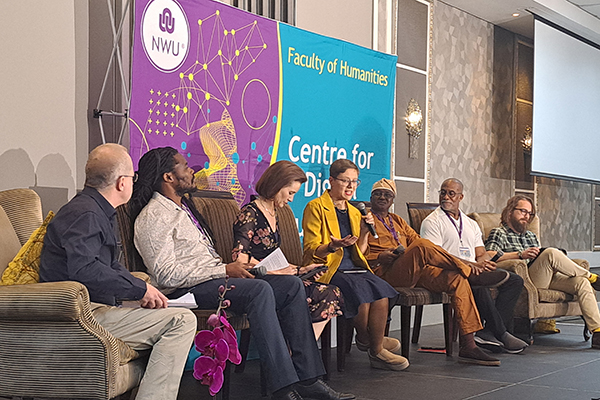
Prof. Janelize Morelli (centre with the microphone) during the launch of the Centre for Digital Humanities.


