
The future of the North-West University (NWU) was reimagined in powerful terms at the Entrepreneurship Ecosystem Indaba held at Pont de Val in Parys, where the principal and vice-chancellor, Prof. Bismark Tyobeka delivered a compelling call for the institution to position itself as a driver of innovation, job creation and economic transformation.
Against the backdrop of rising graduate unemployment, rapid technological disruption and the accelerating impact of artificial intelligence (AI), Prof. Tyobeka challenged the university to rethink its societal purpose.
He told NWU Council members, deputy vice-chancellors, student representatives and academics that universities can no longer focus solely on producing graduates for the job market. Instead, they must actively develop creators, innovators and problem-solvers equipped for a fast-changing global economy.
At the centre of his address was a bold vision: the establishment of a single, integrated NWU Entrepreneurship Ecosystem that connects fragmented initiatives across the three campuses of the university into one coordinated platform for impact.
“This ecosystem must strengthen graduate employability, accelerate enterprise creation, enhance research commercialisation and deepen the contribution of the NWU to regional economic development,” he said.
A key pillar of this vision is the proposed Innovation, Entrepreneurship and AI in Business Hub, designed to serve as a central enabler linking students, researchers, industry partners, government and communities.
The indaba was an initiative between the vice-chancellor’s office and the Faculty of Economic and Management Sciences. The event was widely regarded as a success, marking an important milestone in the journey of the NWU towards building a unified entrepreneurial culture and strengthening collaboration across faculties and campuses.
Adding a national higher-education perspective, Dr Edwell Gumbo, director of Entrepreneurship Development in Higher Education at Universities South Africa, highlighted the urgent need for universities to foster environments that enable innovation and economic participation.
“There is a shift towards economic participation in universities. We need to instil that in the minds of graduates. Universities are now called to do more,” Dr Gumbo said.
He stressed the importance of policy support, research commercialisation and building an institutional culture where entrepreneurship is a shared identity rather than a niche activity.
Reflecting on the outcome of the indaba, Prof. Herman van der Merwe, deputy dean for teaching and learning in the Faculty of Economic and Management Sciences, said the gathering had achieved its purpose of uniting diverse stakeholders around a common vision.
“The success of the Entrepreneurship Ecosystem Indaba lies in the fact that it brought together diverse voices from across the NWU to collectively reimagine the entrepreneurial future of the university. Entrepreneurship is not the responsibility of a single faculty or unit, but a shared institutional endeavour,” he said.
Throughout the discussions, delegates explored how to better connect existing initiatives, reduce fragmentation and build a more accessible and coordinated entrepreneurship ecosystem.
Dr Joe Molete, deputy vice-chancellor for student life, transformation and people and culture with the assigned function of the Mahikeng Campus, spoke about the evolving role of universities in driving regional economic growth through innovation and entrepreneurship.
“This is not the end of a conversation, but the beginning of a coordinated effort to build a vibrant entrepreneurship ecosystem that will drive innovation, enterprise development and economic impact across all our campuses and beyond,” he said.
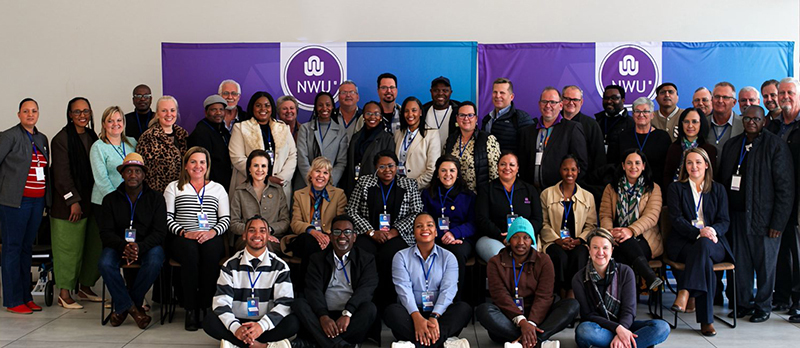
The future of the NWU was reimagined in powerful terms at the Entrepreneurship Ecosystem Indaba.


