
On Wednesday, 5 August, Prof. June Monica Palmer from the Faculty of Education at the North-West University (NWU) celebrated her professorial inauguration. The lecture highlighted Prof. Palmer’s substantial contributions to the fields of educational leadership, human rights and institutional transformation research.
In her inaugural lecture, titled “Transformative epistemic justice leadership for the future-focused university”, Prof. Palmer challenged higher-education institutions to move beyond merely transforming knowledge towards the co-creation of knowledge that is inclusive, ethical and socially responsive.
She argued that educational leadership should extend beyond organisational effectiveness to embrace human dignity, democratic participation and educational justice. Central to this vision is her proposed transformative epistemic justice leadership framework, which examines the fairness of the knowledge systems sustained by universities. The concept also aims to ensure that all voices have the opportunity to shape the production of knowledge.
Prof. Palmer outlined four dimensions that she believes should guide ethical leadership in higher education:
Contributory justice – which encourages the co-creation of knowledge with all stakeholders.
Agential justice – which promotes meaningful participation rather than mere representation.
Disruptive justice – which challenges the status quo and its structures.
Discriminatory justice – which confronts systemic bias and exclusion.
Building on this ethical framework, Prof. Palmer stated that the success of knowledge creation also depends on the environmental conditions in which it is generated. According to Prof. Palmer, universities should cultivate conditions in which recognition, legitimacy, participation and public impact enable knowledge to flourish.
“University leaders must move beyond merely managing institutional performance and become architects of epistemic environments,” she said, urging leaders to protect academic freedom while nurturing courageous dialogue across institutions.
Looking ahead, Prof. Palmer described her vision of a future-focused university as one where students and communities are active partners in knowledge creation, where technology amplifies rather than replaces humanity, and where justice and academic excellence are inseparable.
Prof. Palmer also advocated for institutional systems – including promotion pathways, funding models and research evaluation practices – that are aligned with the value of justice.
In concluding her address, Prof. Palmer emphasised the broader responsibility of higher-education institutions in shaping a more equitable society.
“Transformative epistemic justice leadership invites us to move beyond merely producing graduates and managing performance. It calls on us to become custodians of a more just knowledge society and stewards of the ethical conditions of knowing itself,” she said.
Prof. Palmer added: “May we have the wisdom to recognise contributions wherever they emerge, the courage to disrupt exclusionary practices, the commitment to restore human agency, and the determination to eliminate discrimination in all its forms. If we can do this, the future-focused university will not just survive the challenges of our time; it will help humanity to imagine and create a more just, equitable and hopeful future.”
Prof. Lloyd Conley, executive dean of the Faculty of Education, presented Prof. Palmer’s biography before conducting the robing ceremony.
In response to Prof. Palmer’s address, Prof. Darrell de Klerk, deputy director of the School of Professional Studies in Education, emphasised the importance of creating university environments in which knowledge can thrive and every voice is heard.
The Deputy Vice-Chancellor: Research and Innovation, Community Engagement, Postgraduate Studies with assigned function of the Vanderbijlpark Campus, Prof. Jeffrey Mphahlele, presented Prof. Palmer with the inaugural certificate and offered his congratulations.
“Thank you for delivering such a thought-provoking lecture and making the concept of epistemic justice so accessible and easy to understand. It has been a valuable learning experience for all of us.”
An academic career dedicated to justice in education
Prof. Palmer holds a PhD in Education Management and has devoted her academic career to postgraduate education, research development and the advancement of transformative leadership. Her research challenges leaders to reimagine leadership as a transformative practice that empowers individuals, strengthens communities and advances the fundamental human right to a quality education.
Since joining the NWU in 2024 as a professor in the Faculty of Education on the Potchefstroom Campus, Prof. Palmer has become an integral member of the Edu-HRight research entity, where her work contributes to national and international scholarship on transformative human rights approaches to leadership in education. Guided by the principles of participation, inclusion and respect for human rights, Prof. Palmer’s work continues to influence the future of educational leadership in South Africa and beyond.
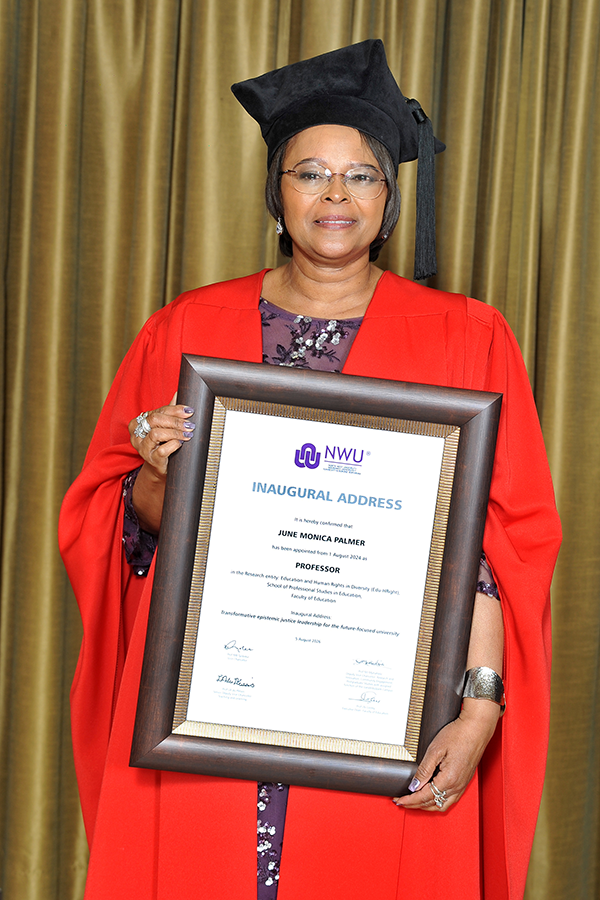
Prof. June Monica Palmer


