
At a time when artificial intelligence (AI) is reshaping higher education, Prof. Liandi van den Berg is helping lead the way in rethinking how universities assess student learning. Her work, recently featured in the Digital Education Council (DEC) Best Practices Collection, highlights a forward-thinking approach that is gaining global recognition.
The initiative was born out of a growing concern that traditional assessment methods are no longer as reliable as they once were. With the rise of generative AI, take-home assignments and similar formats have become increasingly vulnerable to AI misuse. Instead of responding with stricter policing, Prof. Liandi and her team chose a different path, one that is focused on empowering lecturers and reimagining assessment altogether.
At the heart of this shift is a simple but powerful idea that it is no longer enough to assess what students produce; universities must also understand how they arrive there. In the past, a finished assignment or test was seen as clear evidence of learning. Today, however, AI can generate polished outputs with ease. This has encouraged a move toward assessing the learning process itself and look at how students think, engage, and make decisions, especially when working alongside AI.
To help lecturers navigate this shift, Prof. Liandi developed the “Winning the Assessment Game” online course. The course introduces academics to the AI Assessment Scale, which ranges from no AI use to full integration. Through practical activities, lecturers are guided on how to redesign their assessments, incorporate challenge-based learning, and use AI tools effectively in both preparation and teaching. Importantly though, this also equips them to guide students in using AI responsibly and ethically.
The support from NWU extends beyond the course and include a combination of in-person workshops, micro-credential badges, as well as ongoing learning opportunities ensures that lecturers are not simply left to figure things out on their own. More than a third of the university’s academics have already taken part in training, supported by resources such as a hands-on AI toolkit and monthly “Lunch and Learn” sessions where ideas and experiences are shared openly. Through her work with TELIT-SA, Prof. Liandi also encourages lecturers to engage in research and contribute to broader conversations on AI in education.
While many of the innovative assessments developed through this initiative are still being documented, early signs show a shift across faculties toward more meaningful, skills-based evaluation. These approaches are designed not only to maintain academic integrity but also to better prepare students for a world where AI is part of everyday work and decision-making.
Being recognised by the Digital Education Council is a significant milestone for Prof. Liandi and the university, positioning NWU as a contributor to global thinking on assessment in the AI era rather than merely a participant trying to keep up. “This is validation for me and the team, and for our practical, forward-looking approach and the impact it is already having. Crucially, this work does not frame AI as a threat, but as an opportunity. The focus is on using AI to enhance learning and to support thinking, not replace it,” she said.
By incorporating AI into teaching and assessment in a thoughtful way, students can develop the skills they will need in their future careers, while still maintaining academic integrity.
Prof. van den Berg encourages universities across Africa to take a measured and collaborative approach, noting that each institution operates in its own context, and solutions should reflect that. Rather than rushing into rigid policies, she advocates for thoughtful strategy, improved access to technology, and stronger collaboration between institutions.
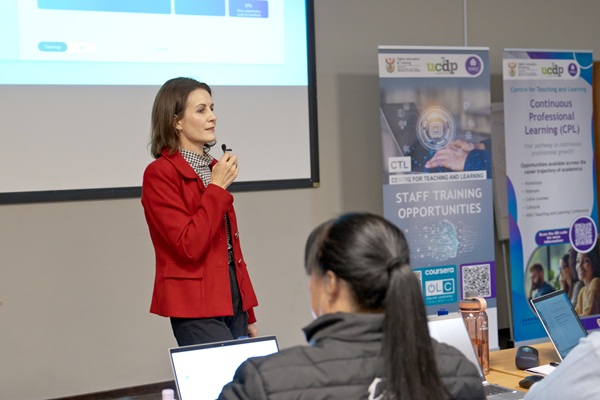
Prof. Liandi, conducting in-person AI at workshop at the Potchefstroom campus


