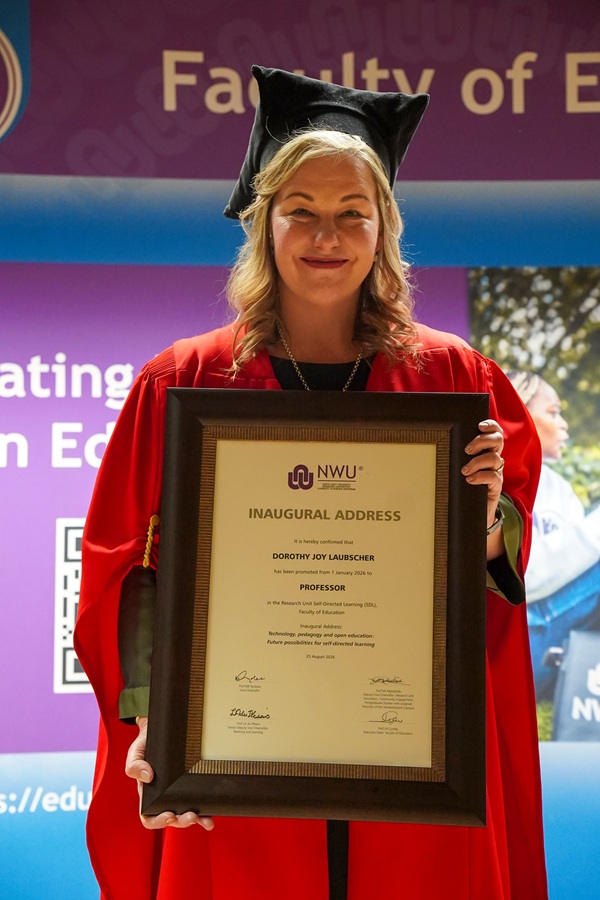
“At what point have we moved from supporting learning to replacing the process in which learning develops?” This is a question that became part of Prof. Dorothy Laubscher’s intellectual journey that shaped her academic career.
Prof. Laubscher, acting director of the Research Unit for Self-Directed Learning, spent many years as a Mathematics teacher before she progressed into Mathematics Education at the North-West University (NWU). Her role contributes to research leadership, collaboration and the advancement of self-directed learning.
Prof. Laubscher recently received her status as full professor, and she presented her inaugural lecture at the Senate Hall on the Potchefstroom Campus – a celebration that highlighted her contributions to education practice.
Titled: “Technology, pedagogy and open education: Future possibilities for self-directed learning (SDL)”, Prof. Laubscher’s lecture explored how technology and open education can transform teaching and create opportunities for self-directed learning.
Technology reshaping possibilities for teaching and learning
Prof. Laubscher’s journey into Mathematics education started in 1995 when she served as a Mathematics teacher and head of department at the Potchefstroom High School for Boys. During her thirteen years at the school, technology became part of her teaching, and she described it as a tool that “seemed to have opened a new set of possibilities”.
She was one of the first teachers in her school to have a smart board connected to the internet in the early 2000s, and this made her question how technology can transform learning.
As she moved into academia at the NWU in 2008, her context shifted from teaching learners to preparing students to become teachers. Her work shifted towards cooperative and blended learning and SDL, where she explored the importance of providing support and creating collaborative learning environments.
She argued that SDL can be developed from a young age.
“When technology is implemented in a carefully structured cooperative learning environment, learners are given opportunities to work with each other, reflect and take increasing responsibility for their own learning,” she said.
Open education, resources, and consumers of knowledge
In 2023, Prof. Laubscher was appointed as the UNESCO Chair on Multimodal Learning and Open Educational Resources at the NWU, a role she currently holds. This appointment granted her an opportunity to engage with different contexts and to think about questions of access, openness, participation and the sharing of knowledge.
In her recent work on open education Prof. Laubscher argued that it not only makes resources available, but it expands access, collaboration, participation and sharing in teaching and learning.
“Open education can position students and facilitators not only as consumers of knowledge, but as people who evaluate, adapt, create and contribute.”
Prof. Laubscher’s work has also explored the possibilities and challenges presented by AI in supporting SDL and when she gave her address, she asked a pressing question: “What will students stop doing because AI can now do it for them?”
“The greater the freedom students have, the more responsibility they carry. Open education gives choice. AI gives choice. Digital environments give choice. But choice alone is not agency,” she said.
Prof. Laubscher challenged future research to look into the distinction between AI supporting and substituting the student.
Future possibilities for SDL
“I believe that SDL is becoming increasingly important,” said Prof. Lauscher. “Students are being given more choices, resources, technologies and information. The challenge is no longer scarcity of information, but too much information.”
“Our most important educational responsibility is not only to help people learn what is known today, but to create the conditions in which all learners can become capable of learning what they will need tomorrow. To help them not only acquire knowledge, but to learn how to learn.”