
A university’s ambitions can stretch far beyond its gates. Its finances determine how far those ambitions travel.
For South Africa’s public universities, the challenge is to open their doors to students, support them through their studies and produce research that serves the country. How to sustain that work has consequences well beyond the balance sheet.
Prof Bismark Tyobeka, principal and vice-chancellor of the North-West University (NWU), will continue to help address this challenge following his reappointment as chairperson of the Universities South Africa (USAf) Funding Strategy Group.
The USAf Board approved his reappointment at its meeting on 20 October 2026. His further three-year term runs from 2 January 2027 to 31 December 2029.
In a letter dated 26 October, USAf chief executive officer Dr Phethiwe Matutu thanked Prof Tyobeka for his dedicated service, strategic insight and commitment to advancing the organisation’s objectives.
“Your leadership has been instrumental in guiding the Funding Strategy Group’s work within an evolving higher education landscape,” she wrote.
Matutu expressed confidence that his continued leadership would strengthen the group’s contribution to shaping and advancing strategic priorities relating to higher education funding in South Africa.
USAf represents the country’s 26 public universities. Its Funding Strategy Group provides strategic direction on university funding matters and advises on related policy, projects and strategies. The group helps inform a collective response to challenges whose effects extend across the university system.
Its published priorities for 2026 include the long-term financial sustainability of higher education, income streams and efficiencies, student debt, fee regulation, the sustainability of the National Student Financial Aid Scheme (NSFAS), and shared services.
These concerns bring difficult questions into the same conversation: how to sustain institutions, keep higher education accessible and ensure that available resources support quality teaching and research.
Prof Tyobeka has recently argued that universities must also scrutinise how effectively they use the resources already at their disposal.
Speaking during a discussion at USAf’s fourth Higher Education Conference on 7 October, he challenged institutions to reconsider costly duplication and pursue collaboration that delivers measurable benefits. According to USAf’s account of the discussion, he advocated sharing facilities, pooling expertise and undertaking joint research.“If we could partner for impact on certain areas as universities, there’s so much we can achieve,” he said.
His argument gives practical expression to the shared-services approach on the Funding Strategy Group’s agenda. Cooperation can help institutions make limited resources go further, while retaining their distinctive strengths and responding to the communities they serve.
There is continuity in this approach. When his earlier appointment as chairperson was announced in June 2023, Prof Tyobeka identified finding long-term sustainable funding solutions for the sector as a central objective.
His reappointment continues the NWU’s contribution to national deliberations on the financial future of higher education. The task ahead is to turn those deliberations into decisions that strengthen universities’ capacity to teach, conduct research and serve society.
Ultimately, sustainable funding must help carry the promise of a university place through to the achievement of a qualification.
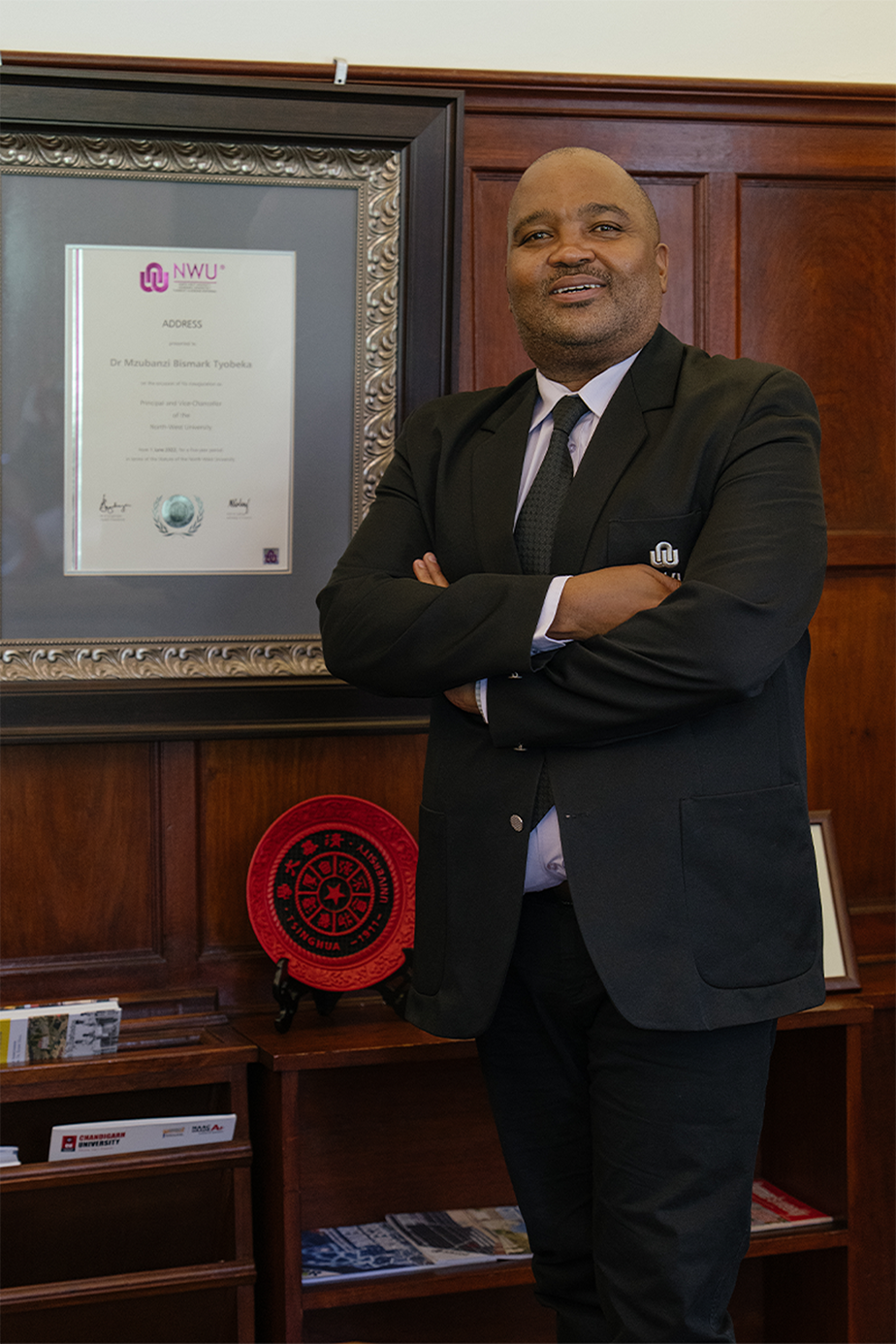
Prof. Bismark Tyobeka


