
The North-West University (NWU) recently hosted a prestige lecture that brought together academics, students, staff, management and anti-corruption experts for an in-depth discussion on the evolving nature of public sector corruption and the tools being used to combat it.
Held at the Vanderbijlpark Campus under the theme, “The evolution of lifestyle audits and cyber forensics in combating public sector corruption”, the lecture explored how investigative techniques are adapting to increasingly sophisticated forms of corruption.
The keynote address was delivered by Leonard Lekgetho, acting head of the Special Investigating Unit, who shared insights into the changing methods used to identify, trace and investigate suspected corruption.
Leonard explained that lifestyle audits have become an increasingly important investigative tool, particularly in cases where an official’s apparent standard of living does not correspond with their legitimate income.
Investigators can examine property ownership, luxury vehicles, bank accounts, investments, business interests and other financial records to identify unexplained wealth, conflicts of interest or undeclared interests.
He also highlighted the growing role of social media and other digital information in investigations. Public displays of wealth by officials can, in some cases, provide investigators with information that warrants further scrutiny.
“Thieves tend to talk about their newly acquired wealth to show off, but are unaware that they are giving it away,” Leonard said.
The lecture further examined how corruption has become increasingly sophisticated, with illicit transactions sometimes concealed through companies, intermediaries, procurement networks and complex financial arrangements.
In this environment, Leonard said, cyber forensics has become an important component of modern investigations.
“Digital evidence and data analysis can assist investigators in tracing transactions, identifying relationships and uncovering patterns that may not be immediately visible through traditional investigative methods.”
However, Leonard stressed that technology alone cannot defeat corruption.
“Investigations could have the most sophisticated technology in the world, access to enormous quantities of data, and advanced analytical tools, but if the people operating those systems lack integrity, professional competence and ethical judgment, technology will not solve the corruption problem.”
The discussion also extended beyond public-sector corruption to academic integrity. Leonard highlighted concerns around practices such as ghost-writing and the admission of students who do not meet minimum entry requirements, underscoring the importance of ethical conduct across institutions.
The programme was directed by Oscar Mosiane, manager for corporate communication, who also served as the event organiser. Reflecting on the lecture, Oscar described it as a success and said the strong engagement demonstrated the importance of creating platforms where complex societal issues can be openly discussed.
“The event provided an important platform for meaningful engagement between the university community and experts in the fight against corruption. The discussions demonstrated that combating corruption requires more than sophisticated investigative tools; it requires ethical leadership, accountability and a collective commitment to protecting public resources.”
The welcome address was delivered by Prof. Jeffrey Mphahlele, deputy vice-chancellor for research and innovation, community engagement and postgraduate studies, with the assigned function of the Vanderbijlpark Campus.
Prof. Mphahlele said the lecture formed part of NWU’s broader role in creating spaces for intellectual engagement on issues affecting society.
“The university’s Prestige Lecture programme provides an opportunity for distinguished leaders and experts to share knowledge and engage with students, academics and other stakeholders on issues of national importance. This lecture provided an opportunity to explore governance, ethics, public administration, justice and the use of technology in strengthening accountability.”
Prof. Mphahlele added that the prestige lecture reaffirmed NWU’s role as a platform for meaningful public dialogue and demonstrated how universities can contribute to national conversations on integrity, ethical leadership, good governance and the protection of public resources.
“As corruption continues to evolve, the discussion highlighted the need for institutions to evolve alongside it – combining technology, effective investigative systems and, ultimately, a strong culture of integrity.”
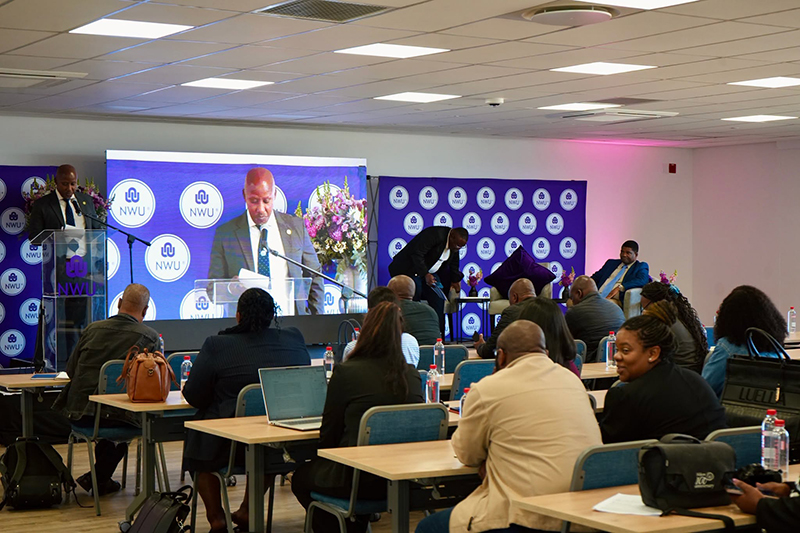
Leonard Lekgetho, acting head of the Special Investigating Unit, shared insights into the changing methods used to identify, trace and investigate suspected corruption.


