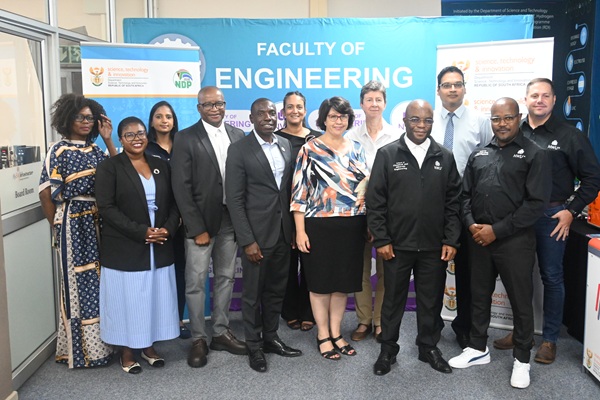
The North-West University (NWU) is taking a big step forward! The university has been awarded Phase Two of the South African Circular Minerals and Metals Initiative, co-hosted by the CSIR through Circular Innovation South Africa, and the official launch took place on Friday, 6 February at the Department of Science, Technology and Innovation (DSTI) HySA Infrastructure Centre of Competence on the Potchefstroom Campus.
It was an exciting day, marking a real milestone for NWU and for South Africa’s mining sector.
The announcement from the DSTI puts the NWU’s Centre for Sustainable Mining right at the heart of efforts to help the industry use resources more responsibly, while keeping it strong and competitive.
Mining is a key part of South Africa’s economy, supplying minerals and metals both locally and worldwide. At the same time, it’s a resource-intensive industry that relies on significant energy and water use and faces growing environmental and regulatory pressures. With global attention on critical minerals and climate commitments, there’s a real push for the sector to evolve.
That’s where the circular economy comes in. It’s all about using resources more efficiently, getting more value from materials that would otherwise go to waste, and finding new ways to improve the efficiency and security of supply. What might have sounded like a theory in the past is now a very practical approach that can help the industry plan for the future.
The Circular Economy Science, Technology and Innovation Strategy, launched in 2024, highlights mining as one of the three priority sectors with huge potential to adopt and grow circular practices. The focus is on improving resource security, boosting efficiency, and diversifying mineral sources — all key to modernising the sector and keeping South Africa competitive.
Prof. Linda Godfrey, manager of Circular Innovation South Africa and custodian of the initiative, explained that mining hasn’t always been part of circular economy conversations.
“As an extractive industry, mining has often been left out of these discussions,” she said. “But with growing pressure on and interest in South Africa’s minerals, the circular economy offers real opportunities to manage risk, diversify sources, and address tensions around critical minerals.”
Phase One of the initiative, led by the Mandela Mining Precinct, focused on understanding the landscape and developing a circular minerals-and-metals strategy to guide innovation and investment. Phase Two now takes that further, building stronger partnerships across the innovation system and with industry, helping companies test, adopt, and scale solutions that deliver real benefits.
Dr Mmboneni Muofhe, deputy director-general for Socio-Economic Innovation Partnership at the DSTI, said the NWU’s Centre for Sustainable Mining was the perfect partner for this next phase.
The Centre, established in 2024, focuses on responsible, environmentally conscious mining through research education, and partnerships. A big part of its work is ensuring the next generation of engineers and mining professionals is ready for an industry that’s changing rapidly.
Dr Sihe Nhleko, director of the centre, said this means giving students and practitioners the right skills and knowledge.
“This includes training the next generation through degrees, diplomas, and short courses that focus on sustainability and future-ready mining practices,” he said. This work ties directly into the NWU’s strategy, “Taking the NWU forward - 2024 and beyond”.
At the launch on 6 February, Dr Nhleko highlighted the importance of working together.
“We are excited to collaborate with the South African mining sector to better understand the business case and technology solutions needed to move towards circular practices,” he said.
The news was met with widespread excitement across the university. Prof. Daryl Balia, deputy vice-chancellor for operations, digital and AI systems with the assigned function of the Potchefstroom Campus, called the announcement wonderful news for the NWU. He spoke about how this initiative strengthens the university’s role as a trusted partner in innovation and how it brings academia, government, and industry closer together.
Prof. Liezl van Dyk, executive dean of the Faculty of Engineering, also expressed her excitement. She said she was proud of the Centre for Sustainable Mining and the impact it is making. She highlighted how leading a national initiative like this shows the faculty’s commitment to training engineers and professionals who can support a sustainable future for the mining sector.