
Some of the universe’s most interesting events happen without warning and can disappear just as quickly. The only way to capture them is to look continuously at the sky.
The North-West University (NWU) has taken a significant step to ensure that fleeting celestial events are recorded for the next generation of scientists and engineers with the launch of the university’s first Transient Array Radio Telescope (TART) on 29 October.
This telescope is installed on the roof of Building G5 on the Potchefstroom Campus and forms part of a growing African network of radio astronomy instruments.
It is managed by the NWU’s Centre for Space Research and the project leader is Dr Fanie van den Heever, senior lecturer.
The TART is cost-effective for continuous monitoring
Dr Fanie explains that the telescope uses a spiral antenna array of 24 monitors, each of which are similar to the GPS systems found in cellphones and tablets. It collects data at specific frequencies and detects satellites and transient cosmic phenomena such as high-energy cosmic rays.
“It also provides a platform for developing new imaging algorithms and testing advanced calibration and data-processing techniques,” he says.
The TART was originally developed by Dr Tim Molteno and students at the University of Otago in New Zealand under the Electronics Research Foundation. It has already been rolled out in South Africa and other African Square Kilometre Array (SKA) partner countries through collaborations involving the foundation, Rhodes University, the South African Radio Astronomy Observatory (SARAO) and the DARA programme.
Prof Amare Abebe, director of the NWU’s Centre for Space Research, says the installation creates exciting possibilities for collaboration. “We are delighted with our first TART telescope. This is one of many that are currently being launched in Africa and the rest of South Africa. It opens opportunities for collaboration not only in South Africa and Africa but also across the world.”
How students can use this telescope to unlock new opportunities
Dr Fanie says the TART’s greatest value lies in the opportunities it creates for students.
“It is not only a science instrument. It is more a platform to test the algorithms with which interferometry works.” (Interferometry is a measurement technique that combines waves from two or more different detectors.)
He explains that the telescope collects data every second through the specialised antennas operating at a specific frequency. By working with this real observational data, students gain practical experience in radio astronomy, data analysis, antenna calibration, receiver design, precision timing and radio frequency engineering.
“These are skills that are often difficult to get without access to specialised facilities. I believe the TART will have a significant impact in equipping students with these skills, which they can use in the private sector.”
Beyond its scientific and educational value, the telescope also offers a powerful tool for attracting young people to science and technology, he says. “I believe it will become an important asset for student recruitment and play a significant role in our Centre’s outreach initiatives, which are mostly aimed at school learners.”
As the TART continuously scans the skies above Potchefstroom, it will search for fleeting signals from space while helping students develop the knowledge and expertise needed to contribute to future scientific and technological advances. The telescope will ensure that curiosity, discovery and innovation continue to inspire the next generation of the NWU’s space experts.

The newly installed TART telescope.
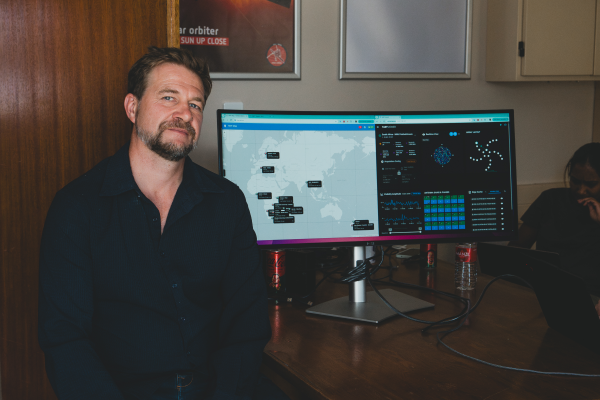
Dr Fanie van den Heever, project leader and senior lecturer at the NWU’s Centre for Space Research, shows the software that is used to monitor the data the TART telescope collects in real-time.
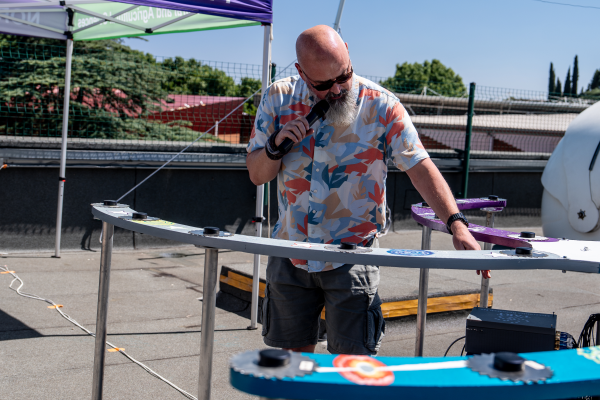
Dr Oleg Smirnov of Rhodes University, who spent the last couple of years travelling across African countries to install TART, explains how the TART telescope functions during the launch.
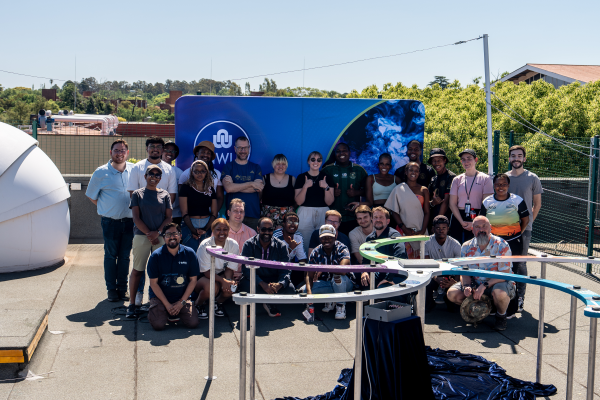
Staff and students of the NWU’s Centre for Space Research and the Faculty of Natural and Agricultural Sciences celebrate during the launch of the NWU’s new TART telescope.


