
Conservation is about more than just protecting wildlife and preserving nature. It is also about ensuring that communities understand the value of these resources and recognising their role in protecting the environment for future generations.
Honours-degree Advanced Corporate Communication students from the North-West University (NWU) School of Communication are developing new ways to bring conservation closer to communities. Their goal is to inspire the next generation of environmental ambassadors.
The students are taking their learning beyond the classroom through a three-year partnership between the South African National Parks (SANParks), the School of Communication, the Language Directorate of the NWU and SANParks Honorary Rangers. Together they are contributing fresh ideas to SANParks Vision 2040. This long-term plan aims to build a future in which people and nature thrive together.
This partnership creates a strong framework for multilingual teaching, research and community engagement. It serves as a massive launchpad for students to team up with real-world conservation professionals to tackle industry challenges and build effective multilingual communication strategies.
A new Look at Conservation
Phumi Tshabalala, one of the participating students, said the project challenged his understanding of what conservation truly meant. “I used to believe that conservation was only about protecting wildlife. Now I understand that human beings, our cultures, languages and stories are just as important and need to be preserved.”
Prof. Lida Hotlzhausen, director of the NWU School of Communication, believes the partnership bridges the gap between theory and reality. She noted that the willingness of the professionals to engage with student ideas created a valuable opportunity for students to make meaningful societal contributions and supports students to gain graduate attribute which align them with the Communication industry.
People and nature belong together
The SANParks Vision 2040 initiative focuses more on inclusive conservation that promotes connected landscapes where sustainable economic activities and community development support one another.
A key part of the vision is that conservation must become a shared responsibility. This requires communication that reaches people in ways they can understand and relate to. Great storytelling connects people to nature, and because of this the partnership’s main focus is on breaking down barriers and using multilingual ways to share the story of conservation.
The project began in the first semester of 2026 where the students in the Strategic Marketing Management module (presented by Prof Lida Holtzhausen) received a real conservation brief to develop national marketing management campaigns aimed to introducing local communities surrounding the major conservation parks in South Africa to a Mega Living Landscape concept. This forms part of the SANParks Vision 2040. In the second semester, they expanded their work in the project through their Advanced Corporate Communication project module.
During this period, the students worked on the Youth Ambassadors’ Programme, which encourages young people to participate in conservation initiatives. The concept received highly positive feedback from the representatives and was since identified as a national project.
Creative campaigns and innovative thinking
During the 1st and 2nd semester of 2026 students were tasked with identifying key stakeholders, conducting research and analysing how language, culture and accessibility influenced the way people understand conservation.
As part of their work, the students visited the Golden Gate Highlands National Park and there they connected with the SANParks Honorary Rangers and presented their proposals to the SANParks representatives.
Kevin Moore, general manager of Visitor Services at SANParks, praised the students’ approach and commitment. “It gives me great pleasure to see the enthusiasm and professional way in which this young group of people tackled their assignments,” he said.
Dr. Anette Degenaar, senior lecturer in Corporate Communication, added that the firsthand experience was a game-changer for the students. .
“The feedback from our honours-degree students has been overwhelmingly positive, with the visit to Golden Gate Highlands National Park an absolute highlight and a once-in-a-lifetime experience for some.”
Young ambassadors are the future voices of conservation
The Youth Ambassador programme not only puts young people at the centre of conversations about conservation, but it advocates that they protect the natural heritage of South Africa.
Phumi believes that involving young people is essential to building a stronger conservation future. “Young people should be co-creators in conservation because they will inherit the responsibility of protecting the natural environment. The sooner we engage in these efforts, the better the outcomes,” he said.
Prof. Rosemary Cromarty, acting director of the Language Directorate and member of the SANParks Honorary Rangers, shared her gratitude for the students’ hard work on the marketing campaigns and the Vision 2040 concept.
“My gratitude goes to the students who have done their very best to produce a wonderful marketing campaign and Vision 2040 concept such as the Youth Ambassador Programme for SANParks,” she said.
She further highlighted that the Language Directorate’s involvement ensures that conservation communication remains accessible and culturally sensitive.
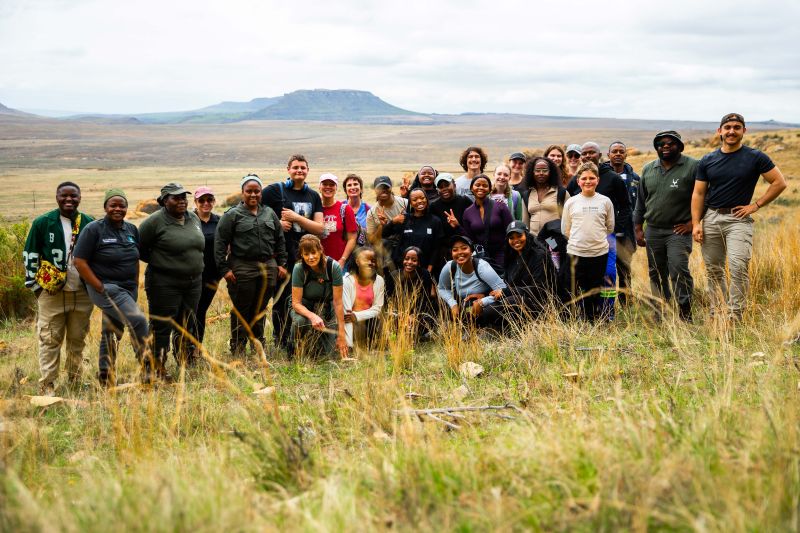
The students went on a field visit to Golden Gate Highlands National Park to further explore the conservation environment, where the SANParks Honorary Rangers commended their professionalism and innovative thinking.


