
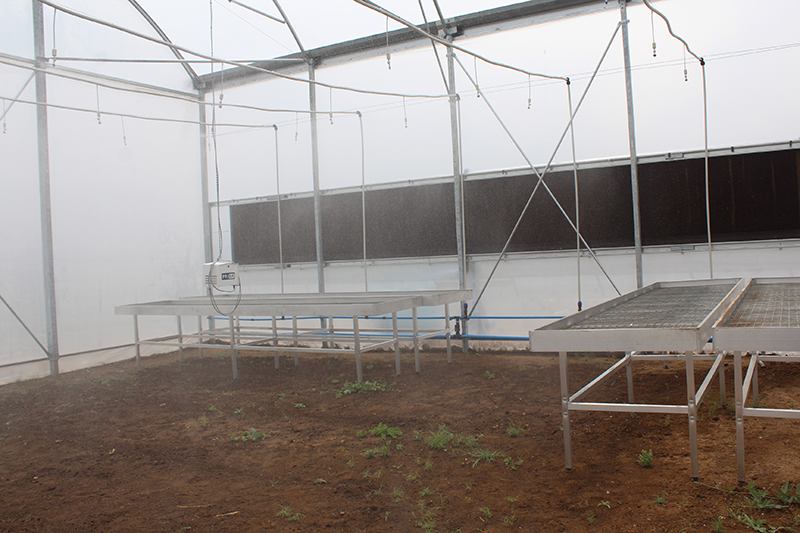
The Food Security and Safety (FSS) research niche area at North-West University (NWU) has secured a state-of-the-art automated greenhouse that will strengthen research capacity, support student training and expand crop production studies under controlled conditions.
The initiative is meant to equip students with both skillsets to operate both traditional and highly conventional automated greenhouse systems.
The facility allows researchers to control environmental conditions with precision, enabling accurate scientific experiments without interference from external weather conditions. According to Prof. Sydney Mavengahama from the FSS, the greenhouse makes it possible to regulate both the ambient and soil environment during experiments.
“The greenhouse allows for very accurate control of the ambient and soil environments during research, enabling researchers to measure the effects of different treatments without interference from the external environment,” said Prof. Mavengahama.
The greenhouse worth R3 million is operated through a computerised automation system that manages temperature, irrigation, humidity and nutrient supply. This system enables researchers to maintain optimal growing conditions throughout the year.
The facility was funded through the Faculty of Natural and Agricultural Sciences Research Equipment Fund set up by the executive dean, Prof. Francois Van der Westhuizen, to strengthen research infrastructure and student training capacity in the faculty.
Prof. Mavengahama explained that the facility differs from conventional greenhouse tunnels which rely on natural conditions and often cannot maintain stable temperatures during extreme seasons.
“In conventional greenhouse tunnels it is difficult to keep the temperature at the desired level. During summer tunnels overheat and in winter they rely on trapped radiation, but there is no precise control of temperature,” he said.
The automated greenhouse will support research linked to food security, particularly in the context of climate change and limited agricultural resources. Greenhouse size is 9,6m x 45m, but the area is bigger could be 200m2. The facility will also be used to train students and farmers in modern crop production methods, including both conventional greenhouse production and advanced automated systems.
Securing food security
“It will be used to train students in crop research and production. These skills will have a multiplier effect when students become farmers, farm managers or researchers. The greenhouse can also be used to train farmers in greenhouse farming so that they can produce both field crops and high-value horticultural crops,” said Prof. Mavengahama.
He added that the system makes it possible to grow crops during winter when conventional farming is not possible due to low temperatures.
The greenhouse will primarily support student research, especially at postgraduate level, as most experimental work in crop science is conducted by students.
Because the FSS entity includes several disciplines, the greenhouse is expected to support a wide range of projects including research on horticultural crops, agronomy and soil fertility.
The automated greenhouse forms part of the NWU’s efforts to strengthen research in agriculture and food security, while preparing students and researchers to respond to changing environmental and production conditions.


