
Two North-West University (NWU) scholars have received national recognition for research addressing two defining challenges of the modern age: the impact of HIV on African communities and the growing influence of artificial intelligence on journalism.
Prof. Monray Williams and Soligah Solomons were honoured at the National Research Foundation (NRF) Awards ceremony in Gqeberha on Thursday, 3 September.
Prof. Williams, an associate professor of biochemistry in the Faculty of Natural and Agricultural Sciences, received the Research Excellence Award for Early Career/Emerging Researchers in the life sciences. Solomons, a lecturer in journalism and media studies in the School of Communication, received the Research Excellence Award for Next-Generation Researchers in the social sciences and humanities.
Each received a R75 000 research grant, trophy and certificate.
Prof. Jeffrey Mphahlele, deputy vice-chancellor for Research and Innovation, Community Engagement and Postgraduate Studies, with the assigned function of the Vanderbijlpark Campus, congratulated them.
“The recognition of Prof. Williams and Ms Solomons demonstrates the breadth and relevance of research being conducted at the NWU. Their work addresses urgent African challenges, from the continuing burden of HIV to the profound changes artificial intelligence is bringing to journalism and society.
“We are immensely proud of their achievements. These awards affirm their excellence and show what becomes possible when talented emerging scholars are supported in pursuing knowledge that can make a meaningful difference.”
The NRF Awards recognise leading South African scientists and high-performing researchers for excellence in creating and disseminating knowledge. They also seek to inspire emerging scholars and advance transformation within the country’s research community.
A virologist and molecular neurobiologist in the NWU’s Biomedical and Molecular Metabolism research unit, Prof. Williams investigates how diseases develop and affect the nervous system.
His work focuses particularly on HIV-1 subtype C, the dominant subtype in southern Africa. Through clinical studies, computational analysis and laboratory-based cell models, his group examines how variations in viral proteins influence inflammation, metabolism, cardiovascular risk and neurological complications in children and adults living with HIV.
His group also analyses blood and cerebrospinal fluid for biomarkers that could help predict or monitor neurological complications, enable earlier diagnosis and inform treatments better suited to African populations.
In a commentary published in Nature Reviews Microbiology, Prof. Williams and his fellow researchers warned that HIV research remains disproportionately focused on subtype B, which is prevalent in Europe and North America, while forms prevalent in Africa remain comparatively understudied.
Their HARNESS framework calls for greater African investment in laboratories, biobanks, genomic surveillance and scientific training, supported by stronger collaboration across the Global South.
Prof. Williams holds a PhD in neuroscience from the University of Cape Town (UCT). His earlier research contributed to an internationally patented approach aimed at improving HIV detection during the window period. He joined the NWU in 2020 and has also received a Fulbright Fellowship.
Solomons’s award recognises her doctoral research at the intersection of journalism, technology and society. A PhD candidate at UCT’s Centre for Film and Media Studies, her work examines artificial intelligence in South African newsrooms.
In a peer-reviewed study co-authored with Prof. Musawenkosi Ndlovu, she explored journalists’ perceptions and use of AI. It found that AI adoption remained uneven and raised concerns about costs, inadequate training, editorial accountability, algorithmic bias and the representation of marginalised communities.
Her research places South African newsroom realities at the centre of a debate often shaped by wealthier media markets.
Although their fields differ, both researchers are producing knowledge rooted in African realities. Their recognition affirms their scholarly excellence and the growing contribution of emerging NWU researchers to South Africa’s research landscape.
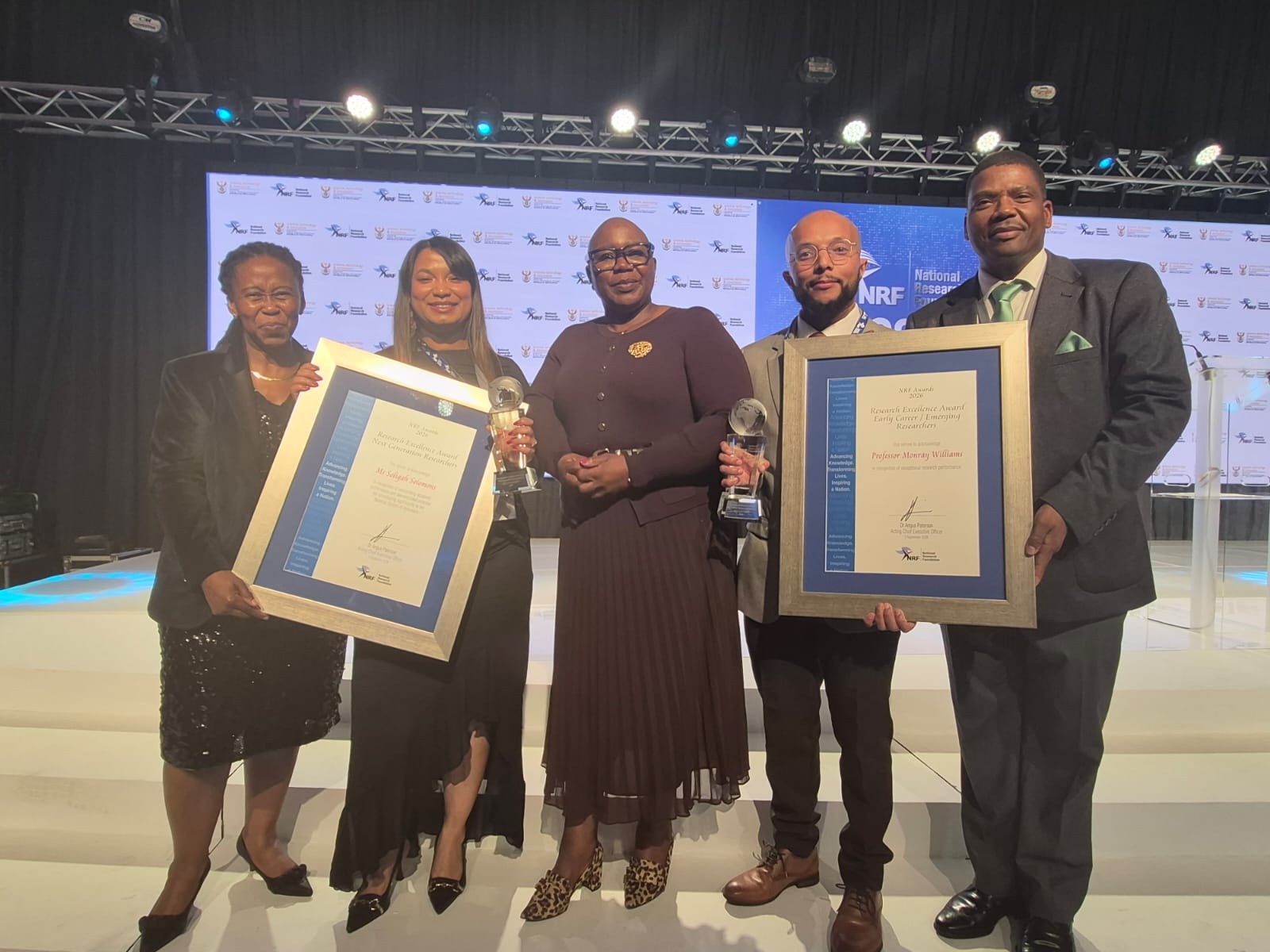
A proud moment: Prof. Nnenesi Kgabi, chief director for Research and Postgraduate Support at the NWU, Soligah Solomons, Nomalungelo Gina, Deputy Minister of Science, Technology and Innovation, Prof. Monray Williams and Prof. Jeffrey Mphahlele.


