
A study highlighting a less recognised form of chemical exposure among South African petrol attendants has earned the North-West University (NWU) PhD student Lize van der Westhuizen international recognition.
Lize received the award for the best oral presentation by an early-career researcher at the 10th Occupational and Environmental Exposure of Skin to Chemicals (OEESC) Conference, held in Manchester in the United Kingdom from 14 to 16 September 2026.
Hosted by the British Occupational Hygiene Society, the conference brought together international experts in occupational hygiene, health and safety, dermatology, skin research and related fields.
Lize is a first-year PhD student in the Occupational Hygiene and Health Research Initiative (OHHRI) at the NWU. She completed her MHSc in Occupational Hygiene in 2025 and is continuing her research under the supervision of Prof. Suranie Horn and Prof. Stefan Linde.
Her presentation, titled “Dermal exposure to benzene, toluene, ethylbenzene and xylene experienced by petrol-filling attendants”, focused on exposure to a group of chemicals known collectively as BTEX.
Petrol attendants regularly handle fuel and refuel vehicles, often while working shifts of up to 12 hours. Although research into occupational exposure at petrol stations has traditionally concentrated on inhalation, Lize’s study considers another potential route of exposure: contact with the skin.
“Fuel can come into contact with the skin through spills, splashes, direct handling and contaminated equipment or surfaces,” she explains.
Her study investigated BTEX deposition on four areas of petrol attendants’ hands during their normal working activities. The preliminary findings confirmed that these chemicals could be detected on their skin.
Of the four areas examined, the index finger recorded the highest deposition. Lize says this may be linked to how frequently the index finger is used when handling fuel nozzles and other equipment. Further task-based research will be needed to explore the reasons for this pattern.
Toluene showed the highest measured deposition, followed by xylene, benzene and ethylbenzene. However, Lize emphasises that the highest level of deposition does not necessarily represent the greatest health concern. Benzene remains particularly important because of its carcinogenic properties.
The findings suggest that dermal exposure should form part of the conversation when assessing and controlling occupational exposure among petrol attendants.
Presenting this work in Manchester was a particularly significant milestone for Lize, as it was her first international conference.
“It was a privilege to represent the North-West University and to share research that I am genuinely passionate about with an international audience,” she says.
The conference also allowed her to engage with researchers from different backgrounds and to consider how the occupational health challenges investigated in South Africa fit into the wider international research landscape.
Receiving the award came as a surprise.
“I was honestly incredibly surprised, honoured and grateful. Because this was my first international conference, receiving the award made the experience even more special.”
For Lize, the recognition also reflects the contribution of her supervisors and colleagues, the petrol attendants who participated in the study, and the organisations that supported the research.
The award has strengthened her confidence as an early-career researcher and motivated her to continue investigating areas of occupational exposure that may not yet receive sufficient attention.
Her PhD research will examine dermal exposure in greater depth, including seasonal differences, exposure patterns, skin barrier function and the possible modelling of BTEX permeation through the skin.
Lize hopes the work will ultimately contribute to practical improvements in how occupational exposure is assessed and prevented.
“This achievement has shown me that research originating from South Africa can contribute meaningfully to international conversations around occupational exposure and occupational health,” she says.
She also hopes that the recognition will create opportunities for international collaboration and knowledge sharing as her research progresses.
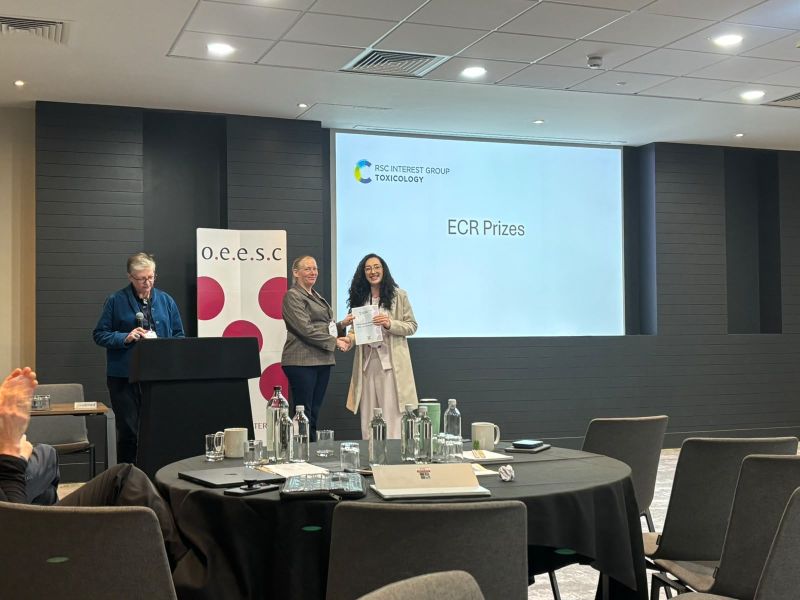
Photo: Lize van der Westhuizen receiving her award.


