
A renewed sense of focus and institutional purpose marked the official opening of the 2026 academic year at the North-West University (NWU) on Friday, 13 February.
The ceremony, broadcast live from the Potchefstroom Campus to Mahikeng and Vanderbijlpark, signalled not only the start of lectures and registrations, but also served as a reaffirmation of the commitment of the university to excellence, transformation and societal impact.
Proceedings began with a formal welcome by the vice-principal and senior deputy vice-chancellor for teaching and learning, Prof. Linda du Plessis, who set a tone of unity across the three campuses of the institution. She emphasised shared responsibility and collaboration in navigating the complex realities facing higher education.
A solemn moment of silence followed, grounding the event in reflection and shared humanity. The gesture underscored a culture of compassion and collective accountability, reminding staff and students that academic achievement rests on community, dignity and mutual respect.
The principal and vice-chancellor, Prof. Mzubanzi Bismark Tyobeka, formally declared the 2026 academic year open, greeting audiences across Mahikeng, Potchefstroom and Vanderbijlpark in multiple languages to reinforce the vision of “One University”.
Reflecting on 2025, he described the year as demanding but productive, commending staff for concluding the academic cycle with integrity and ensuring readiness for the new term. “Resilience and adaptability define who we are as an institution,” he said. “Even when circumstances shift, our mission remains steadfast.”
The vice-chancellor highlighted the extraordinary demand for higher education in South Africa, revealing that the NWU had received more than 480 000 applications for 2026. The figure reflects both confidence in the institution and the aspirations of young South Africans seeking opportunities. However, he pointed out the broader systemic challenge: public universities collectively can accommodate only a fraction of qualified applicants each year.
Within these constraints, 11 800 first-year spaces had been allocated across the three campuses. The allocation demonstrates growth while simultaneously exposing the capacity pressures confronting the higher education sector.
Student funding and financial processes remain critical priorities. Prof. Tyobeka acknowledged challenges arising from delayed national funding guidelines and financial clearance systems. In response, the university had implemented extended registration deadlines, operational financial registration committees and targeted internal bursary support for students in need.
A significant announcement during the address was the introduction of a full-cost bursary scheme for academically deserving honours degree, master’s degree and doctoral students from households earning below R600 000 annually. The initiative strengthens postgraduate access and reinforces institutional commitment to equity and academic progression. “Our institutional promise remains clear and unwavering. It all starts here,” Prof. Tyobeka said.
The vice-chancellor also noted further developments and milestones.
Infrastructure development continues apace, with projects of R2,27 billion currently being implemented. These projects include new medical school facilities, enhanced student support centres, upgraded residences and expanded digital systems aimed at modernising the academic environment and improving operational efficiency.
Globally, the NWU maintained its position in the 801 – 1 000 band in the Times Higher Education World University Rankings among more than 2 000 universities worldwide. Strong subject performances in Law, Psychology, Medical and Health Sciences, Arts and Humanities, and Business and Economics reflect sustained academic momentum.
In a notable milestone, the university became the first in South Africa to adopt a formal artificial intelligence policy approved by Council, positioning it at the forefront of responsible AI integration in higher education.
Looking ahead to 2026, strategic priorities include establishing a School of Mines and Mining Engineering, advancing the Desmond Tutu Medical School, expanding Veterinary Sciences and strengthening entrepreneurship and international partnerships. Emphasis was also placed on staff well-being, employment equity and upskilling to ensure a future-ready workforce.
Following the formal opening, long service awards ceremonies were held across campuses to honour employees who have dedicated many years to the institution. The celebrations recognised loyalty, institutional memory and sustained contribution, highlighting the individuals whose commitment underpins stability and growth.
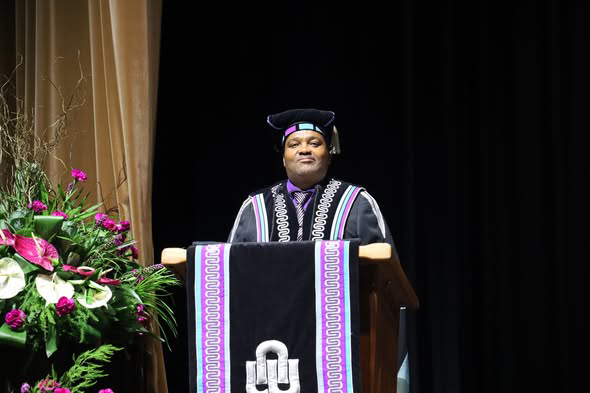
NWU principal and vice-chancellor, Prof. Mzubanzi Bismark Tyobeka, formally declares the 2026 academic year open.


