
While many developing countries are still in the early stages of establishing governance frameworks for Artificial Intelligence (AI), NWU master’s student Lebogang Marago is advocating for its responsible and secure use.
Born in a rural community in the Ventersdorp region, where young people face high unemployment and limited prospects, Lebogang was motivated to ask deeper questions about governance, development, inequality and policy making.
“I became interested in understanding how political and legal systems shape people’s lives and why some communities remain marginalised despite democratic governance,” he said. “This curiosity gradually developed into a strong passion for academic inquiry and research.”
Lebogang is currently pursuing his Master of Arts in Political Studies in the Department of Political Science and International Relations. His research, titled “Navigating the Digital Frontier: A Strategic Assessment of Artificial Intelligence as a National Security Threat in South Africa,” examines the growing security risks associated with emerging technologies.
His work focuses on the weaponisation of AI, institutional readiness, and cyber defence frameworks in the context of global technological competition and the strategic challenges facing countries in the Global South.
He believes that rapid technological change is transforming economies, governance systems, and national security landscapes worldwide.
“AI offers significant opportunities for innovation and economic growth,” Lebogang explained. “However, my research highlights the growing gap between technological advancement and policy preparedness. Many states are not fully prepared to regulate or mitigate the risks associated with emerging technologies.”
Through his work, Lebogang stresses the importance of integrating security policy, technological governance, and strategic planning to ensure that AI systems are developed responsibly.
Lebogang’s research is highly relevant to African countries navigating the Fourth Industrial Revolution. He believes that African states should actively shape the governance of emerging technologies, rather than simply adapting to policies developed elsewhere.
“I want my work to contribute to conversations about how African countries can embrace technological innovation responsibly, while also protecting themselves from potential risks.”
Academic Excellence and Research contributions
Lebogang has contributed to several research projects affiliated with the Department of Political Science and International Relations.
Notably, he is the author of a forthcoming book chapter titled “Utilising Artificial Intelligence for Climate Change Policy in Africa,” which is currently awaiting publication. He also authored a conference paper titled "Unlocking the Potential: Harnessing AI-Driven Strategies to Foster Sustainable Innovation in Environments Prone to Crisis”.
This paper, still pending publication, examines how AI-driven innovation strategies can support sustainable development and resilience in crisis-prone environments. Through these projects, Lebogang seeks to contribute to evidence-based policymaking on technology governance, development, and security in Africa.
In addition to his research, Lebogang is involved in academia through providing lecturing support and working in academic administration within the Student Academic Lifecycle Administration (SALA) unit. In October 2024, he presented the paper “Unlocking the Potential: Harnessing AI-Driven Strategies to Foster Sustainable Innovation in Environments Prone to Crisis” at the Conference on Public Innovation, Development and Sustainability, which was hosted by the University of KwaZulu-Natal (UKZN).
Looking ahead
Lebogang argues that the future of governance will be shaped by emerging technologies.
“Artificial intelligence will have a profound impact on the future of governance, security, and economic development,” he said. “It is therefore crucial that African countries develop the institutional capacity and policy frameworks necessary to harness its benefits while mitigating its risks.”
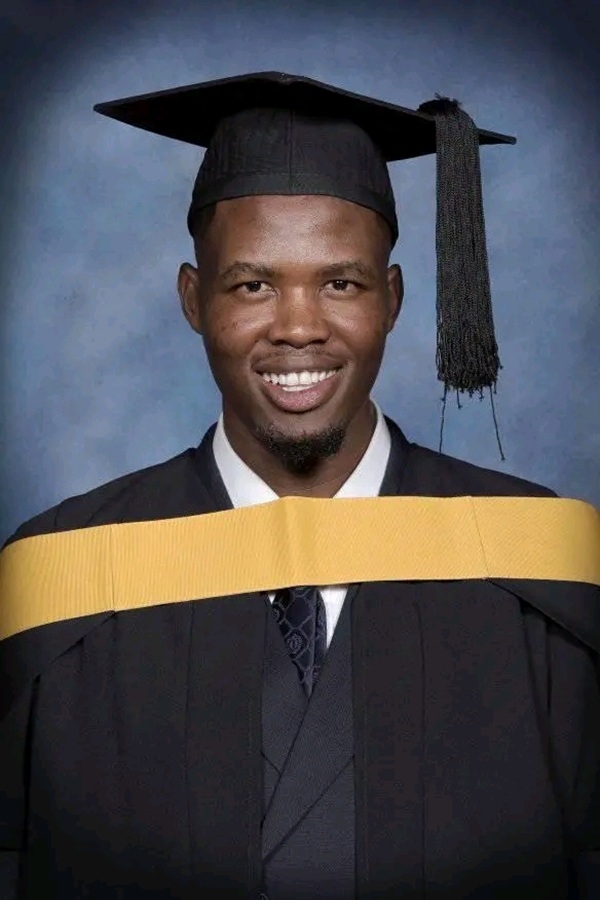
Lebogang Marago


