
Researchers and students at the North-West University (NWU) will livestream a partial solar eclipse from the NWU Solar Observatory* on the Potchefstroom Campus. This gives the public a safe way to experience the breathtaking celestial event on 17 February 2026.
Dr Ruhann Steyn, senior lecturer and researcher at the Centre for Space Research in the School of Physical and Chemical Sciences, says the eclipse will be visible across most of South Africa, including all three NWU campuses.
“The maximum eclipse from the Potchefstroom Campus will happen at 15:09 South African Standard Time (SAST). Although the eclipse is associated with a “Ring of Fire”, this annular phase will not be visible from South Africa. During a partial solar eclipse, the moon passes between the earth and the sun and covers part of the sun’s disk,” he explains.
Safe viewing is non-negotiable
Ruhann emphasises that while the event is spectacular, safety precautions are essential. “It is important to remember that the sun can cause harm to your eyes when you look at it directly. Do not look directly at the sun with unprotected eyes. Always use certified eclipse glasses to view the sun safely,” he cautions. The livestream from the observatory is an alternative way for viewers to follow the eclipse without risking eye damage.
Solar event takes place in phases
According to Ruhann, a solar eclipse of this nature occurs when the moon moves directly in front of the sun during its new-moon phase, but is too far from Earth in its elliptical orbit to completely obscure it. As a result, a thin rim of sunlight remains visible around the sun. Unfortunately, we will not be able to see this rim of sunlight, but what we will see is a small piece of the sun being obscured by the moon.
The event, as it will be seen from South Africa, unfolds in four contact stages. The first, known as “first contact”, marks the moment when the moon appears to take a bite out of the sun, gradually transforming it into a narrowing crescent. The precise moment when the sun is obscured the most is the “second contact”. At the “third contact”, the moon moves away from the sun, and the eclipse reduces from a full disk to a partial phase until “fourth contact”, when the sun is fully visible again.
Solar eclipse timeline for the NWU campuses
There are slight variations in timing and coverage on each of the campuses of the NWU
Mahikeng Campus (4,96% eclipse)
Partial eclipse begins: 14:30 SAST
Maximum eclipse: 15:10 SAST
Partial eclipse ends: 15:47 SAST
Potchefstroom Campus (7,43% eclipse)
Partial eclipse begins: 14:24 SAST
Maximum eclipse: 15:09 SAST
Partial eclipse ends: 15:51 SAST
Vanderbijlpark Campus (8,28% eclipse)
Partial eclipse begins: 14:24 SAST
Maximum eclipse: 15:10 SAST
Partial eclipse ends: 15:53 SAST
*Observatory supports solar research and training
Commissioned in 2022, the NWU Solar Observatory hosts three dedicated hydrogen-alpha telescopes used for daily solar observations. Ruhann manages the facility with the support of a team of undergraduate and postgraduate students. This team includes Calmay Lee (PhD student), Thembalethu Zulu (MSc Student), and third-year Physics students Kaitlyn Andrew, Colwin van Zaanen, Omphile Mathe and Denel Tolmay.
The observatory continues to create opportunities for student involvement such as research initiatives while bringing significant astronomical events closer to the broader community.
Please note, although the intention is to livestream the event, weather conditions may have an impact on whether the livestream will go ahead or needs to be cancelled.
Livestream link: https://youtube.com/live/I1Kt6ItEjhk?feature=share (available from 14:15 on 17 February).
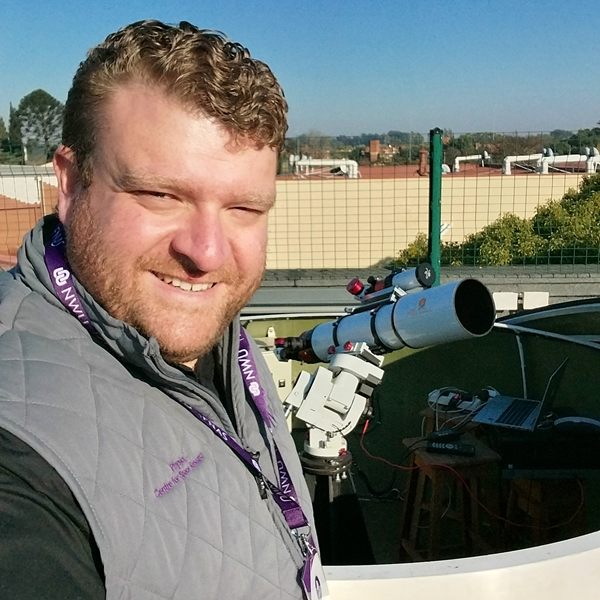
Dr Ruhann Steyn.


