
We live in Africa, a continent of rich cultures, beautiful landscapes, diverse people and endless possibilities. From its busy cities and growing towns to its quiet villages and close-knit communities, Africa is filled with stories of creativity, determination and progress. Every day, people across the continent are coming up with new ideas, finding ways to solve local problems and creating opportunities for a better future. Yet, when the world speaks about foreign aid and development, these stories are often overlooked. Africa is too often portrayed as a continent waiting for help, rather than one rich in knowledge, experience and ideas, with the ability to shape its own future.
This was the central message of a lecture hosted by North-West University’s (NWU) Focus Area for Social Transformation (FAST) on 22 October 2026. The lecture featured Dr Jacinta Mwende Maweu, a senior lecturer in Philosophy and Media Studies at the University of Nairobi in Kenya, who explored how the media can help amplify Africa's agency in foreign aid and the right to development.
Dr Maweu is a senior lecturer in Philosophy and Media Studies at the University of Nairobi and an associate faculty member at its Institute for Climate Change and Adaptation. She holds master's degrees in Philosophy and Media Studies from the University of Nairobi and a PhD from Rhodes University in South Africa. With more than 19 years of experience in higher education and research, her work spans social and political philosophy, environmental ethics, climate change, media and human rights, democracy, conflict and peacebuilding.
Speaking on the topic, The role of the media in amplifying Africa's agency in foreign aid and the right to development, Dr Maweu challenged the way Africa is represented in global development conversations. She argued that the media, both on the continent and internationally, has an important role to play in shifting the narrative from one in which Africa is spoken about to one in which Africans actively shape the conversation.
She explained that development reporting should not focus only on what is going wrong, but should also highlight what is working, influence better policy choices and give visibility to alternative pathways to development beyond dependence on foreign aid.
Drawing on her research in media ethics, democracy, human rights, climate change and peacebuilding, Dr Maweu highlighted how media coverage can influence public understanding of foreign aid and, ultimately, how Africa's right to development is recognised.
One of the issues she raised was the tendency of media reports to focus on how much governments borrow or receive in foreign aid, without sufficiently examining what these figures mean for ordinary people.
"We don't just want to hear how much our leaders have borrowed," she said, emphasising the need for journalists to explain how these decisions affect people's everyday lives.
She acknowledged that commercial, political and economic interests often influence which stories receive attention. However, she stressed that the media's social responsibility should not be overlooked. Journalists must ask difficult questions, scrutinise both governments and donor agencies, and hold those in positions of power accountable.
The discussion also turned to climate change and the importance of recognising the knowledge and solutions that already exist within African communities.
Using Kenya as an example, Dr Maweu questioned the effectiveness of introducing development interventions without first understanding the realities of the communities they are intended to serve. She referred to the country's tree-planting initiative, pointing out that in areas where water scarcity is a major challenge, encouraging communities to plant trees without addressing the availability of water may not offer a lasting solution.
Instead, she argued for approaches that build on existing local knowledge, resilience and community-led initiatives, with external assistance strengthening these efforts rather than replacing them.
The question-and-answer session further explored how African media can move beyond negative or deficit-based portrayals of the continent while maintaining its responsibility to hold governments and development partners accountable.
Dr Maweu reiterated that amplifying African voices does not mean abandoning critical journalism. Rather, it means giving equal attention to African expertise, local innovations and community-led solutions while continuing to question how development programmes are designed, funded and implemented.
She concluded by emphasising that Africa's agency depends on its people having a voice in the decisions and conversations that shape their development. Access to accurate information, transparency and accountability are essential to making this possible.
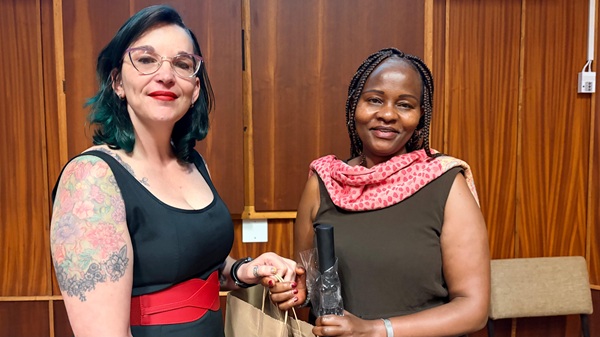
Prof. Aïda C. Terblanché-Greeff and Dr Jacinta Mwende Maweu
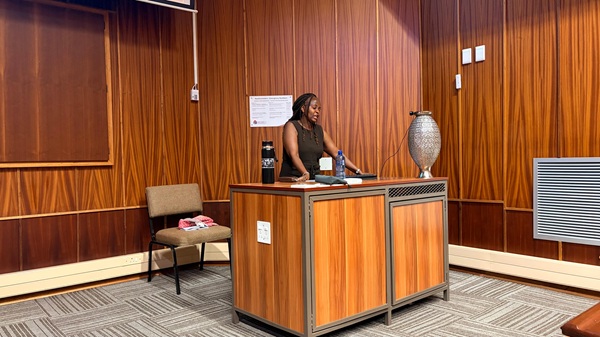
Dr Jacinta Mwende Maweu


