
The future of higher education is being shaped at the intersection of artificial intelligence, cybersecurity, digital transformation and human leadership – and the North-West University (NWU) is making its voice heard at the centre of that conversation.
As universities grapple with unprecedented technological change, two senior NWU leaders are contributing to efforts to ensure that the people leading this transformation are equipped for the challenges ahead.
Andiswa Msi, campus chief director of the Vanderbijlpark Campus, and Thato Lehutso, IT service delivery director, are serving as faculty members at the Higher Education Information Technology South Africa (HEITSA) Annual Leadership Institute (ALI) in Cape Town.
Their participation places the NWU among institutions contributing directly to the development of current and emerging leaders in higher-education technology.
The intensive leadership programme brings together managers and emerging leaders from across the higher-education technology sector, challenging participants to move beyond technical expertise and develop the ability to lead people, manage change, influence strategy, make complex decisions and drive meaningful institutional transformation.
For Andiswa, serving as a faculty member represents a significant milestone in her leadership journey.
“Serving as a faculty member at the HEITSA ALI is meaningful to me both professionally and personally. It gives me an opportunity not only to share my own leadership experience, but also to contribute to the development of managers who are leading in an increasingly complex higher-education technology environment,” she said.
Andiswa is facilitating sessions on effective teams and ethical considerations, while Thato is facilitating emotional intelligence and leading for performance. Their areas of contribution highlight a critical reality facing universities: technology transformation is not simply about implementing new systems. It is about people.
The human side of technology leadership
As artificial intelligence changes the way institutions work, cybersecurity threats become more sophisticated and digital platforms increasingly shape teaching, learning and administration, and technology leaders are being called upon to do far more than manage infrastructure.
They must lead people through uncertainty, build trust, make ethical decisions and ensure that technological innovation remains aligned with institutional purpose.
For Thato, emotional intelligence is central to this process.
“Every leadership decision is influenced by emotion before it is justified by reason. The emotionally intelligent leader is not the one who ignores emotions, but the one who understands them well enough to lead wisely,” he said.
The statement captures one of the central themes of the institute – that effective technology leadership requires more than technical competence.
Self-awareness, empathy, communication, sound judgement and the ability to understand and influence people are increasingly becoming essential leadership capabilities.
The institute brings together faculty and participants from a range of institutions and international environments, including the University of Cape Town, the University of South Africa, Auckland University of Technology and the University of Western Australia.
From technology managers to transformation leaders
Rapid technological change is forcing universities to rethink leadership in the digital age. Artificial intelligence, cybersecurity, digital learning and data are transforming how institutions operate, requiring technology leaders to become strategic thinkers, change agents, people leaders and ethical decision-makers.
This is reflected in the focus on leadership, emotional intelligence, ethical decision-making, effective teams, performance, communication and change management of the HEITSA ALI.
For Andiswa, successful transformation depends on taking people along the journey through trust, sound judgement and a shared sense of purpose.
The participation of two NWU leaders also highlights the contribution of the university to shaping higher-education technology leadership while creating opportunities for knowledge-sharing, collaboration and innovation.
“For me, the most important message is that the NWU is not only part of the higher-education technology ecosystem. Through opportunities such as this, we are also helping to shape the leadership capability of that ecosystem,” she said.
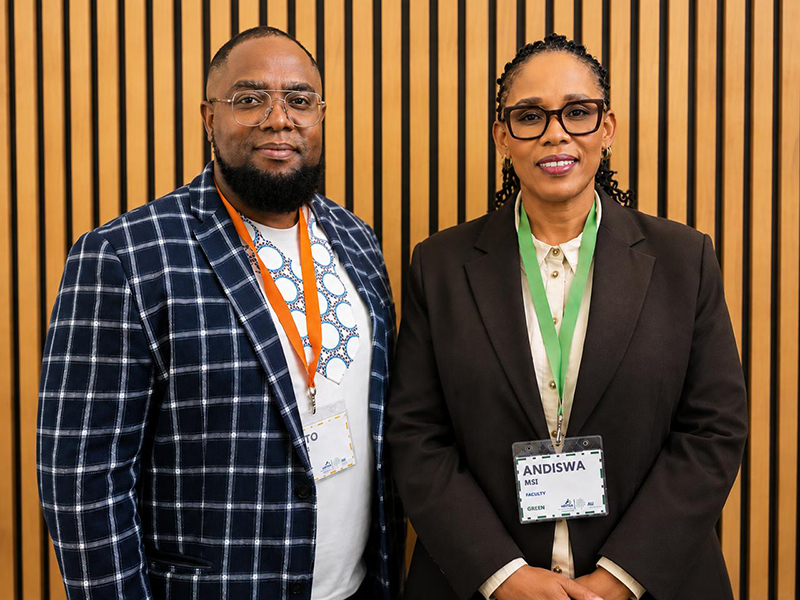
Thato Lehutso and Andiswa Msi are serving as faculty members at the Higher Education Information Technology South Africa Annual Leadership Institute in Cape Town.


