
The North-West University (NWU) positioned higher education as a driver of global cooperation as leaders from government, academia and the diplomatic community gathered to mark the 29th International Day of the Indian Ocean Rim Association (IORA) at its Mahikeng Campus on 27 March 2026.
The event, held in partnership with the Department of International Relations and Cooperation (DIRCO), brought together stakeholders from across the Indian Ocean region, including diplomats and ambassadors from member states and dialogue partners.
Its aim was to reflect on the theme “Strengthening connections amongst the people of IORA”, while outlining the role of academic institutions in driving economic participation and cooperation.
Dr Joe Molete, deputy vice-chancellor for student life, transformation, people and culture with the assigned function of the Mahikeng Campus, delivered a message on behalf of the NWU principal and vice-chancellor, Prof. Bismark Tyobeka. He said higher education has become central to economic development and global collaboration.
“The global higher education system has reached a scale of over 264 million students worldwide,” he said, adding that this expansion reflects a shift where education underpins economic growth and societal transformation.
He said the Indian Ocean region remains a key site for trade, knowledge exchange and cooperation, and that institutions must act within multilateral frameworks to respond to global challenges. “No single institution, and no single country, can adequately respond to these challenges in isolation. Collaboration is essential.”
Dr Molete said universities are active participants in development, pointing to the NWU’s strategy of impact, internationalisation and partnerships. He cited institutional projects such as the Desmond Tutu School of Medicine, the School of Mines and Mining Engineering and the AgriHub as examples of aligning education with economic participation and research.
“These platforms serve as living laboratories… demonstrating how universities can translate knowledge into impact,” he said.
DIRCO representative and IORA alternate senior official Ben Joubert placed the event within a broader geopolitical context, warning that instability in the Indian Ocean region affects trade and livelihoods. He said cooperation remains central to managing conflict and sustaining development.
“Conflicts have spilled into our beloved Indian Ocean Region with dire consequences to lives, livelihoods, international trade and maritime transport routes,” he said.
He added that partnerships linked to the Blue Economy, the sustainable use of ocean and coastal resources, and continental initiatives such as Agenda 2063, the African Unions 50-year masterplan to transform Africa into an international powerhouse, are necessary to support growth and regional integration.
Speaking on behalf of the South African chapter of the IORA Academic Group, Kgame Molope, programme leader in the subject group Political Studies and International Relations at the NWU, said the hosting of the event at NWU reflects the growing role of universities in regional cooperation. “Hosting the 29th IORA Day celebration affirms our contribution to regional cooperation and sustainable development,” he said.
He also called for stronger academic collaboration across the region, including training programmes and research exchanges.
The programme included contributions from diplomatic representatives, government officials and student leadership, reflecting a multi-stakeholder approach to regional engagement.
Dr Molete said the focus must now shift from dialogue to implementation. “IORA provides the framework. its continued relevance will be defined by the extent to which we translate this framework into measurable outcomes.”
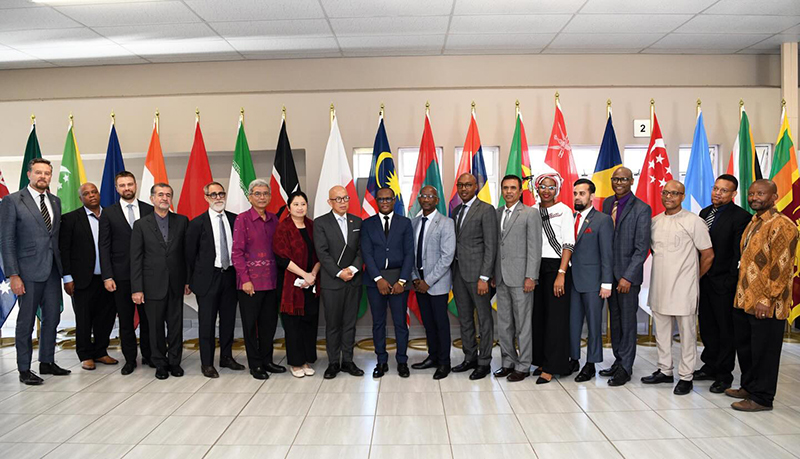
Diplomates, NWU officials and executives from DIRCO gathered to mark the 29th International Day of the Indian Ocean Rim Association (IORA).
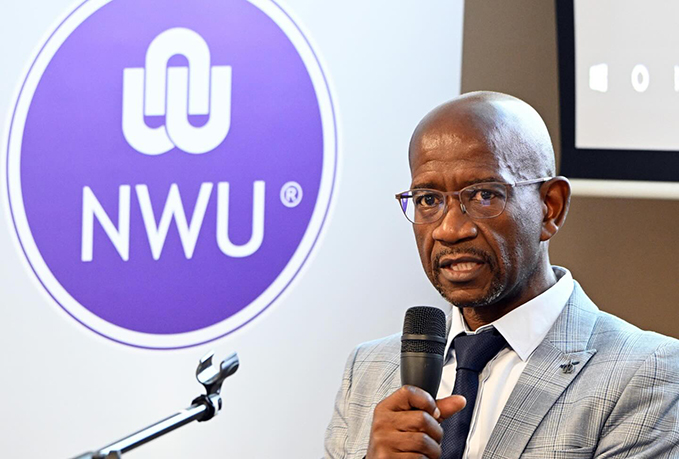
Dr Joe Molete, deputy vice-chancellor for student life, transformation, people and culture with the assigned function of the Mahikeng Campus, delivered a message on behalf of the NWU principal and vice-chancellor, Prof. Bismark Tyobeka.


