
The North-West University (NWU) honoured Kgosi Kgotleng Jeffrey Montshioa, king of the Barolong Boo Ratshidi, for 25 years of traditional leadership and service, while reaffirming the commitment of the university to indigenous knowledge, heritage and meaningful partnerships with traditional communities.
The occasion, held on 8 October 2026 at the NWU’s Mahikeng Campus, brought together traditional leaders, academics, students, government representatives, community stakeholders and members of the Royal House of Barolong for a heritage public lecture themed “Heritage, leadership and legacy: celebrating 25 years of Kgosi Jeffrey Montshioa and the living heritage of the Barolong Boo Ratshidi”.
The programme included an indigenous knowledge and Barolong heritage exhibition, cultural performances, a public lecture by Kgosi Montshioa, a moderated discussion and engagement with the audience.
Leadership is service
Reflecting on his 25 years of leadership, Kgosi Montshioa described the milestone not simply as a celebration, but as an opportunity to reflect on his journey, his people and the responsibility he carries towards future generations. He emphasised that traditional leadership is fundamentally about service and listening. “A traditional leader does not own a community. A traditional leader serves a community. The title may give one authority, but it is the people who give meaning to that responsibility. Kgosi, ke Kgosi ka morafe.”
For Kgosi Montshioa, leadership requires leaders to listen carefully to their communities, understand changing circumstances and remain present in the lives of the people they serve.
Heritage as a living inheritance
The lecture placed particular emphasis on heritage as something that must be lived, protected and passed on to future generations. Kgosi Montshioa reminded young people that their cultural heritage should not be viewed as a burden, but as a valuable inheritance. “Your heritage is not a burden. It is an inheritance. Ke letlotlo!”
He noted that heritage extends beyond ceremonies, clothing, music and dance. It encompasses language, history, values, indigenous knowledge and the wisdom passed from one generation to another. He encouraged young people to remain rooted in their heritage while embracing technology, education, research, entrepreneurship and opportunities in the modern world.
Knowledge belongs to communities
In his remarks, the NWU principal and vice-chancellor, Prof. Bismark Tyobeka, reflected on the importance of bringing different knowledge systems together.
Drawing on the African proverb, “Wisdom is like a baobab tree; no one individual can embrace it”, Prof. Tyobeka emphasised that knowledge does not belong exclusively to one person, institution or system.
He highlighted the knowledge held in communities, including their languages, histories, relationship with the land, customary practices and intergenerational experiences, and called for stronger collaboration between universities, traditional authorities and communities.
He also emphasised the constitutional recognition of traditional leadership and customary law, noting that the constitutional democracy of South Africa should provide space for traditional institutions to develop within the values of human dignity, equality, freedom and the rule of law.
Bridging indigenous knowledge and academic scholarship
Prof. Tyobeka stressed that meaningful engagement with communities requires more than developing solutions in academic or institutional spaces and then presenting them to communities. Instead, communities and traditional authorities should be involved in identifying challenges, shaping solutions and evaluating outcomes.
He pointed to opportunities for collaboration in areas such as food security, agriculture, youth unemployment, mental health, early childhood development, education and economic participation.
The NWU already has several initiatives that can contribute to this approach, including the work of its Law Clinic, veterinary services and Molelwane agricultural initiatives. The commitment of the university to indigenous knowledge also recognises the central role of indigenous languages in preserving identity, memory, culture and knowledge.
Strengthening the NWU-Barolong Boo Ratshidi partnership
The event also provided an opportunity to strengthen the relationship between the NWU and the Barolong Boo Ratshidi traditional leadership.
Through the office of Dr Joe Molete, the deputy vice-chancellor for student life, transformation, people and culture with the assigned function of the Mahikeng Campus, the NWU is initiating a process towards establishing a formal memorandum of understanding with the Barolong Boo Ratshidi.
The proposed partnership will explore opportunities in areas including indigenous knowledge systems, education, history, tourism, health, language, business, youth development and community engagement.
The intention is to conclude the process by the end of 2026, paving the way for a formal signing ceremony between Kgosi Montshioa and Prof. Tyobeka. The partnership reflects the broader commitment of the NWU to working with traditional authorities and communities to ensure that knowledge and expertise are translated into meaningful opportunities and development outcomes.
A legacy measured by people
For Kgosi Montshioa, the true measure of leadership is not found in titles or monuments, but in the lives changed and opportunities created. “Legacy is not a monument. It is not a title. It is found in people. It is found in the young person who receives an opportunity. It is found in knowledge that is preserved. It is found in a community that remains united. It is found in institutions that become stronger. It is found in the values that survive from one generation to another.”
His message resonated with the commitment of the university to developing graduates and communities who are equipped to contribute meaningfully to society while remaining connected to their heritage and identity.
A symbolic gift from the NWU
In a gesture symbolising the respect of the university for Kgosi Montshioa, the Barolong Boo Ratshidi Royal House and the enduring relationship between the NWU and traditional communities, Prof. Tyobeka presented Kgosi Montshioa with a Bonsmara heifer on behalf of the NWU.
The gift, presented at the conclusion of the Heritage Public Lecture, carried significance beyond the occasion itself. It reflected the recognition of the university of the importance of cattle in the cultural and traditional life of communities, while also symbolising partnership, continuity, heritage and shared responsibility for future generations. The presentation further strengthened the spirit of collaboration between the NWU and the Barolong Boo Ratshidi as the university continues to pursue opportunities for partnership in indigenous knowledge systems, education, agriculture, language, tourism, youth development and community engagement.
Prof. Tyobeka concluded by returning to the image of the baobab tree, emphasising that wisdom and progress are strengthened when people gather around shared knowledge and purpose. “If wisdom is indeed like a baobab tree that no individual can embrace alone, then perhaps our responsibility is to gather around that tree together.” The heritage public lecture therefore served not only as a celebration of 25 years of Kgosi Montshioa’s leadership, but also as a platform for reflection on the role of traditional leadership, indigenous knowledge and universities in shaping a stronger future.
As the NWU continues to deepen its relationship with traditional communities, the university reaffirmed that heritage is not simply something to remember. It is knowledge to preserve, a foundation on which to build and a living legacy to pass on to future generations.
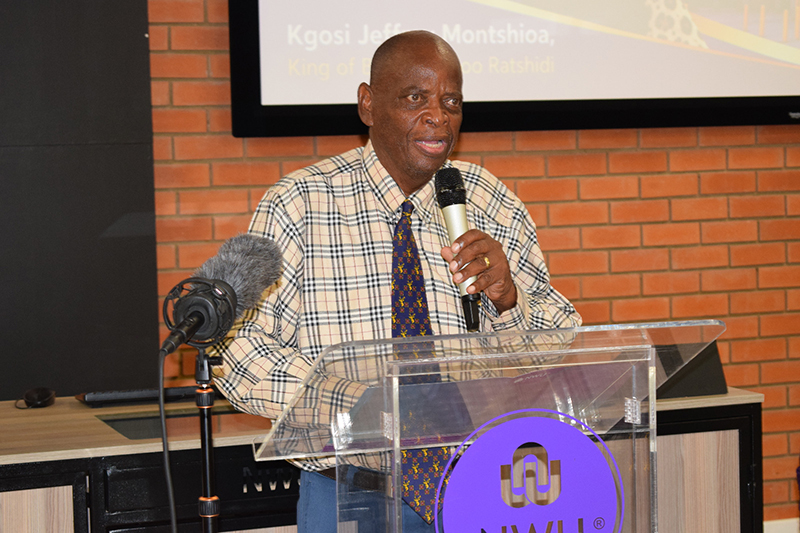
During the lecture, Kgosi Montshioa reminded young people that their cultural heritage should not be viewed as a burden, but as a valuable inheritance.
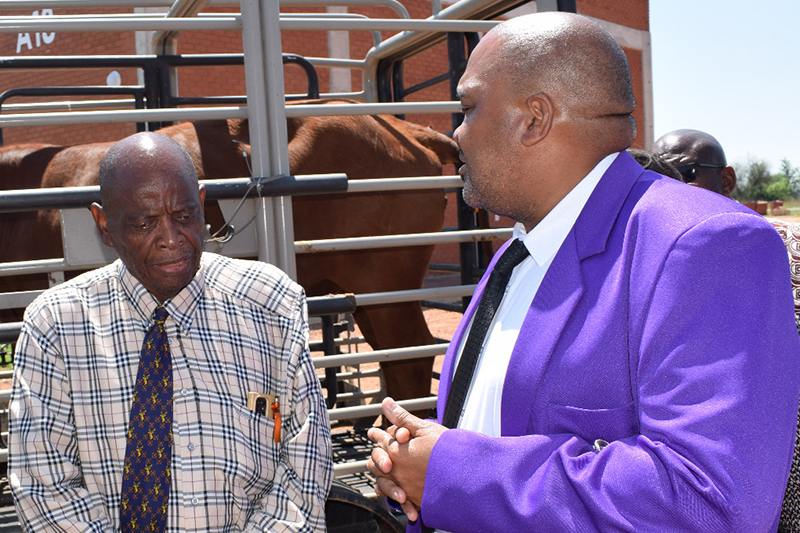
Prof. Tyobeka presented Kgosi Montshioa with a Bonsmara heifer on behalf of the NWU.


