
Against the backdrop of South Africa's persistent youth unemployment crisis, the North-West University (NWU) hosted its Economic Update under the theme Umuntu Omusha – "Education for Jobs in Our Economy", challenging students to rethink their role in the economy by becoming adaptable graduates, innovative entrepreneurs and ethical leaders capable of shaping South Africa's future.
Held at the Tsebonokeng Hall on the Vanderbijlpark Campus on 13 July, the event brought together students, university leadership, industry representatives and economic stakeholders for a solutions-focused discussion on graduate employability, entrepreneurship and inclusive economic growth.
The dialogue was opened by Prof Jeffrey Mphahlele, Deputy Vice-Chancellor for Research and Innovation, Community Engagement and Postgraduate Studies, followed by a keynote address by Andiswa Msi, Campus Chief Director. A panel discussion featuring Prof Mphahlele, Dr Tumi Ledwaba, Deputy Director in the School of Social Sciences., Tshepang Motlhamme, Bulelani Mxwera, Adin Bernard and Sibusiso Hlongwane concluded with an interactive question-and-answer session.
In his opening remarks, Prof Mphahlele described South Africa's youth unemployment crisis as deeply concerning, noting that while the statistics are sobering, they should inspire action rather than despair. He emphasised that graduate employability must become an institutional priority, embedded across teaching, curriculum design and the broader student experience.
"The reality of youth unemployment demands that universities rethink their role. Graduate employability cannot be confined to student support initiatives – it must be embedded across our teaching, curriculum and institutional priorities. At NWU, we are committed to developing graduates who possess not only academic excellence, but also the entrepreneurial mindset, innovation and practical skills needed to become ethical leaders, problem-solvers and creators of employment in their communities," he said.
Delivering the keynote address, Andiswa encouraged students to take ownership of their career journeys by proactively developing the skills and experience employers increasingly demand. While qualifications remain important, she said graduates must also demonstrate communication, digital literacy, teamwork, adaptability and initiative. She encouraged students to view entrepreneurship as a way of solving everyday problems, creating value in their communities and building sustainable livelihoods.
"Your qualification opens the door, but it is your skills, resilience, initiative and willingness to keep learning that will determine how far you go. Do not wait for opportunities to find you; create them. Become problem-solvers, innovators and job creators who use your talents to make a meaningful difference in your communities and in the economy," she said.
Organised by SASCO at the NWU Vanderbijlpark Campus in collaboration with student leadership structures, the dialogue sought to strengthen the relationship between higher education, economic development, entrepreneurship and employment.
Speakers highlighted that while South Africa's overall unemployment rate stands at 32,7%, youth unemployment remains disproportionately high at 60,9% among those aged 15 to 24 and 40,6% for those aged 25 to 34. They stressed that these figures represent not only an economic challenge, but also untapped potential that requires coordinated action from universities, government and industry.
A recurring theme throughout the evening was that universities must become catalysts for economic growth by producing graduates who are equipped for the future of work. Beyond academic excellence, students were encouraged to cultivate transferable skills such as critical thinking, problem-solving, communication, integrity, teamwork and digital literacy, while actively seeking practical experience and expanding their professional networks.
Entrepreneurship was positioned as an essential driver of inclusive growth. Rather than focusing solely on establishing businesses, speakers encouraged students to identify challenges within their communities and develop innovative solutions capable of creating both social and economic value. By fostering an entrepreneurial mindset, graduates can become not only job seekers, but also job creators.
Aligned with the National Development Plan 2030, government's economic reconstruction priorities and the NWU Strategy: Taking the NWU Forward 2024 and Beyond, the Economic Update reinforced the importance of stronger collaboration between higher education, government and industry to improve graduate outcomes. The event concluded with a shared commitment to transforming discussion into action by strengthening partnerships that prepare graduates not only to enter the workforce, but also to create opportunities through innovation, leadership and entrepreneurship, contributing meaningfully to South Africa's social and economic development.
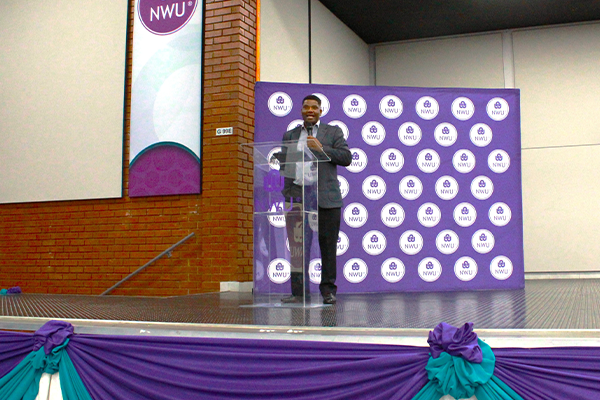
Prof Jeffrey Mphahlele
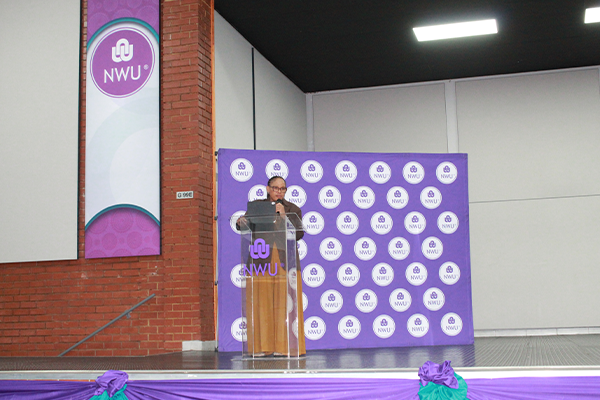
Andiswa Msi
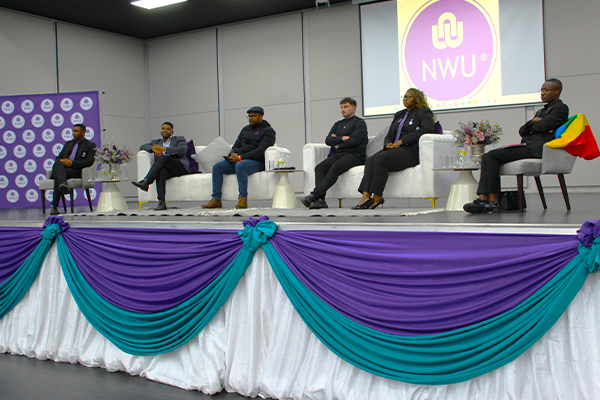
The panel: Sibusiso Hlongwane, Prof Jeffrey Mphahlele, Dr Tumi Ledwaba, Adin Bernard, Tshepang Motlhamme and Bulelani Mxwera
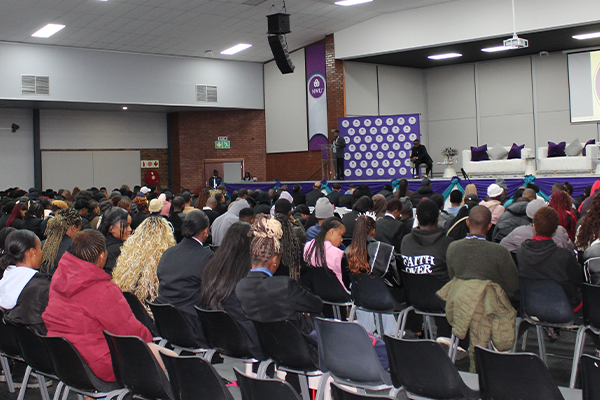
Attendees


