
As the world accelerates its transition towards cleaner and more secure energy systems, Africa – and South Africa in particular – cannot afford to be spectators. Green hydrogen presents a unique opportunity to strengthen energy security, drive industrial growth, create skilled jobs and position the continent as a future leader in the global low-carbon economy. A sustained commitment to hydrogen research today could unlock long-term economic and environmental benefits for generations to come.
It is a vision that the North-West University (NWU) is actively helping to advance. For the past 15 years, the NWU, in partnership with the Council for Scientific and Industrial Research (CSIR), has co-hosted the Department of Science, Technology and Innovation (DSTI)-supported HySA Infrastructure Centre of Competence (CoC), one of South Africa’s flagship hydrogen research initiatives.
Recently, Vice-Chancellor Prof. Bismark Tyobeka and members of the NWU Senior Management Team visited the centre to engage with its latest achievements, ongoing projects and strategic priorities for the next five years.
The CoC is headed by Prof. Dmitri Bessarabov, Director of the DSI National Centre of Competence: Hydrogen Infrastructure, who says hydrogen is already indispensable to modern society, underpinning industries that support food security and economic development.
“Without hydrogen, modern society would not be able to produce fertilisers, refine petrochemical feedstocks, manufacture methanol or sustain many of the industrial processes that underpin modern economies,” he says.
He adds that green hydrogen offers South Africa a unique opportunity to convert its abundant wind and solar resources into valuable export products, such as green ammonia, that can be supplied to countries with limited renewable energy capacity.
The recent engagement between NWU leadership and the HySA Infrastructure CoC underscored the University’s long-term commitment to hydrogen as a strategic research priority.
“NWU is committed to continuing its journey towards innovation in the energy transition across various low-carbon energy technologies. Low-carbon hydrogen forms an important and strategic area for the University. It is our intention to continue supporting the HySA Centre of Competence,” says Prof. Tyobeka, who also acknowledged the longstanding support of the Department of Science, Technology and Innovation.
The HySA Infrastructure CoC’s research agenda reflects both national priorities and global trends. Its focus areas include green hydrogen and ammonia production,
advanced hydrogen storage technologies, hydrogen applications for green ironmaking, and hydrogen safety solutions. Together, these initiatives aim to unlock greater value from South Africa’s mineral resources – particularly its platinum group metals (PGMs), which are critical to many hydrogen technologies – while laying the foundations for a globally competitive hydrogen economy.
The centre’s work extends beyond scientific discovery. It is cultivating specialist skills, strengthening research partnerships and accelerating industrial development in a field expected to play a pivotal role in future energy systems. HySA also works closely with industry partners to ensure that research outcomes can be translated into practical applications that support commercialisation, industrial growth and South Africa’s broader energy transition.
During the engagement, Prof. Jeffrey Mphahlele, Deputy Vice-Chancellor for Research and Innovation, emphasised the importance of strengthening collaboration with the National Research Foundation (NRF) to further enhance South Africa’s hydrogen research ecosystem. Prof. Linda du Plessis, Deputy Vice-Chancellor for Teaching and Learning, reaffirmed the University’s commitment to supporting hydrogen-related education and human capital development initiatives.
As countries compete to secure a foothold in the emerging hydrogen economy, institutions such as NWU will play a pivotal role in determining whether South Africa remains a consumer of future technologies or becomes one of their creators. Through the HySA Infrastructure CoC, NWU is helping to position South Africa to be the latter.
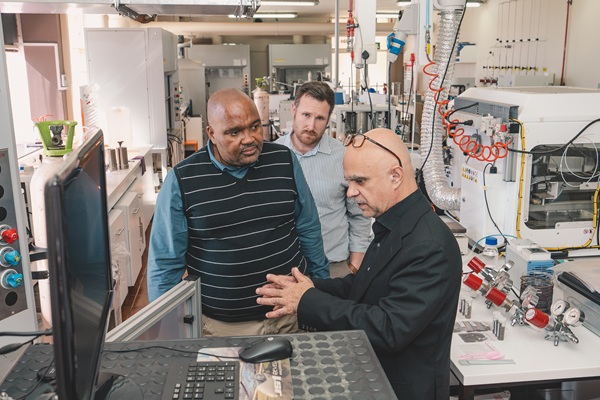
Innovation in action
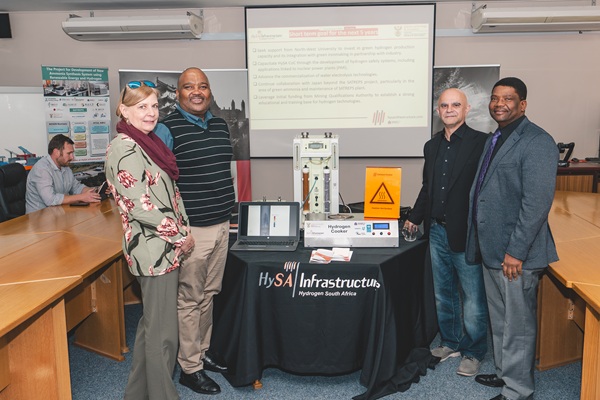
Prof. Linda du Plessis, Prof. Bismark Tyobeka, Prof. Dmitri Bessarabov and Prof. Jeffrey Mphahlele


