
From the classrooms of the Mahikeng Campus of the North-West University (NWU) to the leadership of the Special Investigating Unit (SIU) of South Africa, Leonard Gaoretelelwe Lekgetho’s journey is one of perseverance, academic excellence and a lifelong commitment to public service.
Born and raised in Taung, North West, Leonard has built a career defined by discipline, resilience and an unwavering determination to make a difference. His recent appointment as permanent head of the SIU marks another significant milestone in a journey that began at the NWU.
From his early career as an investigator with the former Directorate of Special Operations (DSO), widely known as the Scorpions, to his rise through the ranks of the SIU, Leonard has remained committed to protecting public resources, uncovering wrongdoing and strengthening accountability.
From Taung to the NWU
Leonard chose the NWU because it was the closest university to home and was highly regarded for its academic excellence. Many of his high school classmates were also planning to attend the university, while several of his teachers were NWU graduates.
“I admired their achievements and professionalism, which inspired me to follow a similar path and enrol at the university,” he recalls.
His time at the NWU became an important foundation for his professional life. He remembers dedicated lecturers, a safe and conducive learning environment and a vibrant student political environment that encouraged leadership, debate and participation.
Among those who made a lasting impression was his Geography lecturer, Dr Wagner, whom he describes as exceptionally supportive.
“He encouraged me to further my academic journey by registering for both an honours and a master's degree,” he says.
“The NWU taught me a great deal and played a significant role in shaping the person I am today.”
During his honours-degree studies, Leonard specialised in Geographic Information Systems (GIS), developing an interest in applying data and spatial analysis to complex challenges. His academic journey later expanded to include qualifications in law, education and science, a diploma in forensic auditing and a postgraduate diploma in cyber law.
From scorpion to cobra
While completing his master’s degree, Leonard joined the DSO. His natural curiosity and love of problem-solving had already drawn him towards investigations, while his uncle, a police officer, had also influenced his career choice.
“I often visited him at work and was fascinated by the way he approached cases, gathered evidence and solved problems,” he says.
At the DSO, Leonard developed his investigative skills and proposed using GIS and spatial analysis to support criminal investigations and intelligence gathering.
When the Scorpions were disbanded, he moved to the SIU in 2007. His career progression took him from chief forensic investigator to assistant project manager, project manager and regional head of the Limpopo office of the SIU. He later served as programme manager, projects director, chief national investigations officer and chief operations officer.
“I have spent almost 20 years at the SIU, dedicating my career to investigative work,” he says.
His experience working under previous SIU heads also shaped his leadership philosophy, giving him insight into different approaches to leading the organisation.
Leading the SIU
Leonard previously served as acting head of the SIU before his permanent appointment.
“Receiving the news of my appointment as the permanent head of the SIU was both a humbling and deeply gratifying moment,” he says.
He views the appointment as more than a personal achievement, saying it reflects the contribution of the many people who supported his development.
As head of the organisation, his priorities include strengthening investigative and litigation capabilities, improving the speed at which matters are finalised and enhancing the recovery of financial losses suffered by the state.
He also wants to invest in the greatest asset of the SIU – its people.
“The greatest asset of the SIU is its people,” he says, highlighting the importance of specialised skills, leadership development and creating an environment in which employees can perform at their best.
Leonard identifies digital forensics, data analytics and financial investigations as increasingly important in tackling sophisticated forms of corruption.
“No single institution can combat corruption alone,” he says, calling for stronger collaboration between government institutions, law-enforcement agencies, oversight bodies, civil society and other stakeholders.
Beyond investigation
For Leonard, lasting change requires more than investigating wrongdoing.
“While accountability for wrongdoing is essential, lasting impact will only be achieved if we place equal emphasis on prevention, ethical leadership and strengthening institutions,” he says.
He advocates for strong governance systems, effective internal controls and transparent procurement processes, while emphasising that ethical behaviour must be demonstrated from the top.
Technology, he adds, will increasingly help identify risks and detect irregularities through data analytics and digital forensics.
A message to NWU students
Despite his national responsibilities, Leonard remains connected to the institution where his journey began. His advice to students is rooted in his own experience: remain curious, work hard and never underestimate the importance of integrity.
“Technical knowledge is important, but your character and values will ultimately define your reputation and success,” he says.
For aspiring investigators and forensic auditors, he recommends curiosity, attention to detail, critical thinking and objectivity. He also encourages students to embrace technology and innovation as artificial intelligence, data analytics and digital forensics reshape their professions.
Lastly, and perhaps most importantly, he urges young people to believe in their potential.
“My own journey started at the NWU, and I could never have imagined the opportunities that lay ahead,” he says.
“Success rarely happens overnight. It is built through perseverance, discipline, resilience and a willingness to learn from both successes and setbacks.”
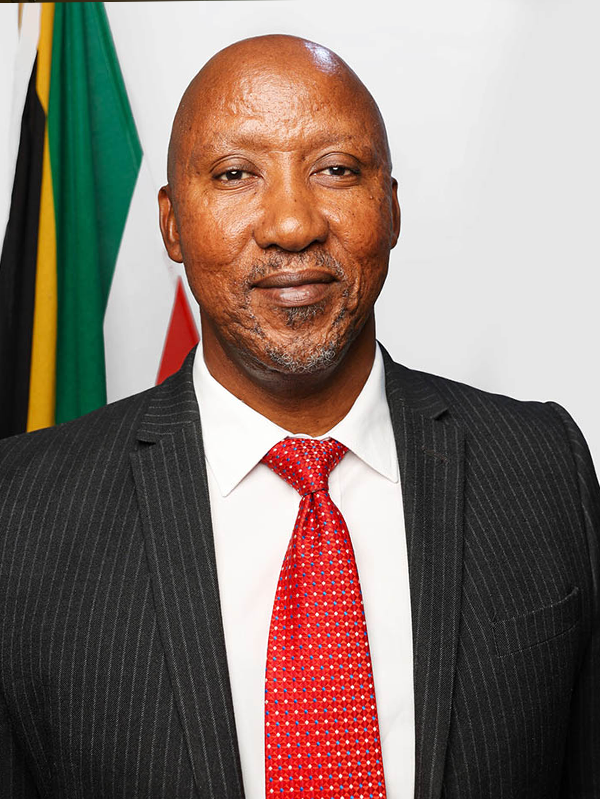
Photo: Leonard Gaoretelelwe Lekgetho


