
The North-West University (NWU) chancellor, Dr Anna Mokgokong, has highlighted the potential of strategic partnerships between universities, traditional leadership, farmers and industry to strengthen agricultural production, create employment and connect local producers to commercial markets.
Dr Mokgokong joined his majesty Kgosi Motheo Mamogale, king of the Bakwena Ba Mogopa, representatives of the NWU Department of Agriculture and producer Dawie Rothmann, owner of Rothmann Boerdery, for a pilot barley harvest on Monday, 26 October 2026.
Held under the theme “From rural potential to industrial prosperity”, the harvesting demonstration marked an important milestone in exploring how scientific expertise, available land and industry partnerships can unlock agricultural opportunities and contribute to economic growth.
The pilot project aims to assess the potential for producing barley for industrial use, including the brewing industry, with Heineken identified as a potential off-taker. The initiative brings together agricultural expertise, traditional leadership, farming capacity and commercial opportunities to establish a model that could benefit additional farmers and communities.
Dr Mokgokong described the initiative as an example of how collaboration can connect farmers to the knowledge, resources and markets needed to participate meaningfully in the economy. “We are here today to witness the harvesting of our barley project. This is a very significant initiative because it is the pilot of a partnership that brings together the NWU scientists and professors, Kgosi Mamogale as patron of the initiative, and commercial partners who help connect the project to potential financing partners, off-takers and other resources,” she said.
She emphasised that communities with access to land have an opportunity to participate more actively in agriculture, diversify their sources of income and contribute to addressing poverty and unemployment.
“Agriculture offers a wide range of opportunities, and we must explore how this land can be used to address poverty and unemployment while opening doors to global export markets,” Dr Mokgokong said. She also highlighted the importance of agricultural exports in expanding market opportunities and strengthening the competitiveness of local producers. “Exports can create additional demand, diversify revenue streams and help our producers compete internationally in export crops,” she said.
However, she cautioned that accessing international markets requires more than production capacity. “Export success requires consistent quality, reliable supply, sanitary and phytosanitary compliance, efficient logistics and market knowledge,” she said. “Our vision must be to build agricultural value chains that are locally rooted, nationally competitive and regionally connected.”
Dr Mokgokong added that the harvest would provide valuable production data to assess the outcomes of the pilot and inform decisions on the potential expansion of barley production.
Traditional leadership enables agricultural participation
Kgosi Mamogale welcomed the partnership, explaining that the farm in Bakweneng had been selected because it met the requirements of the project, including irrigation infrastructure, start-up resources and the capacity to manage production according to the required standards.
“We are here to experience the harvesting of barley for Heineken. This is one of the farms we identified in Bakweneng because it had the necessary resources, including irrigation and the capacity to manage the farm according to the required standards,” he said.
Kgosi Mamogale explained that the land had been made available after Dr Mokgokong, through CEO Mogamisi, had approached him to request land for the initiative. The barley had been planted in March, and the harvest marked a key stage in evaluating the progress of the project. He stressed that the pilot should encourage wider participation by domestic, emerging and commercial farmers, as well as community farming associations.
“This is a pilot project, but it is not a project to be forgotten. We want to encourage every farmer, whether domestic, emerging or commercial, as well as community associations, to participate. We are making land accessible to alleviate poverty, create employment and develop skills,” Kgosi Mamogale said. He welcomed the involvement of the NWU, particularly the participation of students, saying the collaboration connects academic knowledge with practical farming experience.
The Kgosi also highlighted the importance of inspiring young people to consider agriculture as a career and a business opportunity. He noted that mining companies in the surrounding area have supported local youth through educational opportunities, including studies in crop production and livestock farming. “We have young people in our communities who are interested in farming and agriculture, whether in crop production or livestock. Seeing a project like this can motivate them to do something better with their lives in this field,” he said.
From harvesting to commercial opportunities
Producer Dawie Rothmann, owner of Rothmann Boerdery, demonstrated the harvesting process, providing participants with practical insight into barley production and the requirements associated with supplying commercial markets. The involvement of an established farming operation offers an opportunity to evaluate the practical requirements of production, including irrigation, farm management and the ability to meet industry expectations.
For the NWU, this initiative provides a platform to apply scientific research and academic expertise to practical agricultural challenges while exposing students to commercial farming and collaboration between universities, the industry and communities.
The findings of the pilot will help determine the feasibility of expanding production and replicating the model on other farms. By linking agricultural research and expertise with land, farming capacity and potential market demand, the partnership seeks to establish a commercially viable approach that can benefit producers and strengthen the agricultural value chain.
The initiative reflects the commitment of the NWU to using knowledge and strategic partnerships to create practical solutions that contribute to economic participation, skills development and sustainable agricultural growth.
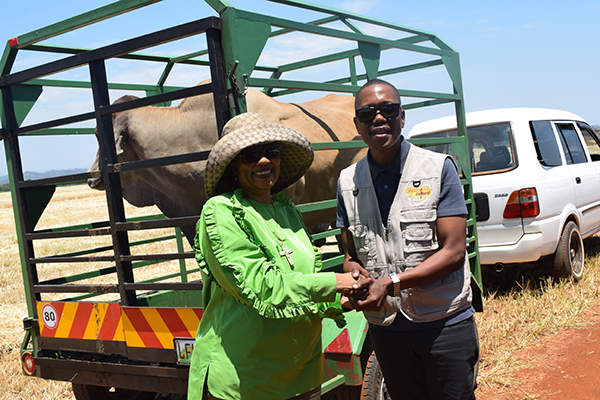
NWU Chancellor Dr Anna Mokgokong with his majesty Kgosi Motheo Mamogale of the Bakwena ba Mogopa.


