
On 14 May 2026, the Technology Transfer and Innovation Support Office (TTIS) at the North-West University (NWU) hosted a commemorative event to celebrate the granting of a European patent for a novel method to determine the risk of chronic stress and stroke.
The event brought together members of the Faculty of Health Sciences, family, friends and former colleagues of Prof. Leone Malan and her late husband, Prof. Nico Malan, whose decades of research underpin the invention.
The patented method uses a unique combination of three biomarkers that, when analysed together with blood pressure, enable the accurate identification of chronic stress risk in individuals. It also allows for the prediction of an individual’s likelihood of experiencing a stroke in the foreseeable future. This advancement opens new possibilities for early intervention and preventive healthcare, with potential benefits for patients and healthcare systems globally.
Highlighting the significance of the achievement, Dr Janine Chantson, TTIS chief director, said: “Behind every granted patent are years of dedication, patience and belief in an idea. This European patent not only recognises the contribution of Prof. Nico and Prof. Leone Malan as inventors but also affirms the global impact and commercial potential of research developed at the NWU.”
The breakthrough builds on more than 30 years of sustained research, originally conducted by Prof. Nico and later by Prof. Leone in the Hypertension in Africa Research Team (HART), housed in the Faculty of Health Sciences. Their work has made a significant contribution to cardiovascular research, particularly in the African context.
Prof. Nico retired from the NWU as head of HART and passed away in July 2024. Prof. Leone, who retired in 2024, continued to play an active role in the patent process by contributing to the finalisation of filings and responses to patent office examinations. The European Patent Office granted the patent on 25 March 2026, nearly seven years after the initial provisional application was filed. Patents have also been granted in South Africa and Australia, with applications in the USA and Canada still pending.
Prof. Jeffrey Mphahlele, deputy vice-chancellor for research and innovation, community engagement and postgraduate studies with the assigned function of the Vanderbijlpark Campus, described the innovation as a major contribution to global healthcare.
“Through this pioneering work, Prof. Leone and her late husband have gifted not only the NWU, but the world, with a life-changing and potentially life-saving innovation. It stands as a powerful example of how collaboration, perseverance and innovation can produce solutions to global health challenges,” he said.
In her remarks, Prof. Leone paid tribute to her late husband, their local and international collaborators and the pioneering contribution of the research team to the field.
“Nico Malan and his team were among the first researchers since 1987 to assess stress-axis responses in more than 10 000 individuals across Africa. Overwhelmed with gratitude, I honour his legacy as my beloved husband, a dedicated father, family man, friend, scientist, leader, colleague and now also as an inventor. I also extend my sincere appreciation to former colleagues, family and friends for their many years of love and support, as well as to the TTIS team for their dedicated technical assistance throughout the seven-year patent journey,” she said.
The European patent marks a significant milestone in translating decades of research into an innovation with the potential to improve health outcomes on a global scale.
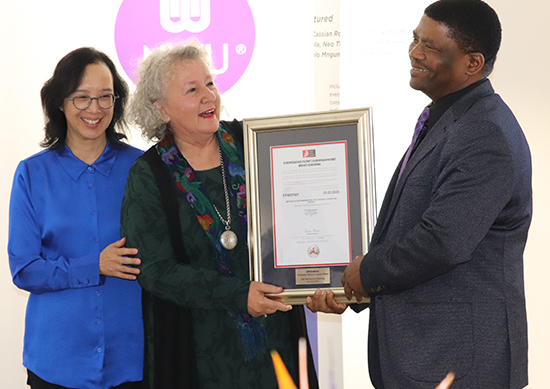
Prof. Jeffrey Mphahlele and Dr Janine Chantson’s hand over of the framed patent certificate to Prof. Leone Malan.
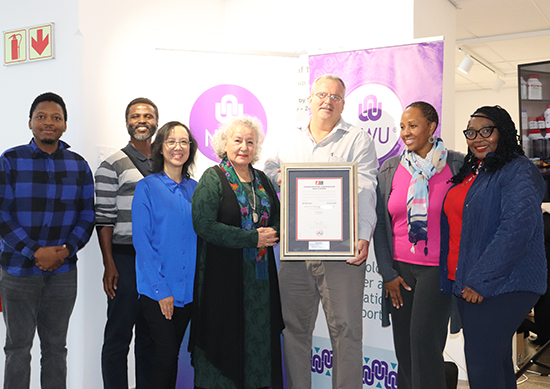
TTIS staff celebrate with Prof. Leone Malan.


