
Research can change lives, but what happens when the people who need it most cannot afford to access it? This question took centre stage as the North-West University (NWU) brought together academics, researchers and library professionals to examine the rising cost of publishing research and the barriers that prevent African scholars from sharing their work with the world.
The discussions formed part of the university’s International Open Access Week celebrations, hosted by the NWU Library and Information Service (LIS) in collaboration with various stakeholders. Under the theme “The cost of knowledge,” speakers called for a fairer research publishing system that lets people read, share and use knowledge without financial barriers.
The event also examined how universities can make research available to communities, policymakers and professionals who rely on scientific findings to address social and economic challenges.
Opening the programme, Veli Tshetsha, LIS director for research and open scholarship services, highlighted the importance of removing barriers that limit access to knowledge. She introduced the theme as an opportunity to examine who pays for research, who controls its distribution and who benefits from the current publishing system.
Dr Mathew Moyo, LIS chief director, said the cost of knowledge goes beyond journal subscriptions and publication fees. It also includes the time, expertise and resources needed to produce, review and share research.
He stressed that open access should promote fairness and inclusion, particularly for African researchers who face financial constraints.
According to Dr Moyo, universities must ensure that African research reaches international audiences while protecting the interests and knowledge of the communities that contribute to it.
He challenged participants to consider three questions: What is the true cost of the current knowledge system? Who bears these costs and who ultimately benefits from them?
Delivering the keynote address, Prof. Ushotanefe Useh, deputy dean for community engagement and stakeholder relations in the Faculty of Health Sciences, questioned a publishing system in which public funds support research, yet publishers charge people to access the findings.
He said universities have a responsibility to produce knowledge that benefits society, not to keep it inaccessible to the public.
Prof. Useh also urged academics to communicate their findings in language that ordinary people can understand. He warned that complex academic writing can prevent communities from benefiting from research conducted in their own environments.
He highlighted the financial pressure facing African scholars, noting that some international journals charge between US$3 000 and US$5 000 to publish an article.
These charges, known as article processing charges, can prevent researchers from publishing their findings, even when their work meets academic standards.
Prof. Useh acknowledged the LIS in negotiating publishing agreements that help reduce these costs.
Prof. Olubukola Oluranti Babalola, a research director at the NWU and Africa vice-president of the World Academy of Sciences, expanded the discussion by explaining how different publishing models affect researchers and readers.
She distinguished between gold open access, where authors often pay publication fees; green open access, where researchers deposit manuscripts in repositories; and diamond open access, which charges neither authors nor readers.
Prof. Babalola argued that removing subscription barriers alone would not solve inequality if researchers still could not afford to publish their work.
She called for greater investment in shared publishing platforms, institutional repositories and systems that support researchers from countries with limited resources.
The discussion also addressed the hidden costs of academic publishing, including unpaid work by reviewers and editors, digital infrastructure and the energy required to operate research platforms.
Prof. Babalola encouraged researchers to consider publication costs when planning projects and preparing funding applications.
She also challenged universities to value research quality and social impact rather than relying mainly on the reputation of academic journals.
Speakers agreed that meaningful change would require cooperation among universities, publishers, research funders, policymakers, librarians and students.
The event reinforced the NWU's commitment to making research more accessible and ensuring that knowledge produced at universities benefits society.
It also raised a central challenge for higher education: creating a publishing system in which the ability to share valuable research depends on its quality and contribution to society, rather than a researcher's ability to pay.
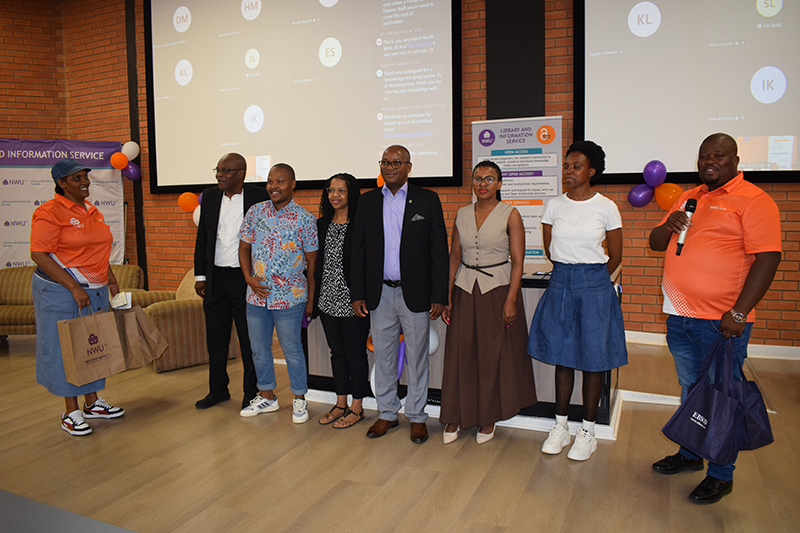
The NWU's International Open Access Week celebrations highlighted the cost of knowledge and the need to make research accessible to academics, communities and policymakers.


