
Academic excellence, resilience and visionary leadership took centre stage as the North-West University (NWU) Business School recently honoured its MBA and PhD graduates at an elegant Black & White Soirée held at the picturesque Feather Hill Boutique Hotel in Potchefstroom.
The prestigious celebration brought together graduates, academics, families and distinguished guests to mark the culmination of years of sacrifice, dedication and scholarly achievement. Against a backdrop of monochrome sophistication, the evening celebrated not only academic success but also the impact these graduates are poised to make in business, government and society.
Opening the ceremony, chief director of the NWU Business School, Prof. Joseph Sekhampu, reflected on the determination that had brought graduates to this milestone.
"This graduation session marks the culmination of years of commitment, sacrifice, resilience and personal growth," he said. "As the NWU Business School, we are proud not only of what you have achieved academically, but of who you have become through the process."
He reminded graduates that academic qualifications alone do not define success.
"Qualifications may open doors, but it is character, integrity, wisdom and humanity that ultimately determine the impact you will have in the world," he added.
Delivering the keynote address, NWU principal and vice-chancellor Prof. Mzubanzi Bismark Tyobeka challenged graduates to become adaptive leaders capable of navigating an increasingly uncertain and technologically driven world.
"We are living through one of those moments in history where change is not only constant, but transformative," he said.
Prof. Tyobeka argued that the greatest challenge facing organisations today is not technological advancement itself but the ability to respond effectively to rapid change.
"The defining leadership challenge of our time is not technology itself. It is adaptation," he said.
Quoting futurist Alvin Toffler, he urged graduates to embrace lifelong learning.
"The illiterate of the twenty-first century will not be those who cannot read and write, but those who cannot learn, unlearn and relearn."
MBA programme leader Dr Lungile Ntsizwane paid tribute to the perseverance shown by graduates throughout their studies.
"Many of you studied late into the night after long working days," she said. "Others carried responsibilities quietly while refusing to surrender your aspirations. And yet, despite the pressures and setbacks, you persisted. That persistence deserves recognition."
Senior deputy vice-chancellor for teaching and learning, Prof Linda du Plessis, described the graduates' achievements as a testament to the transformative power of higher education.
"As you celebrate this important milestone, know that your achievement represents more than personal success. It represents possibility, perseverance and the continuing hope that education remains one of the most powerful instruments for transformation, leadership and societal progress."
A major highlight of the evening was the recognition of the Business School's newest doctoral graduates whose research addresses some of South Africa's most pressing organisational, economic and social challenges.
Among those honoured were Dr Debapriyo Nag, who developed a performance management scorecard for private secondary schools in eThekwini, and Dr Edward Khumalo, whose research evaluated the effectiveness of South Africa's Twin Peaks financial regulatory model.
Dr Elmarie Hamman explored sovereign credit rating methodologies and their impact on sub-Saharan Africa, while Dr Sumarie Nel examined the effectiveness of remote internal auditing in South African entities.
Research focused on workplace wellbeing and organisational sustainability also featured prominently. Dr Malebo Keebine investigated judges' wellness behaviour and burnout, while Dr Johan Pretorius developed a framework linking work-life balance, organisational support and occupational stress among engineers.
Other doctoral graduates tackled issues ranging from technology business incubation and small-business growth to women in leadership, labour relations, personal financial management and sustainable facility management.
Dr Xolile Ngubane's study developed a framework for technology business incubation aimed at supporting the sustainable growth of small businesses in KwaZulu-Natal, while Dr Nomusa Dube examined the barriers women continue to face in securing leadership positions within the mining sector.
The breadth of research presented during the celebration underscored the Business School's growing contribution to knowledge creation and evidence-based solutions for both the public and private sectors.
Throughout the evening, speakers returned to the theme of responsible leadership and the need for graduates to use their knowledge in service of society.
"The future does not require more managers of complexity," Prof. Tyobeka told the audience. "It requires more leaders of consequence."
Guests were treated to a sophisticated dining experience and networking opportunities as graduates celebrated their achievements with colleagues, friends and family members.
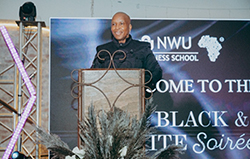
Chief director of the NWU Business School, Prof. Joseph Sekhampu

NWU principal and vice-chancellor Prof. Mzubanzi Bismark Tyobeka

MBA programme leader Dr Lungile Ntsizwane
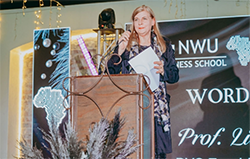
Senior deputy vice-chancellor for teaching and learning, Prof Linda du Plessis


