
Science belongs to everyone and should not be limited by geography, background or access. This is the message the North-West University (NWU) aims to share when it hosts the 2026 Vice-Chancellor’s Science Day at Hoërskool Wolmaransstad on 5 August 2026.
Being held under the theme “Science, technology and innovation are for everyone”, the initiative will once again take science beyond university spaces by creating opportunities for learners, schools and communities to engage with researchers, innovators and industry experts.
Wolmaransstad in the Dr Kenneth Kaunda District of the North West Province was chosen as it embodies the university’s commitment to expanding access to science education, particularly in communities outside major centres. Learners from surrounding schools have been invited to attend the day. This is according to Lerato Molebatsi, manager of the NWU Science Centre and coordinator of the Vice-Chancellor’s Science Day.
“The event is hosted in a different region each year to inspire learners, strengthen collaborations with local schools and stakeholders, and ensure that young people in underserved communities have access to science, technology, engineering and mathematics (STEM) education, career guidance and opportunities for innovation,” says Molebatsi.
She says the theme reinforces the message that science belongs to everyone and that young people should see themselves as contributors to future solutions.
“Science should be accessible to all individuals, irrespective of their backgrounds. Through innovation, collaboration and education, young people can use STEM to address real-world challenges, improve their communities and create prosperous futures.”
Reaching more learners with every event
Since its launch in 2023, the Vice-Chancellor’s Science Day has grown into one of the NWU’s flagship science engagement initiatives, reaching learners in rural communities across the North West and Northern Cape provinces.
The first Vice-Chancellor’s Science Day in Mabeskraal reached more than 1 200 learners. The 2024 edition in Taung attracted approximately 1 300 participants, while the 2025 event in Kuruman engaged more than 1 400 learners.
Molebatsi says the growth of the initiative demonstrates the importance of partnerships in making science more visible and accessible.
“Over the years, the programme has expanded its geographic reach, strengthened collaborations with government departments, educational institutions and industry partners, and created more opportunities for learners to experience practical science, career guidance and innovation,” she says.
The 2026 programme will include science exhibitions, live demonstrations, competitions, career guidance sessions, university recruitment opportunities and interactions with NWU researchers and industry partners.
“The aim remains to bring science directly to communities and ensure that learners, regardless of where they are located, have access to opportunities that can motivate them to pursue studies and careers in STEM fields,” says Molebatsi.
Curiosity, opportunity and education
NWU Vice-Chancellor Prof Bismark Tyobeka, who is a nuclear scientist, says the Vice-Chancellor’s Science Day carries personal significance to him because it represents the power of exposure, opportunity and access in shaping future careers.
“My own journey in science has shown me that curiosity, when supported by opportunity and education, can open doors that young people may never have imagined. A future scientist, engineer or innovator can come from any community, but that potential must first be recognised, encouraged and developed,” says Prof Tyobeka.
Taking science directly to learners is one way of breaking barriers and ensuring that young people understand that STEM fields are within their reach, he says.
“The Vice-Chancellor’s Science Day is not only about demonstrating science; it is about changing mindsets. We want learners to understand that science, technology and innovation belong to them and that they can use these fields to solve challenges facing their communities, the country and the world,” says Prof Tyobeka.
He adds that the initiative supports the NWU’s vision of being an engaged university that creates a positive impact through teaching, research and innovation.
“As a university, our responsibility extends beyond producing knowledge. We must ensure that knowledge reaches communities and inspires action. Through initiatives such as the Vice-Chancellor’s Science Day, the NWU is investing in the next generation of scientists, innovators and problem-solvers who will help shape a better future,” says Prof Tyobeka.
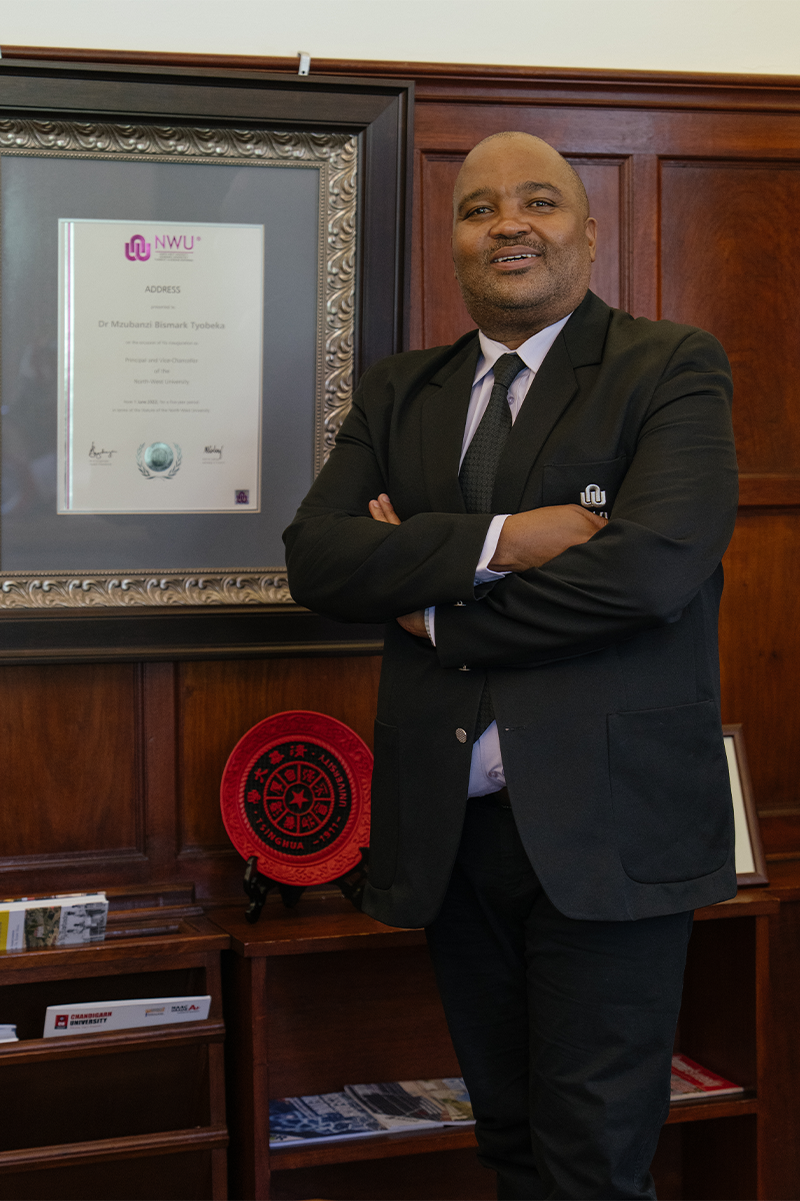
Prof. Bismark Tyobeka


