
A potential partnership between the North-West University (NWU) and the Sernick group could create new opportunities for student training, livestock research and emerging farmer development.
The two organisations have started discussions on collaborations in beef production, research, experiential learning and agricultural development. Meetings took place at the Pienaarskamp Research Farm in Potchefstroom on 28 September 2026 and at the Mahikeng Campus and Molelwane Research Farm on 2 October.
The discussions also explored how the NWU AgriHub could help emerging farmers gain access to livestock genetics, training, mentorship and research expertise.
Sernick chairman Nick Serfontein led the delegation. At Pienaarskamp, Prof. Francois van der Westhuizen, executive dean of the Faculty of Natural and Agricultural Sciences, welcomed the group.
Prof. Bismark Tyobeka, the NWU principal and vice-chancellor, said the AgriHub has strong potential to support provincial and emerging farmers. In Mahikeng, Prof. Simon Letsoalo, director of the School of Agricultural Sciences, and Prof. Gerhard du Preez, deputy school director, welcomed the delegation alongside academics and heads of department.
Sernick is an agribusiness with close to 600 employees and interests that include livestock breeding, auctions and abattoirs. Nick said its farmer development journey started with a farmers' day in 2016 that attracted about 400 emerging farmers from the Free State. This later developed into a training initiative that has reached hundreds of farmers.
Student experiential learning emerged as one of the immediate opportunities for collaboration. Sernick indicated that it could accommodate about five NWU students from 2027, with scope to increase the number from 2028. Its facilities already accommodate interns and provide training and accommodation.
“Those people are the future farmers of South Africa,” said Nick.
Prof. Tyobeka said universities should aim beyond preparing graduates for employment. They should also equip students to create businesses and become farmers and entrepreneurs. School leaders welcomed the proposed placements, noting the continued demand among students for workplace experience.
Research could form another important pillar of the partnership. Sernick expressed interest in research on veld condition, grazing systems, nutrition and carrying capacity. Regular monitoring could build a long-term database on veld quality and nutritional value. This could support postgraduate dissertations and theses as well as practical livestock management.
Prof. Van der Westhuizen said expertise from other parts of the university, including the Unit for Environmental Sciences and Management, could contribute to the work.
Livestock development was also high on the agenda. At Pienaarskamp, discussions proposed that cattle purchasing should begin before December 2026, initially with about 30 animals. The longer-term vision is for Pienaarskamp and Molelwane to have commercial cattle, while the stud herd would be concentrated at one farm.
Sernick suggested Pienaarskamp as a possible location for the stud herd. Giel Bekker said developing a high-quality genetic herd could take about three generations. Sernick indicated that it could assist with breeding and access to genetics, potentially reducing establishment costs.
During the Mahikeng visit, the delegation toured the Animal Health Clinic. NWU staff members explained its biosecurity measures, including the separation of healthy and sick animals.
At Molelwane Research Farm, the delegation viewed activities in dairy production, field crops and horticulture. The dairy unit milks about 18 cows, with milk pasteurised and cooled on site. The farm also produces traditional amasi and plans to expand into the production of cheese and yoghurt.
Breed improvement was identified as another area where the partnership could have an impact beyond the university. Through the AgriHub, animal-science academics want to make quality cattle genetics more accessible to emerging farmers who cannot afford high-quality breeding bulls. Options discussed included artificial insemination, embryo transfer, sexed semen and “beef on dairy” crossbreeding.
The university will also seek the advice of Sernick on the future of its Nguni cattle community project. Under the project, participating farmers receive cattle on loan and return the same number after five years.
Nick said successful farmer development requires practical support, access to resources and continued guidance.
“Establishing farmers is not rocket science,” he said. “It is access to land, basic infrastructure, and mentoring and upskilling.” Prof. Tyobeka called for a clear “golden thread” that defines what the NWU and Sernick want to achieve through the AgriHub. A formal memorandum of understanding between the faculty and Sernick could also be explored.
The next step will include an NWU delegation visiting the Sernick operations to gain first-hand insight into its agricultural value chain. This will help both parties identify priority projects and develop a detailed collaboration proposal for consideration by university management.
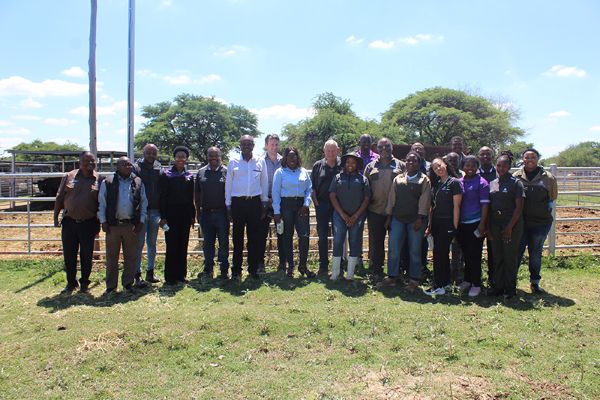
Photo: Representatives from the NWU and the Sernick group during discussions and site visits aimed at exploring collaboration in livestock production, student experiential learning, research, and emerging farmer development.


