
The bilateral agreement between the North-West University (NWU) and the North West Department of Health moved into full implementation with the inaugural meeting of the Joint Agreement Governance Council (JAGC), advancing their partnership to develop the NWU’s Desmond Tutu School of Medicine.
Held on 16 November 2026, the meeting was chaired by Prof. Bismark Tyobeka, principal and vice-chancellor of the NWU. It brought together university and provincial health representatives to constitute the council and establish supporting governance structures to coordinate medical education and clinical training in the province.
“This is a historic moment and the culmination of years of hard work between us as partners. It is testimony to the fact that, if we do things properly in all aspects of governance, changes in leadership should not affect the foundations we have built,” said Prof. Tyobeka.
The council gave practical effect to the bilateral Memorandum of Agreement signed in 2025, providing a joint governance structure through which the NWU and the department could coordinate their responsibilities in developing the medical school.
Prof. Binu Luke, chief director and head of the Desmond Tutu School of Medicine, outlined progress towards welcoming the first cohort of students in January 2028.
“Since we started this process in 2023, we have achieved our planned milestones each year. In 2026, we started appointing the staff who will teach our students in 2028,” said Prof. Luke.
He reported that the programme had received Council on Higher Education accreditation, with a Health Professions Council of South Africa accreditation visit scheduled for March 2027. The school planned an initial intake of 80 students in 2028, subject to the necessary regulatory approvals.
Prof. Luke emphasised that the school’s ambitions extended beyond producing academically qualified graduates.
“We want a clinically competent general practitioner who is socially conscious and community-orientated, an ethical team player who can think critically and use state-of-the-art technology, including AI,” he said.
The school’s contribution to North West was central to its planning: “We must be deliberate about its impact on the province and build that into our academic processes.”
Prof. Beth Engelbrecht, the school’s leadership and governance lead, outlined how the bilateral agreement would support both medical education and provincial healthcare.
“The purpose is to develop fit-for-purpose health professionals, but also, through our partnership with the province, to improve health, improve the quality of care and strengthen the health system. The critical point here is partnership, underpinned by values such as integrity, trust and transparency,” said Prof. Engelbrecht.
The JAGC was mandated to oversee the partnership, monitor compliance with the agreement and guide its implementation. Its responsibilities included determining access to provincial healthcare facilities for teaching, clinical training and research, developing funding models, and guiding recruitment and infrastructure matters.
Supporting structures included a Health Platform Committee, with subcommittees covering district and distributed training platforms, and tertiary and psychiatric hospital platforms. Technical advisory work covered human resources, infrastructure, information technology and finance.
Together, these structures provided a framework for coordinating medical education and healthcare delivery, ensuring equitable access to training facilities and advancing transparency, accountability and ethical conduct.
A separate trilateral agreement between the NWU, the department and the University of the Witwatersrand (Wits) is also being finalised. Once signed, it will bring Wits into the framework of cooperation, with its role focused largely on postgraduate medical training.
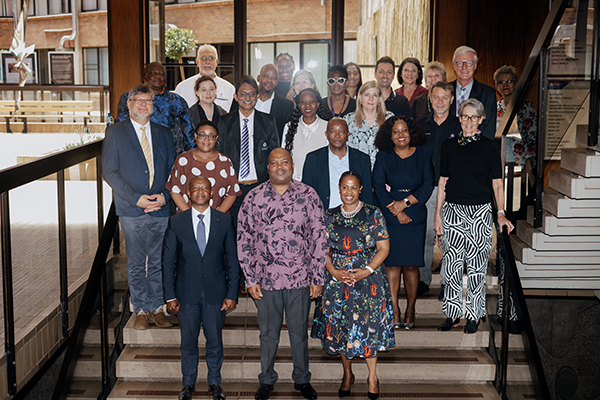
Delegates at the inaugural meeting of the Joint Agreement Governance Council on 16 November 2026.


